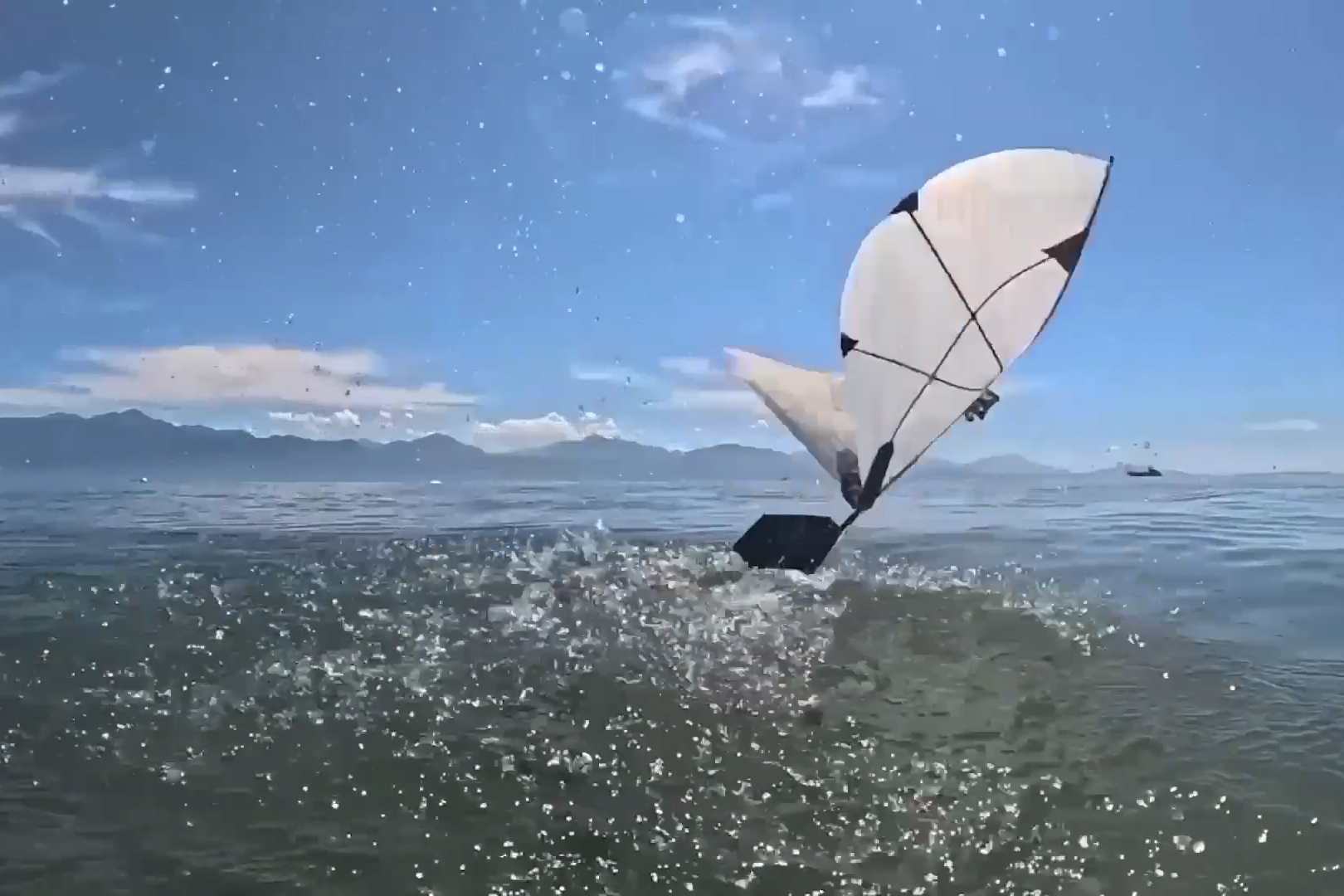
MIT Engineers Build Bird-Inspired Robot That Flies and Swims Using the Same Wings
Researchers at the Massachusetts Institute of Technology (MIT) have developed a lightweight robot capable of flying through the air and swimming underwater using the same pair of wings, marking a significant advance in bio-inspired robotics. The innovation eliminates the need for separate propulsion systems or additional hardware, allowing the robot to transition seamlessly between two vastly different environments.
The breakthrough, detailed in a study published in the journal Science, draws inspiration from diving seabirds such as puffins, which use their wings both to soar through the sky and propel themselves underwater while hunting for food.
Nature Inspires the Design
For years, researchers have looked to nature to solve complex engineering challenges. In this case, the MIT team focused on seabirds that effortlessly switch between air and water despite the two environments having dramatically different physical properties.
“Thinking of a wing that could operate in both air and water somewhat efficiently seems implausible,” said Raphael Zufferey, a mechanical engineer at MIT who led the research, in an interview with NPR.
Unlike conventional drones or underwater vehicles that require dedicated propulsion systems for each environment, the MIT robot relies on one wing design to accomplish both tasks. This simplifies the machine’s construction while improving its versatility.
A Compact, Lightweight Robot
The experimental robot weighs about half a pound (roughly 225 grams) and has a wingspan of just under three feet. Its compact size allows it to move efficiently while keeping the overall mechanical design relatively simple.
One of the team’s biggest engineering goals was to avoid adding unnecessary components that would increase weight, reduce efficiency, or complicate transitions between air and water.
That philosophy led to one particularly notable design choice: the robot has no legs.
Taking Off Without Legs
Many aquatic birds rely on their legs to push themselves off the water before taking flight. Replicating that behavior in a robotic system would have required additional motors, joints, and control mechanisms.
Instead, the MIT researchers asked a different question: Could a robot launch directly from the water using only its wings?
The answer appears to be yes.
By carefully designing the wing motion and optimizing how the robot generates lift and thrust, the team enabled it to move from swimming underwater to flying through the air without requiring extra launch mechanisms.
Removing the legs also helped reduce the robot’s overall weight and mechanical complexity, making the design more efficient and easier to control.
Engineering Around Two Very Different Worlds
Designing a vehicle that performs well in both air and water is an enormous engineering challenge.
Air is nearly 800 times less dense than water, meaning wings must generate lift differently depending on the environment. Movements that work efficiently in flight can create excessive drag underwater, while swimming motions may not generate enough lift for takeoff.
To overcome this challenge, the MIT researchers carefully optimized the wing shape, flapping motion, and control system so the robot could adapt naturally as it transitioned between environments.
Rather than switching to different propulsion methods, the robot simply changes how it uses the same wings.
Potential Real-World Applications
Although the project is currently a research prototype, dual-environment robots like this could eventually support a wide range of real-world missions.
Possible applications include:
- Environmental monitoring of lakes, rivers, and coastal ecosystems.
- Marine wildlife research with minimal disturbance to animals.
- Search-and-rescue operations in flooded or coastal regions.
- Infrastructure inspection, including bridges, offshore platforms, and ports.
- Defense and surveillance, where vehicles capable of moving between air and water could provide greater operational flexibility.
A robot that can seamlessly transition between flying and swimming could access locations that traditional drones or underwater vehicles cannot easily reach.
Bio-Inspired Robotics Continues to Grow
The project reflects a growing trend in robotics: learning from the natural world.
Scientists have already developed robots inspired by insects, fish, snakes, birds, and even octopuses to solve engineering problems that conventional machines struggle with.
By studying how animals have evolved over millions of years, engineers hope to build machines that are more efficient, adaptable, and resilient.
The MIT robot is another example of how biological systems can inspire technological innovation, combining the flight of birds with underwater mobility in a single compact platform.
A Step Toward More Versatile Robots
While additional research is needed before the technology is ready for commercial or field use, the successful demonstration shows that a single-wing system can operate effectively in both air and water.
The achievement opens new possibilities for multi-environment autonomous vehicles, reducing mechanical complexity while expanding operational capabilities.
As robotics continues to evolve, innovations like MIT’s bird-inspired design highlight how engineering and biology can work together to create machines capable of performing tasks that once seemed impossible. Xbox Layoffs Shake Gaming Industry as Microsoft’s Major Reset Leaves Developers Searching for Answers | Maya