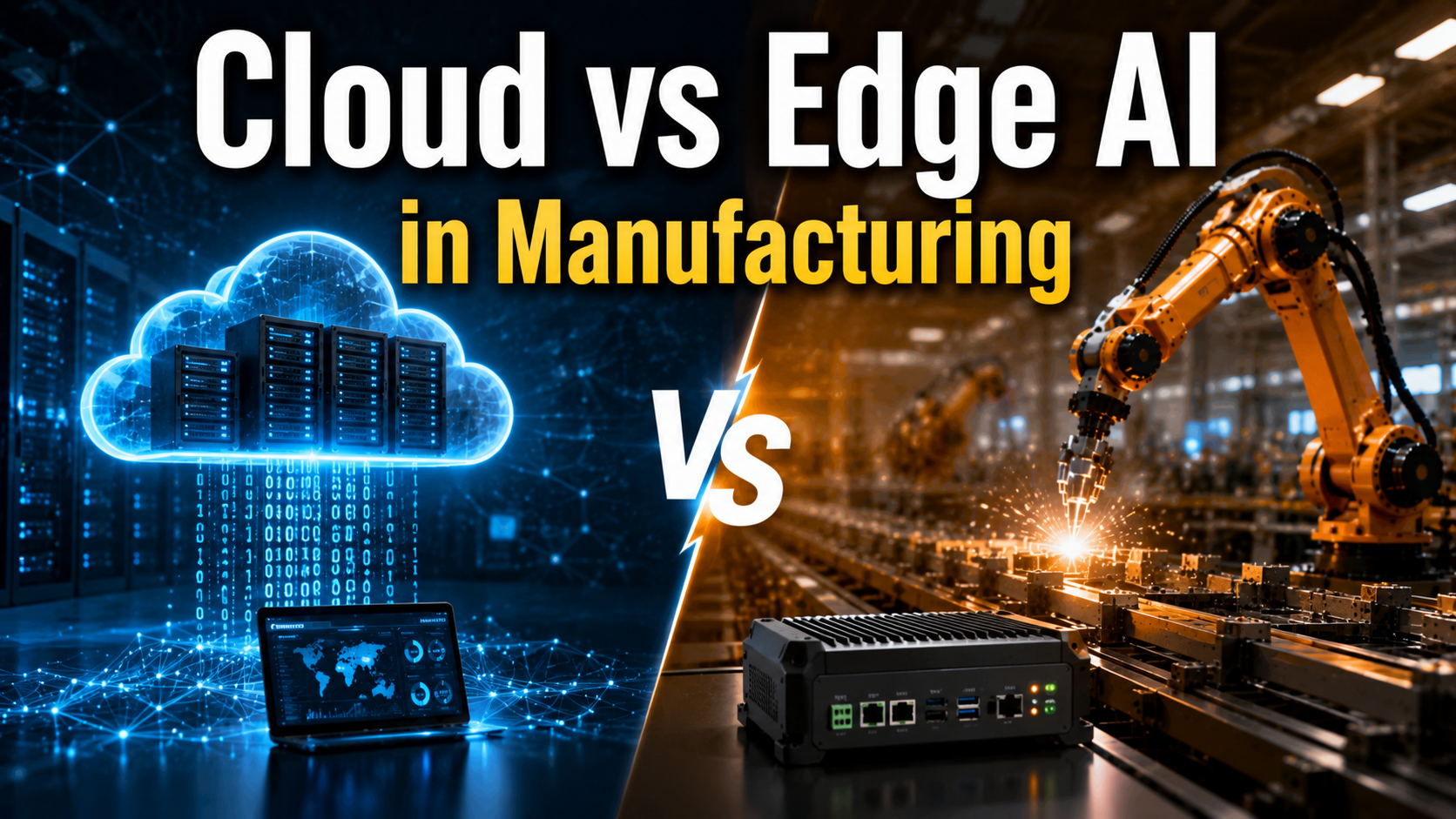
Why China’s Smart Factories Are Ditching Cloud-Dependent Sensors for Edge AI
The Hidden Tax on Every Packet Sent Upstream
Walk the floor of a mid-sized electronics assembly plant in Dongguan and the numbers on the whiteboard tell a story that never makes it into Industry 4.0 marketing decks. The factory runs four thousand sensors across stamping, SMT, and final assembly lines. Each sensor streams data to a cloud analytics platform at a cost that seemed trivial when the first hundred units were deployed. Multiply by four thousand. Multiply by twenty-four hours. Multiply by three hundred production days. The annual cloud egress bill now exceeds what the plant spends on raw copper.
This is not an isolated case. Across China’s manufacturing belt, from the Pearl River Delta to the Yangtze River corridor, plant managers are discovering that the cloud-first sensor architecture they adopted during the 2018-2022 digital transformation push has become a structural cost problem. The sensors themselves are cheap. The connectivity to keep them talking to distant data centers is not. Neither is the latency penalty when a quality control decision needs to be made in milliseconds and the round trip to Shanghai or Singapore takes fifty times longer.
The response is not a retreat from intelligence. It is a migration of that intelligence to the edge—processing data where it is generated, on hardware that sits inside the factory gate, governed by the factory’s own operational rhythms rather than a cloud provider’s billing cycles and network topology.
The Bandwidth Arithmetic Nobody Modeled
Cloud-dependent sensor architectures were designed for an era when data was scarce and insights were precious. The assumption was that every sensor reading was potentially valuable and should be preserved, analyzed, and mined for patterns. In practice, most sensor data is noise. A vibration sensor on a CNC spindle generates ten thousand readings per second. The only ones that matter are the anomalies that predict bearing failure. Everything else is thermal waste in a data center, paid for by the gigabyte.
Chinese manufacturers that have run the numbers on their actual data profiles find that useful signal constitutes less than one percent of total sensor output. The other ninety-nine percent is redundant baseline readings, transient fluctuations, and sensor calibration drift that has no operational significance. Yet under a cloud-first model, all of it travels upstream, incurs storage costs, and occupies analyst time in dashboards that nobody consults.
Edge AI flips this ratio. A vibration analysis model running on a local edge device can evaluate those ten thousand readings in real time, discard the nine thousand nine hundred that fall within normal parameters, and transmit only the flagged anomaly along with its confidence score and spectral signature. The bandwidth requirement drops by two orders of magnitude. The cloud bill collapses. The factory retains full analytical capability without the structural overhead of shipping everything offsite.
The cost savings are not theoretical. A die-casting plant in Ningbo that migrated its thermal monitoring sensors to edge inference reported a seventy percent reduction in data transmission costs within the first year. The savings funded the edge hardware deployment with a fourteen-month payback. After that, the reduced operating cost accrues directly to margin.
When the Cloud Goes Down, Production Stops
Cost is the argument that gets attention in budget meetings. Resilience is the argument that keeps plant managers awake at night.
China’s manufacturing sector learned this lesson during the 2024 submarine cable disruptions in the South China Sea, when multiple fiber links between coastal cities and international cloud regions experienced simultaneous degradation. Factories running cloud-dependent quality control systems suddenly could not access their own anomaly detection algorithms. Production lines that had been configured to halt automatically when cloud connectivity was lost sat idle for hours. Lines configured without that safeguard continued running blind, producing defective batches that were only caught at final inspection.
The economic damage was concentrated in industries with tight process windows: semiconductor packaging, precision machining, pharmaceutical formulation. A single hour of unplanned downtime in a semiconductor back-end facility can cost more than the annual salary of the engineering team that designed its cloud architecture. The defect batches that escaped detection during the outage carried costs that compounded through warranty claims and customer penalties.
Edge AI eliminates this dependency. When inference runs on hardware inside the factory, the quality control loop closes locally. Network outages become irrelevant to production continuity. The factory does not need to choose between safety and uptime. It can maintain both because its intelligence is physically present, not rented from a data center whose connectivity it does not control.
This resilience extends beyond network failures to vendor dependencies. A factory that built its quality system around a specific cloud provider’s machine learning platform discovered during a contract renegotiation that its entire operational intelligence was held hostage to pricing terms it could not influence. Migrating to edge inference running open models on commodity hardware restored bargaining power. The factory could change cloud providers, or abandon them entirely for certain workloads, without rebuilding its core production logic.
The Latency Budget That Determines Yield
Some manufacturing decisions cannot wait for the cloud, regardless of cost or resilience. In laser welding, the weld pool solidifies in milliseconds. A vision system that detects seam misalignment must adjust power and trajectory in real time. Sending the image to a cloud server, waiting for inference, and receiving a correction command introduces a delay that spans multiple weld cycles. By the time the correction arrives, the defect is already embedded in the part.
Chinese manufacturers in high-speed processes have found that cloud latency is not merely a performance issue. It is a yield limiter. Every millisecond of round-trip delay represents potential scrap. In industries where material costs dominate and margins are thin, scrap rates above a few percentage points erase profitability.
Edge AI brings inference into the same physical envelope as the process itself. A vision model running on an industrial PC mounted beside the welding head can evaluate each frame in under ten milliseconds and trigger corrective action within the same control cycle. The latency budget shrinks from network round-trip time to local compute time, a difference of one to two orders of magnitude.
The battery manufacturing sector illustrates this most dramatically. In electrode coating, thickness uniformity must be maintained within micrometers across a web moving at meters per second. X-ray or laser thickness gauges generate data continuously. Cloud-based analysis cannot respond fast enough to correct roller pressure or slurry flow in time to prevent a coating deviation from propagating across hundreds of meters of material. Edge inference on dedicated hardware adjacent to the gauge closes the loop in milliseconds, maintaining yield rates that cloud architectures simply cannot match.
The Model That Works Offline
Cloud-dependent architectures assume continuous connectivity. Chinese factories do not operate under that assumption.
Rural manufacturing facilities in inland provinces run on connectivity that is intermittent at best. A cement plant in Guizhou may have broadband during business hours and satellite backup that degrades in weather. A textile mill in Xinjiang operates behind network infrastructure that prioritizes government and military traffic, leaving manufacturing data streams contending for whatever bandwidth remains. A mining operation in Inner Mongolia may be entirely beyond cellular coverage, relying on directional radio links that fail in dust storms.
These are not edge cases. They represent a significant fraction of China’s industrial base. Cloud-first sensor strategies effectively exclude these facilities from the benefits of AI-driven process optimization. Edge AI includes them.
An edge device with a pre-trained model and local data buffering can operate autonomously for days or weeks without connectivity. It logs anomalies, adjusts setpoints, and maintains process control using only local intelligence. When connectivity returns, it syncs summary statistics and model updates. The factory does not need to choose between digital transformation and geographic reality. It can have both because the intelligence travels with the facility, not with the network connection.
The Technician Who Can Fix It
One of the most underappreciated costs of cloud-dependent manufacturing intelligence is organizational. When a cloud-based quality system malfunctions, the factory’s response depends on a chain of external dependencies: the cloud provider’s status page, the vendor’s support ticket queue, the network operator’s incident response. The technician standing on the shop floor has no diagnostic access to the system that is rejecting good parts or accepting bad ones. She can only wait.
This creates a cultural resistance that slows adoption and increases risk. Experienced production engineers in Chinese factories are practical problem-solvers. They trust systems they can understand, interrogate, and repair. A black-box cloud service whose internal state is invisible to them generates skepticism that translates into underutilization. If the system recommends a process adjustment that contradicts the engineer’s intuition, and the engineer cannot examine the reasoning, the recommendation is often ignored.
Edge AI restores the technician’s relationship with the system. The model runs on hardware the engineer can touch. The inference logs are stored locally and can be inspected. The model can be retrained or fine-tuned with factory-specific data using tools the engineering team controls. When something goes wrong, the diagnostic path is transparent: check the camera, check the model version, check the calibration data, check the inference output. No external support ticket required.
This transparency matters for adoption velocity. Factories that have struggled to get shop-floor buy-in for cloud-based AI systems find that edge deployments are accepted more readily because the engineers can see how they work. The technology stops being something that happens mysteriously in a distant data center and becomes something that happens understandably in the equipment room down the hall.
The Regulatory Inspection That Asks Questions
China’s manufacturing sector operates under intensifying regulatory scrutiny, particularly in industries touching food, pharmaceuticals, automotive safety, and export-controlled technologies. Regulators do not accept “the cloud said so” as an explanation for a process deviation or quality failure. They want to see the data, the model, the validation records, and the chain of custody.
Cloud-dependent systems create compliance friction that edge systems resolve. When a regulator asks how a quality decision was made, a factory running edge inference can produce the exact model version, the training data provenance, the inference log with timestamps, and the calibration certificate for the sensor that provided the input. All of this resides in local systems under the factory’s direct control.
When the same question is asked of a cloud-dependent system, the answer fragments across multiple vendors and jurisdictions. The model may have been updated between the decision in question and the inspection. The inference log may be stored in a different legal regime with access restrictions. The sensor data may have transited networks and platforms whose audit trails are incomplete. The factory cannot provide the regulator with a single, coherent accountability chain because it does not possess one.
This is not an abstract concern. Several Chinese pharmaceutical manufacturers have faced extended regulatory reviews specifically because their cloud-based process analytical technology systems could not satisfy data integrity requirements. The remediation involved migrating to edge inference architectures that kept all critical data and decision logic within the facility’s validated perimeter. The cost of remediation exceeded what an edge-first deployment would have cost from the beginning.
The Model Drift That Nobody Caught
Machine learning models degrade. The statistical distribution of sensor data shifts as equipment ages, materials change, and environmental conditions vary. A model trained on last year’s production data may produce increasingly unreliable inferences as this year progresses. In a cloud-dependent architecture, the factory often does not detect this drift until it manifests as quality escapes or false alarms.
The detection delay is structural. Cloud analytics platforms typically batch process data and report anomalies on dashboards that operations staff check periodically. Model drift is a slow, statistical phenomenon that does not trigger obvious alarms. By the time the accumulated error rate becomes visible in production metrics, the model may have been generating incorrect inferences for weeks.
Edge AI enables continuous local monitoring of model performance. The edge device can compare its own predictions against ground truth from downstream inspection stations in real time. It can track confidence score distributions and flag when they shift outside historical bounds. It can trigger automatic retraining or alert engineering staff when drift exceeds thresholds. The feedback loop is tight because the measurement and the model inhabit the same physical system.
A printed circuit board manufacturer in Shenzhen implemented this approach after a cloud-based solder paste inspection model failed to detect a progressive stencil wear pattern that caused two weeks of elevated defect rates. The edge replacement included a local drift monitor that detected the same pattern within forty-eight hours of its emergence, enabling preventive maintenance before significant scrap accumulated. The difference was not model sophistication. It was architectural proximity between inference and validation.
The Supplier Who Wants Your Data
Cloud-dependent sensor architectures create data flows that manufacturing executives are increasingly uncomfortable with. When every sensor reading transits a cloud platform, the platform operator has access to process parameters, yield rates, equipment health indicators, and production schedules. For a contract manufacturer serving multiple brands, this data exposure is commercially sensitive. For a producer of proprietary materials or processes, it is strategically dangerous.
Chinese manufacturers have become wary of cloud platforms operated by competitors or by entities whose data handling practices they cannot fully audit. The concern is not paranoia. It is competitive reality. A cloud analytics vendor that serves an entire industry segment can aggregate data across customers and derive insights that individual factories cannot access themselves. The factory that generates the data subsidizes the vendor’s industry intelligence.
Edge AI returns data sovereignty to the factory. Sensor data never leaves the premises unless the factory explicitly chooses to share it. Inference happens locally. Aggregated insights can be extracted and shared selectively, or not at all. The factory retains the option to monetize its own data on its own terms rather than contributing it to a vendor’s training corpus by default.
This is particularly relevant as Chinese manufacturers expand into higher-value segments where process knowledge is a competitive moat. A battery manufacturer that has developed proprietary electrode formation protocols does not want those signatures transmitted to a cloud platform where they could be reverse-engineered. An aerospace component supplier whose machining parameters represent years of accumulated expertise does not want them stored on infrastructure it does not control. Edge AI keeps these assets where they belong: inside the factory, inside the enterprise, inside the jurisdiction.
The Hardware That Got Good Enough
The edge AI migration would not be economically viable if the hardware remained expensive or specialized. It is neither.
The chips that power edge inference have followed a trajectory familiar from other semiconductor markets: rapid performance improvement at declining cost. A neural processing unit capable of running vision models in real time cost several thousand dollars in 2020. In 2026, equivalent capability is available in industrial modules priced below two hundred dollars. The gap between edge and cloud compute economics has narrowed to the point where edge deployment is often cheaper than cloud subscription for high-volume, always-on workloads.
Chinese domestic semiconductor suppliers have accelerated this trend. Companies like Horizon Robotics, Black Sesame Technologies, and Cambricon produce edge AI processors optimized for industrial vision and control applications. These chips are not merely cheaper than foreign alternatives. They are designed with Chinese manufacturing use cases in mind: support for the specific camera interfaces common in Chinese equipment, tolerance for the voltage fluctuations and thermal conditions typical of Chinese factory floors, and software stacks that integrate with domestic automation platforms.
The result is that edge AI hardware is no longer a specialized procurement exercise. It is a standard component that factory automation integrators specify routinely. The technology risk has been retired. The remaining decision is economic and architectural: does the specific application benefit from local inference sufficiently to justify the hardware investment?
The Integration Path That Actually Works
Cloud-dependent sensor architectures promised plug-and-play intelligence. The reality for Chinese manufacturers was often months of integration work, custom API development, and ongoing dependency on vendor engineering support for every configuration change. The promised simplicity dissolved into a tangle of connectors, data format conversions, and network security configurations.
Edge AI offers a different integration model. The inference engine is a local software component that runs on standard industrial computing platforms. It connects to sensors through the same protocols—Modbus, OPC-UA, Ethernet/IP—that factories already use for their programmable logic controllers and supervisory control systems. It outputs decisions through the same interfaces that existing automation equipment expects. The integration is horizontal, not vertical. It does not require the factory to adopt a vendor’s entire technology stack.
This matters for deployment velocity. A factory that wants to add AI-based quality inspection to an existing production line can install an edge device, connect it to the line’s existing vision system and reject mechanism, and begin operation within days. The same project using cloud-dependent architecture might require months of network provisioning, security review, and API development. In a manufacturing environment where product lifecycles are shortening and flexibility is a competitive requirement, this deployment speed difference is decisive. AI Chip Stocks Sink as Global Semiconductor Sell-Off Deepens Amid China Competition Fears | Maya
The Cost Resilience Story
The migration from cloud-dependent sensors to edge AI in China’s smart factories is not a rejection of digital transformation. It is a maturation of it. The first wave of Industry 4.0 adoption treated the cloud as the natural home for all intelligence because it was available, scalable, and vendor-promoted. The second wave is discovering that intelligence belongs where it creates value, and that the economics of value creation in manufacturing favor locality.
The cost story is straightforward: eliminate the bandwidth tax, reduce storage waste, and stop paying to ship noise to data centers. The resilience story is equally clear: production that does not depend on network availability, quality control that does not pause for cloud latency, and compliance that does not fragment across vendor jurisdictions. Together, they explain why Chinese manufacturers are increasingly choosing to think where they make, rather than where they rent compute.
The cloud will remain part of the manufacturing technology stack. It is valuable for long-term analytics, cross-facility optimization, and enterprise resource planning. But for the real-time decisions that determine whether a part is good or scrap, whether a machine is healthy or failing, whether a process is in control or drifting, the intelligence is moving to the edge. China’s factories are leading this migration not because they are technologically adventurous, but because they have done the arithmetic and found that cloud dependency is a luxury they can no longer afford.

/newsnation/media/media_files/2026/01/09/x-ban-in-britain-2026-01-09-08-11-20.jpg "How Far Can Britain Go in Policing X Under the Online Safety Act?")