Why Astronaut Urine Might Be the Key to Building Bases on the Moon – As NASA’s Artemis program pushes toward a permanent human presence on the lunar surface, engineers are confronting a problem that sounds more like science fiction than rocket science: the most practical building material for Moon bases may be astronaut pee.*
The $10,000-per-Pound Problem
Let’s start with the economics. Shipping a single pound of material from Earth to the Moon costs roughly $10,000 — and that’s being generous. Some estimates place the figure closer to $1.2 million per kilogram for certain payloads. When you’re talking about building an entire habitat — walls, radiation shields, landing pads — the mass adds up fast. A modest lunar outpost could require hundreds of tons of construction material. At those prices, you might as well be building with gold.
This is why space agencies have pivoted hard toward In-Situ Resource Utilization (ISRU) — the elegant engineering philosophy of using whatever is already there. On the Moon, that means the powdery, gray dust coating the surface: lunar regolith. But regolith alone won’t hold a shape. You need a binder. You need water. And you need something to make the mixture workable.
Enter the most unlikely hero of lunar architecture: urea, the second-most abundant compound in human urine after water.
The Chemistry of Pee and Powder
Urea might not sound glamorous, but chemically, it’s a marvel. As an organic compound, urea has a unique superpower: it can break hydrogen bonds between molecules, reducing the viscosity of fluid mixtures. In plain English, it makes thick, stubborn slurries flow smoothly without requiring extra water.
This matters enormously for lunar construction. Traditional concrete needs vast amounts of water to become workable — water that would be far too precious on the Moon, where every drop must be recycled for drinking, growing food, and keeping astronauts alive. On Earth, engineers solve this with superplasticizers — chemical additives that keep concrete moldable while using minimal water. But those superplasticizers would have to be shipped from Earth, adding yet more mass and cost to an already expensive mission.
Norwegian chemist Anna-Lena Kjøniksen of Østfold University College had a different idea. “I was thinking, what’s available on the moon? If you add humans, then what do you have available?” she recalled. “Maybe human waste could turn into something useful.”
She’d previously used urea to make plastic mixtures less viscous. She’d never heard of anyone using it in cement. “But I thought it was worth a try.”
It was.
The ESA Breakthrough: Printing with Pee
In a landmark 2020 study published in the Journal of Cleaner Production, Kjøniksen and an international team of researchers — collaborating with the European Space Agency — put the idea to the test.
They mixed simulated lunar regolith with water and urea, then fed the mixture through a 3D printer. The results were striking:
-
The urea-based mixture was malleable and easy to shape, extruding cleanly through the printer nozzle.
-
It could support weights up to 10 times its own mass without deforming.
-
It held its shape through eight freeze-thaw cycles simulating the Moon’s brutal temperature swings — from -171°C to 114°C (-280°F to 237°F).
-
Under vacuum conditions mimicking the lunar atmosphere (or lack thereof), the samples remained stable.
Most impressively, the urea mixture outperformed or matched conventional superplasticizers like naphthalene and polycarboxylate — the same additives used in high-performance Earth construction.
The team 3D-printed miniature walls and geopolymer cylinders that were “stronger and retained good workability,” according to ESA’s Advanced Concepts Team.
Why This Actually Works on the Moon
The beauty of the urea approach isn’t just that it works — it’s that it solves multiple problems at once.
1. It reduces water demand. Urea’s hydrogen-bond-breaking ability means you need far less water to achieve a printable, workable mixture. On a world where water ice is buried in permanently shadowed craters and every liter must be wrestled from the regolith or shipped from Earth, that’s transformative.
2. It uses a waste product. Every astronaut produces roughly 1.5 liters of urine per day. On the International Space Station, that urine is meticulously recycled back into drinking water. But on the Moon, some fraction of it could be diverted into the construction pipeline — turning a disposal problem into a structural asset.
3. It pairs with local materials. The main ingredient — lunar regolith — is literally everywhere. You scoop it up, mix it with a small amount of urine-derived urea and water, and print. No massive cargo ships required.
4. It enables 3D printing. The Moon isn’t going to have construction crews in hard hats pouring concrete forms. The most viable construction method is robotic 3D printing, which requires a material that flows smoothly, sets quickly, and holds its shape in low gravity. Urea-regolith geopolymer checks all three boxes.
As ESA researcher Marlies Arnhof put it: “The hope is that astronaut urine could be essentially used as it is on a future lunar base, with minor adjustments to the water content. This is very practical, and avoids the need to further complicate the sophisticated water recycling systems in space.”
The Bigger Picture: Artemis and the Moon Base
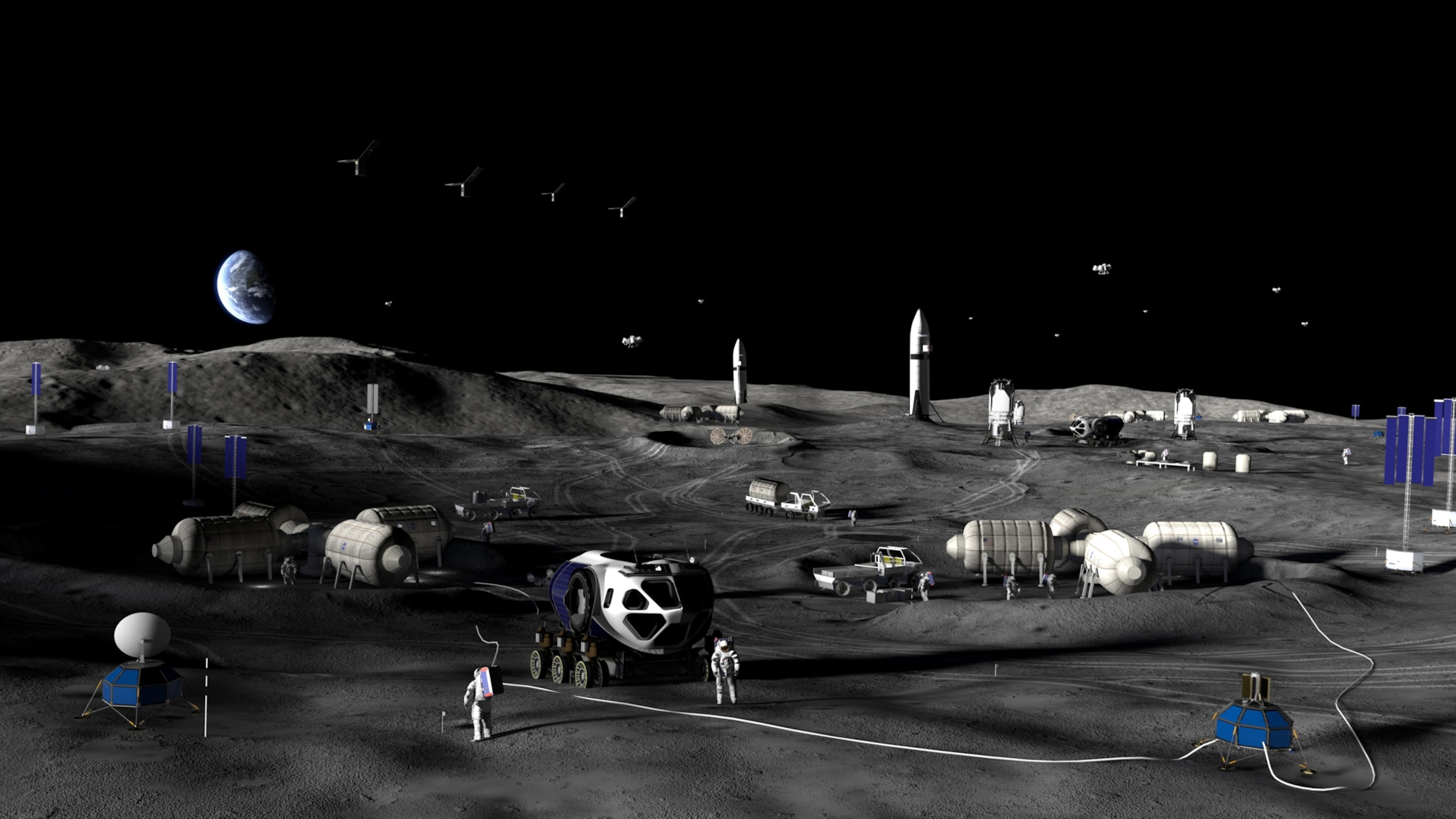
NASA’s Moon Base program, part of the broader Artemis initiative, is targeting the lunar South Pole for humanity’s first permanent off-world outpost. The agency has already awarded contracts to companies like Astrobotic, Firefly Aerospace, and Intuitive Machines to deliver science payloads ahead of crewed missions.
But habitats are the hard part. The ESA’s Moon Village concept envisions inflatable modules protected by 3D-printed regolith shells. These shells would shield astronauts from:
-
Harmful ionizing radiation (the Moon has no magnetic field or thick atmosphere to block cosmic rays)
-
Micrometeorite impacts (constant rain of tiny space rocks at high velocity)
-
Extreme temperature swings (two-week days of scorching sunlight followed by two-week nights of deep freeze)
The urea-regolith geopolymer could form these protective shells — thick, durable, and printed layer by layer around inflatable habitats by robotic construction systems.
Not the Only Game in Town
Urea isn’t the only lunar concrete candidate. Researchers at Louisiana State University have developed a waterless, sulfur-based concrete that binds regolith without any water at all — heating sulfur until molten and mixing it with lunar soil. This approach sidesteps the water problem entirely and cures faster than traditional concrete. NASA has already transferred this technology to Marshall Space Flight Center for larger-scale testing.
Other teams are exploring laser sintering — using concentrated sunlight or high-powered lasers to melt regolith directly into solid ceramic structures, ideal for landing pads that must withstand rocket exhaust.
And a 2025 study proposed a novel powder extrusion and roll-pressing system that could 3D-print lunar regolith with as little as 4% binder by weight, achieving flexural strengths of 2–5 MPa — a promising path for low-binder lunar construction.
But urea-regolith concrete holds a unique advantage: it leverages a resource that grows with the crew. The more astronauts you have, the more urine you produce, and the more building material you can generate. It’s a rare case where human presence directly expands construction capacity.
The Road Ahead
Plenty of questions remain. Would astronauts need to extract pure urea from urine, or could they use urine directly? The researchers suspect raw urine might work — its calcium minerals could even help the curing process — but that remains to be tested.
Scaling from lab samples to full-scale walls is another challenge. And no one has yet tested urea concrete with actual lunar regolith — only simulants. As planetary physicist Philip Metzger notes, “There’s chemistry in the samples of these planets that the simulants cannot perfectly replicate.” Real-world testing on the Moon itself may reveal surprises.
Still, the concept has moved from “daft idea” to serious engineering consideration. As ESA materials scientist Belinda Rich — who wasn’t involved in the initial study but is working on follow-up experiments — summed it up: “It sounds like such a daft idea. But here we are — it works.”
The Final Pour
The next time you flush, consider this: the same substance swirling down your drain might one day form the walls of humanity’s first city on another world. In the harsh economics of space exploration, waste is a luxury no civilization can afford. Astronaut urine — specifically the urea within it — represents the ultimate in circular resource thinking: a daily byproduct of human life transformed into the literal foundation of off-world survival.
As NASA and its international partners push toward the Moon Base and beyond, the humble chemistry of pee may prove to be one of the most practical tools in the toolbox. The Moon, after all, doesn’t care where its building materials come from. And if that means our first permanent lunar settlement is held together, in part, by the most human of substances — well, that’s just good engineering.
The future of lunar construction might not be built by rocket fuel and titanium. It might be built by something far more ordinary — and far more abundant. Who Owns Water on the Moon? The New Space Mining Debate | Maya