Ukraine Hits Moscow Oil Refinery in Record-Breaking 1,000-Drone Assault- A massive wave of Ukrainian long-range strike drones targeted Moscow and its surrounding oblast overnight, damaging key installations at the Moscow Oil Refinery in Kapotnya and marking the most extensive aerial assault directed at the Russian capital since the start of the war. The raid came during the final hours of Russia’s three-day parliamentary elections and directly defied public declarations from Washington suggesting a reciprocal pause on energy infrastructure strikes had been reached.
Scale and Execution of the Assault
The coordinated overnight barrage overwhelmed Russian multi-tiered air defense networks through sheer volume and layered vectoring. Russia’s Ministry of Defense claimed its forces neutralized over 1,100 Ukrainian uncrewed aerial vehicles (UAVs) across national airspace, Crimea, and the Black Sea, with Moscow Mayor Sergei Sobyanin reporting that more than 1,600 drones were intercepted nationwide since Saturday—including roughly 450 aimed specifically at the Moscow capital region.
Despite the high rate of claimed interceptions, several strike elements pierced the outer air defense envelope. Ukrainian President Volodymyr Zelenskyy confirmed that Kyiv deployed a diverse inventory of domestically produced strike systems. Rather than relying solely on slow-moving propeller-driven one-way attack drones, the salvo integrated long-range platforms alongside Ukraine’s newly fielded “Flamingo” and “Pelican” domestic cruise and strike missiles.
The combined use of low-radar-cross-section drones flying at treetop levels alongside faster cruise systems challenged regional air defense grids like the Pantsir-S1, Tor-M2, and S-400 systems guarding the outer perimeter of the capital.
Targets, Industrial Damage, and Civilian Toll
The primary strategic objective of the raid was the Moscow Oil Refinery, operated by Gazprom Neft in the southeastern industrial district of Kapotnya.
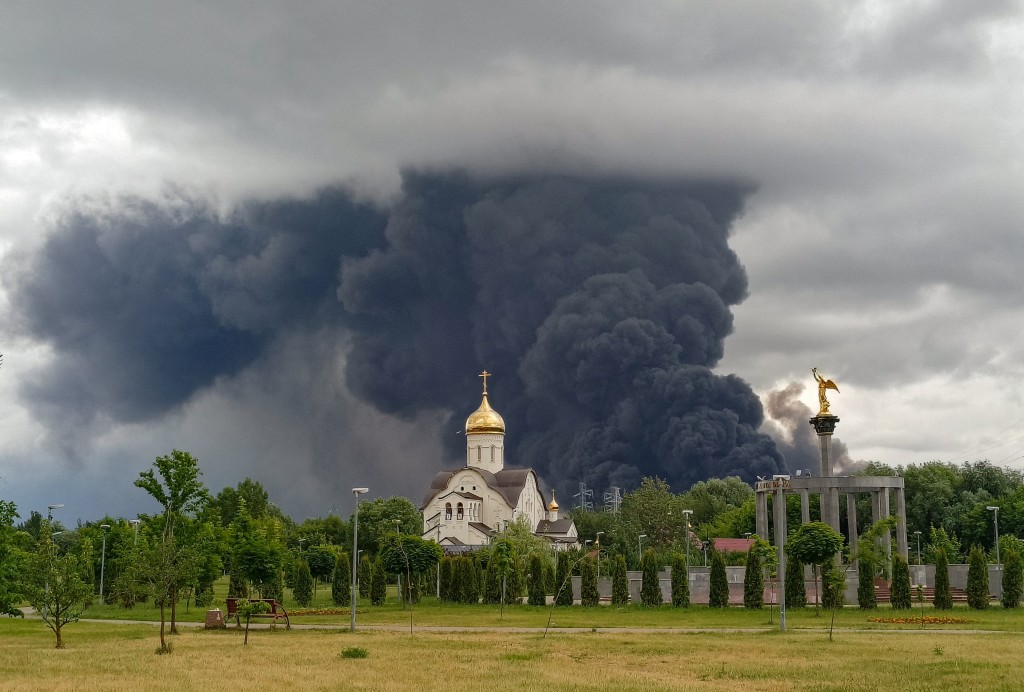
Refinery Impact: Multiple drones struck facilities within the perimeter of the plant, igniting significant fires. Eye-witnesses reported explosions followed by heavy black smoke visible from across southeastern Moscow. The facility—historically processing over 11.5 million metric tons of crude per year—serves as the primary provider of automotive fuels, aviation kerosene, and diesel for Moscow and the Central Federal District.
Logistics Hubs: In parallel, strike groups targeted warehouse and transportation nodes in the Sofyino and Ramensky districts, setting fire to a major logistics warehouse complex.
Casualties and Collateral Damage: While Moscow authorities stated there were no casualties inside the refinery complex itself, intercepted drone debris and direct impacts sparked structural fires across the broader Moscow region. Moscow regional Governor Andrei Vorobyov confirmed that two civilians were killed—a 74-year-old man and a 44-year-old woman. Approximately 20 others suffered injuries. In the Ramenskoye district, a drone collision into a 21-storey residential apartment building caused severe fires, forcing emergency teams to evacuate more than 400 residents, including 70 children.
Strategic Objectives: Economic Asphyxiation and Election Disruption
Ukrainian officials framed the raid as an economic imperative rather than a symbolic gesture. In a statement published on X, President Zelenskyy pointed to Moscow’s refining and hydrocarbon export sector as the financial engine sustaining the Kremlin’s invasion:
“These are billions of dollars that sustain the war machine. Dismantling the enemy’s logistics and energy infrastructure directly limits their capacity to continue terrorizing our cities.”
Over the past year, recurring Ukrainian strikes have systematically shaved points off Russia’s domestic refining throughput. By repeatedly hitting catalytic cracking and atmospheric distillation towers—specialized components that are difficult to replace due to Western industrial export controls—Kyiv intends to force fuel shortages, price inflation, and distribution bottlenecks within the Russian domestic market.
The strike carried equal political weight. September 20 marked the final day of voting in Russia’s nationwide parliamentary elections—the first held since the 2022 invasion began. Mayor Sobyanin explicitly accused Ukraine of trying to undermine the poll, stating the attack was “clearly planned with the aim of disrupting the elections”. Bringing air-raid sirens, rising smoke, and emergency evacuations to the capital directly punctures the Kremlin’s narrative of regular civilian life continuing uninterrupted.
Collapse of the Diplomatic “Energy Truce”
The assault deals an immediate blow to international diplomatic maneuvers aimed at cooling the conflict’s perimeter. Just days earlier, U.S. President Donald Trump publicly claimed that Washington had secured an understanding from both Kyiv and Moscow to halt long-range strikes against electrical grids, energy assets, and refining plants.
Neither combatant altered its operational calculus on the ground. While Ukraine hammered the Kapotnya facility, Russian forces continued heavy glide-bomb and drone assaults across Ukraine, including overnight strikes near Kyiv that killed a mother and her two children.
By committing over a thousand aerial assets in a single night, Kyiv signaled that it views targeting Russian downstream fuel infrastructure as its most potent asymmetric lever, unlikely to be conceded at the negotiating table without reciprocal, ironclad security guarantees.