
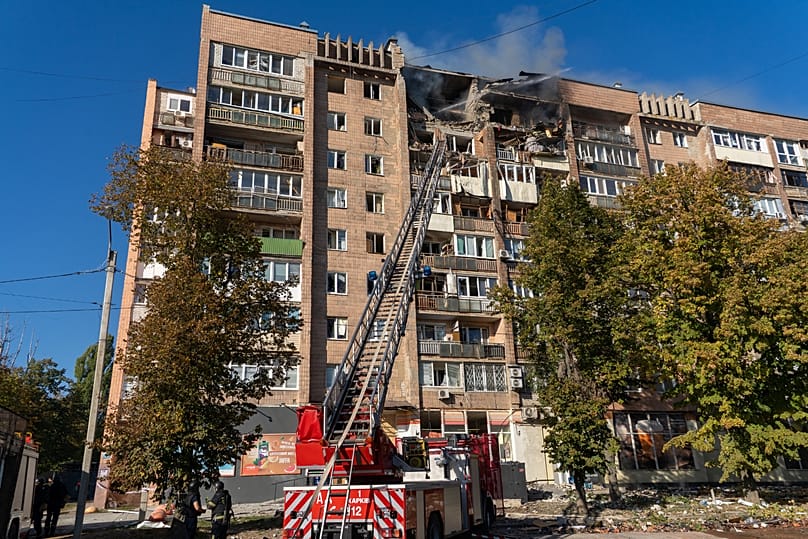
Russia Strikes Six Ukrainian Energy Facilities Despite Trump’s Ceasefire Announcement- Russia has reportedly attacked six Ukrainian energy facilities in a single day, according to President Volodymyr Zelensky, despite US President Donald Trump announcing that Moscow and Kyiv had agreed to an immediate ceasefire covering energy infrastructure. The latest strikes have raised fresh doubts about Washington’s efforts to secure a temporary halt to attacks as electricity disruptions spread across Ukraine and civilian casualties mount.
Zelensky said on Monday, October 12, that Russian forces had targeted energy installations, petrol stations and residential buildings. The attacks reportedly left 33 people injured across Ukraine, while separate strikes killed civilians, including one person in the capital, Kyiv.
The Ukrainian president accused Moscow of ignoring the proposed truce and continuing its campaign against essential infrastructure. Ukraine’s state-owned electricity transmission operator, Ukrenergo, meanwhile, introduced electricity restrictions in affected areas to prevent further strain on equipment damaged by repeated attacks.
“This is what happens when Russia sees the prospect of higher revenues for its war machine,” Zelensky said in a statement on social media, linking the attacks to concerns about Russia’s potential earnings from energy exports.
The latest developments have put Trump’s ceasefire announcement under immediate pressure, with uncertainty remaining over whether both countries had formally agreed to the same conditions.
Power disruptions have affected several Ukrainian regions, including Kharkiv, Donetsk and Zaporizhzhia. In the northeastern Kharkiv region, the city of Izyum experienced blackouts after a Russian strike damaged power infrastructure. Electricity cuts were also reported in parts of Donetsk and Zaporizhzhia following damage to energy equipment.
The restrictions are intended to protect the wider electricity network from becoming overloaded while repair crews work to restore damaged facilities. Ukraine’s energy system has endured repeated attacks during the war, leaving some areas vulnerable to further disruptions.
Damage to power infrastructure can have consequences well beyond the loss of electricity in homes. Hospitals, water supplies, communications networks, transport systems and industrial facilities all depend on reliable power. When multiple installations are damaged in quick succession, restoring normal service can become significantly more difficult.
The latest attacks also underline the challenges Ukraine faces as it attempts to protect essential services while continuing to defend its territory.
In Kyiv, a drone struck a 25-storey residential building in the Darnytskyi district on Monday evening, according to Mayor Vitali Klitschko. The strike killed one person and injured 11 others, he said, as emergency services responded to the incident.
The attack added to concerns about the safety of civilians in Ukrainian cities, where residential buildings and critical infrastructure have repeatedly been exposed to aerial attacks throughout the conflict.
Speaking to Fox News, Zelensky said Ukraine had not attacked Russian targets during the period in question, while Russian forces had struck Ukrainian petrol stations, energy installations and other facilities.
“I think it was Putin’s answer to President Trump,” Zelensky said, referring to Russian President Vladimir Putin and the American leader’s announcement of the proposed ceasefire.
In a separate statement, Zelensky argued that the latest strikes demonstrated Moscow’s unwillingness to accept an energy truce proposed by Washington. He also called attention to the number of facilities reportedly targeted in a single day, warning that Russia intended to continue attacks against Ukrainian communities.
Trump announced the proposed energy ceasefire on Sunday, October 11, saying that Russia and Ukraine had agreed to stop attacking energy infrastructure with immediate effect. The announcement reportedly surprised officials in Kyiv and Moscow, neither of whom had publicly established that a fully operational agreement was in place.
Zelensky said the proposal was news to him but indicated that Ukraine would support the arrangement if Russia also agreed to comply. His response suggested that Kyiv was prepared to consider a limited halt to attacks on energy infrastructure, provided the arrangement applied to both sides.
The Kremlin, however, did not confirm that a comprehensive agreement had taken effect. Russian officials indicated that discussions surrounding the proposed truce were continuing, leaving questions about its terms and implementation.
Russian Foreign Minister Sergei Lavrov added to the uncertainty on Monday by saying that Kyiv did not deserve the respite a ceasefire would provide.
The conflicting statements have highlighted a key obstacle to the initiative: announcing a ceasefire does not guarantee that the parties have agreed on its conditions or will follow them. A workable arrangement would require clarity over which facilities are protected, when the restrictions begin, how violations are verified and what happens when either side is accused of breaking the agreement.
For Ukraine, a temporary halt to attacks could provide an opportunity to repair damaged equipment, stabilise electricity supplies and reduce the danger to civilians. However, without a mutually accepted framework, the initiative risks remaining a diplomatic announcement rather than an effective reduction in hostilities.
The dispute has also emerged against the backdrop of Trump’s recent decision to ease restrictions affecting Russian diesel supplies.
Just days before announcing the proposed ceasefire, Trump revealed an arrangement involving Russian diesel intended to help address rising fuel prices in the United States. The move reportedly involved a temporary easing of sanctions restrictions to facilitate purchases of Russian fuel.
The decision attracted criticism from Ukraine and other opponents of Moscow’s military campaign. Critics argued that additional revenue from energy exports could help Russia finance its war while its forces continued attacking Ukrainian territory.
The timing is particularly significant because the United States is approaching its November 2026 midterm elections, with fuel prices and household expenses remaining politically sensitive issues.
Zelensky criticised the diesel arrangement, arguing that money flowing to Russia could ultimately support its military operations against Ukraine.
His objections reflect a broader disagreement over how Washington should balance domestic energy-market pressures with its stated efforts to bring the war to an end. While easing restrictions could potentially help address short-term supply concerns, the wider implications depend on the scale and duration of the arrangement and the sanctions that remain in force.
The controversy has also raised questions among Ukraine’s supporters about whether economic engagement with Moscow could weaken efforts to restrict the resources available to its military.
Meanwhile, the European Union has announced a substantial expansion of its sanctions listings targeting Russia.
On Monday, October 12, the bloc announced additional restrictive measures covering 1,569 individuals and entities, according to the supplied report. The measures were presented as a major effort to restrict the networks and industrial operations supporting Russia’s military campaign.
The targeted companies and individuals were linked to Russia’s military-industrial sector, including the supply of components used in weapons systems such as missiles, drones and aircraft. The stated objective is to make it more difficult for Russia to obtain the technology and equipment required to sustain weapons production.
The EU’s action reinforces its position that economic pressure remains an important part of the international response to Russia’s invasion of Ukraine.
Sanctions alone cannot guarantee an end to military operations. Their effectiveness depends on enforcement, the availability of alternative suppliers and Russia’s ability to adapt its supply chains. Nevertheless, restrictions on specialised components and military-related businesses can increase costs and complicate the production of weapons.
The latest attacks have therefore exposed a growing divide between diplomatic efforts to secure a temporary truce and the continuing reality of military operations on the ground. Washington is attempting to promote an energy ceasefire while pursuing separate measures aimed at easing fuel-market pressures. Kyiv is demanding that Russia demonstrate its willingness to comply, while European governments are expanding sanctions against Moscow.
For ordinary Ukrainians, the immediate priority remains restoring electricity, repairing damaged infrastructure and protecting communities from further attacks. Power disruptions across several regions demonstrate how quickly damage to essential facilities can affect daily life, even when the attacks are concentrated in specific locations.
The coming days will be crucial in determining whether Trump’s announcement can be converted into a clearly defined agreement that both sides observe. Without verifiable commitments and a mechanism for addressing violations, the proposed ceasefire may struggle to deliver meaningful results.
For now, Ukraine says Russian attacks on its energy infrastructure have continued despite Washington’s announcement, leaving the future of the proposed truce uncertain. The combination of fresh damage, civilian casualties and new European sanctions suggests that diplomatic efforts to limit the conflict remain far from a guaranteed breakthrough.
