
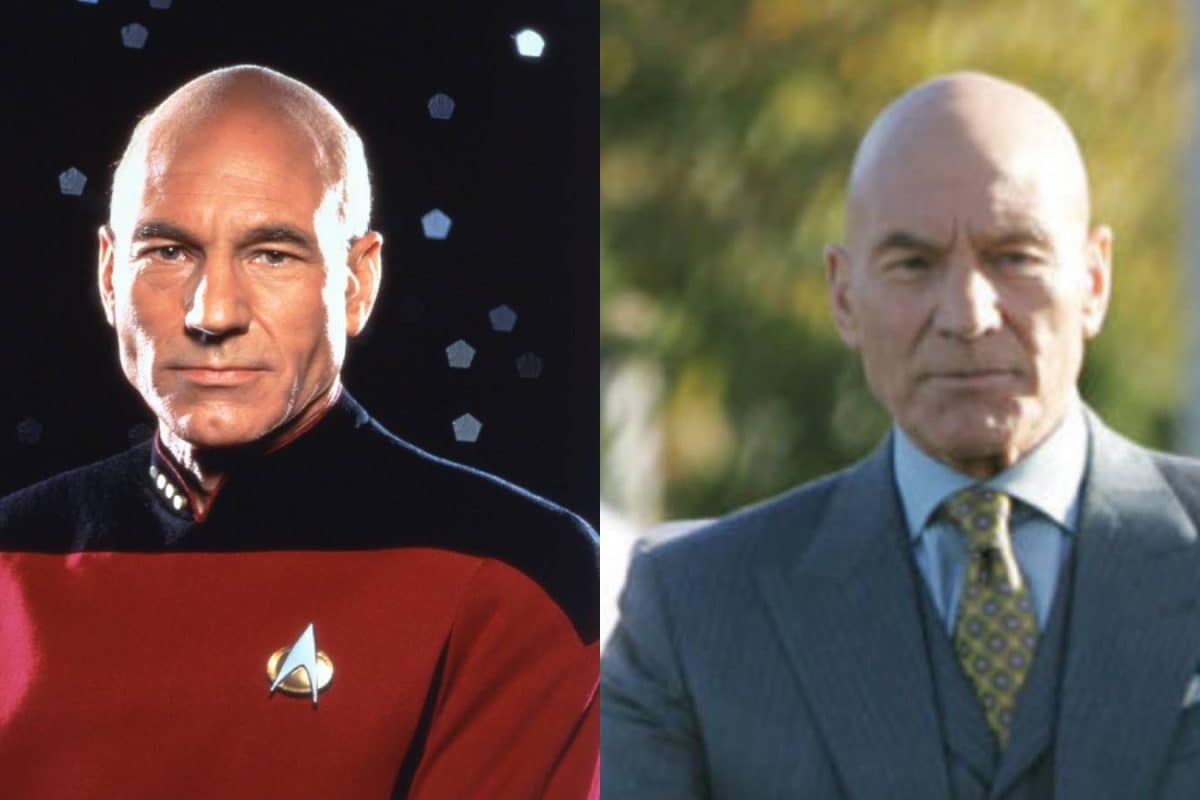
Hollywood Mourns Patrick Stewart: A Career Spanning Six Decade- Hollywood is mourning the death of legendary British actor Sir Patrick Stewart, who passed away at the age of 86, leaving behind an extraordinary legacy across theatre, television and cinema. Best known for portraying Captain Jean-Luc Picard in Star Trek: The Next Generation and Professor Charles Xavier in the X-Men franchise, Stewart was one of the most respected performers of his generation, whose career spanned more than six decades.
Stewart died on Wednesday, October 28, 2026, at his home in Los Angeles, according to a statement released by his longtime spokesperson on Thursday. He passed away following what his representative described as a brief and poignant journey with Alzheimer’s disease and Lewy body dementia, surrounded by his wife, Sunny Ozell, family members and friends.
His death has prompted an outpouring of tributes from actors, filmmakers, colleagues and fans worldwide. Hugh Jackman, Ian McKellen, William Shatner and Marvel Studios were among those who remembered the actor, celebrating not only his remarkable performances but also his warmth, generosity and influence on the entertainment industry.
For millions of viewers, Stewart will forever be remembered as the thoughtful captain of the USS Enterprise and the compassionate mentor of the X-Men. However, his achievements extended far beyond these internationally recognised characters. From Shakespearean theatre in Britain to major Hollywood productions, he built a career defined by versatility, discipline and an unmistakable screen presence.
From Yorkshire to the World of Acting: Patrick Stewart’s Early Life
Born on July 13, 1940, in Mirfield, West Yorkshire, England, Patrick Stewart grew up in a working-class family. He was the youngest of three sons of Alfred Stewart, a former British Army soldier, and Gladys Stewart, who worked in a textile factory.
His childhood was difficult, marked by financial struggles and domestic violence connected to his father’s alcoholism. Stewart later spoke openly about these experiences, explaining how they influenced his understanding of human behaviour and shaped his personal life.
Acting became an important escape from his difficult circumstances. His interest in theatre developed at school after an English teacher introduced him to Shakespeare. At around 12 years old, he was assigned the role of Shylock in The Merchant of Venice, an experience that helped establish his passion for performing.
Stewart left school at 15 and initially worked as a newspaper reporter before deciding to pursue acting professionally. He subsequently received training at the Bristol Old Vic Theatre School, where he developed the skills that would later define his distinguished stage career.
In 1966, he joined the prestigious Royal Shakespeare Company (RSC). His association with the company provided opportunities to perform some of the greatest works in English theatre and work alongside accomplished actors and directors.
During this period, he appeared in numerous Shakespearean productions, taking on challenging characters such as Macbeth, Othello, Shylock, Prospero and Mark Antony. His commanding voice, precise delivery and ability to communicate complex emotions made him a respected figure in British theatre long before Hollywood fame arrived.
Star Trek Turned Patrick Stewart Into an International Icon
Stewart’s international breakthrough came in 1987 when he was selected to portray Captain Jean-Luc Picard in Star Trek: The Next Generation.
At 47, he was already an established stage performer, but the role introduced him to an entirely new global audience. Initially, Stewart was uncertain whether accepting a science fiction television role was the right decision for someone with his theatrical background.
However, the series transformed his professional life.
Running for seven seasons between 1987 and 1994, Star Trek: The Next Generation became one of the most influential science fiction television programmes of its time. Stewart appeared in all 176 episodes, portraying the captain of the USS Enterprise with intelligence, authority and a strong sense of responsibility.
Unlike conventional action heroes, Picard was characterised by his diplomatic approach, intellectual curiosity and preference for peaceful solutions. His leadership frequently involved difficult moral decisions, political negotiations and questions about humanity’s future.
Stewart’s performance made the character a defining figure in the Star Trek universe. Expressions such as “Make it so” and “Engage!” became widely recognised among fans.
He later reprised the role in four feature films: Star Trek Generations (1994), Star Trek: First Contact (1996), Star Trek: Insurrection (1998) and Star Trek: Nemesis (2002).
More than two decades after the original television series concluded, Stewart returned as Picard in the television series Star Trek: Picard, which premiered in 2020 and concluded in 2023 after three seasons.
The series explored the character’s later years, personal relationships and continuing commitment to the principles that had defined his leadership.
X-Men Made Him a Superhero Franchise Favourite
While Star Trek established Stewart as a global television star, his portrayal of Professor Charles Xavier in the X-Men franchise introduced him to a new generation of cinema audiences.
He first played the character in Bryan Singer’s X-Men (2000), portraying the founder of a school for young mutants and the leader of a group fighting for peaceful coexistence between humans and mutants.
Professor Xavier was a powerful telepath, but his greatest strength was his belief in compassion, equality and understanding. Stewart brought remarkable emotional depth to the role, making the character much more than a traditional superhero mentor.
He subsequently appeared in several instalments, including X2: X-Men United (2003), X-Men: The Last Stand (2006), The Wolverine (2013), X-Men: Days of Future Past (2014) and Logan (2017).
His performance in Logan, alongside Hugh Jackman, was particularly memorable. The film presented an ageing and vulnerable Professor Xavier, allowing Stewart to explore themes of memory, friendship, ageing and loss.
He later returned to the Marvel universe with an appearance in Doctor Strange in the Multiverse of Madness (2022).
Stewart had also filmed a role as Professor Xavier for the upcoming Avengers: Doomsday, scheduled for release in December 2026. His appearance is expected to give audiences another opportunity to see him in one of his most celebrated roles.
Beyond Star Trek and X-Men: His Other Films and Television Work
Although Picard and Professor Xavier became his most recognisable characters, Stewart’s filmography included a wide range of genres and performances.
He appeared in David Lynch’s science fiction film Dune (1984), playing Gurney Halleck, and later featured in the romantic thriller Conspiracy Theory (1997), alongside Mel Gibson and Julia Roberts.
Other notable projects included Jeffrey (1995), Moby Dick (1998), in which he portrayed Captain Ahab, and The Lion in Winter (2003), where he played King Henry II.
He also demonstrated his ability to take on darker roles in the 2015 horror thriller Green Room, portraying a threatening antagonist.
His comedy performances revealed another side of his personality. He appeared in Mel Brooks’ Robin Hood: Men in Tights (1993), playing King Richard, and lent his voice to productions such as Family Guy, American Dad!, Gnomeo & Juliet and Ted.
His distinctive voice and impeccable comic timing made him a popular choice for animated productions and voice performances.
A Shakespearean Performer Who Never Left the Stage
Despite achieving worldwide fame through television and cinema, Stewart remained deeply connected to theatre throughout his career.
His work with the Royal Shakespeare Company established him as one of Britain’s distinguished Shakespearean performers. He also appeared on Broadway and received recognition for his stage performances.
Among his notable theatre productions were Antony and Cleopatra, Hamlet, Macbeth, Waiting for Godot and No Man’s Land.
His 2009 performance as Claudius in the Royal Shakespeare Company’s production of Hamlet, alongside David Tennant, was particularly celebrated.
Stewart also enjoyed a long-standing friendship and professional partnership with fellow actor Ian McKellen. The two performed together in Broadway productions of Waiting for Godot and No Man’s Land in 2013.
Their friendship became one of the most admired relationships within the acting community.
His stage work demonstrated that he could move effortlessly between classical drama and modern entertainment, bringing the same commitment and attention to detail to both.
Awards, Knighthood and a Career of Major Achievements
Stewart’s contribution to entertainment earned him numerous awards and honours over the years.
He received two Laurence Olivier Awards, one in 1979 for Antony and Cleopatra and another in 2009 for Hamlet.
In 1996, he won a Grammy Award for Best Spoken Word Album for Children for his narration of Prokofiev: Peter and the Wolf.
He also received a Tony Award nomination for his Broadway performance in Macbeth and several Primetime Emmy nominations for his television work.
One of the most significant honours of his career came in 2010, when Queen Elizabeth II knighted him for his services to drama. He had previously been appointed an Officer of the Order of the British Empire in 2001.
These recognitions reflected a career that successfully connected British theatrical traditions with international popular entertainment.


