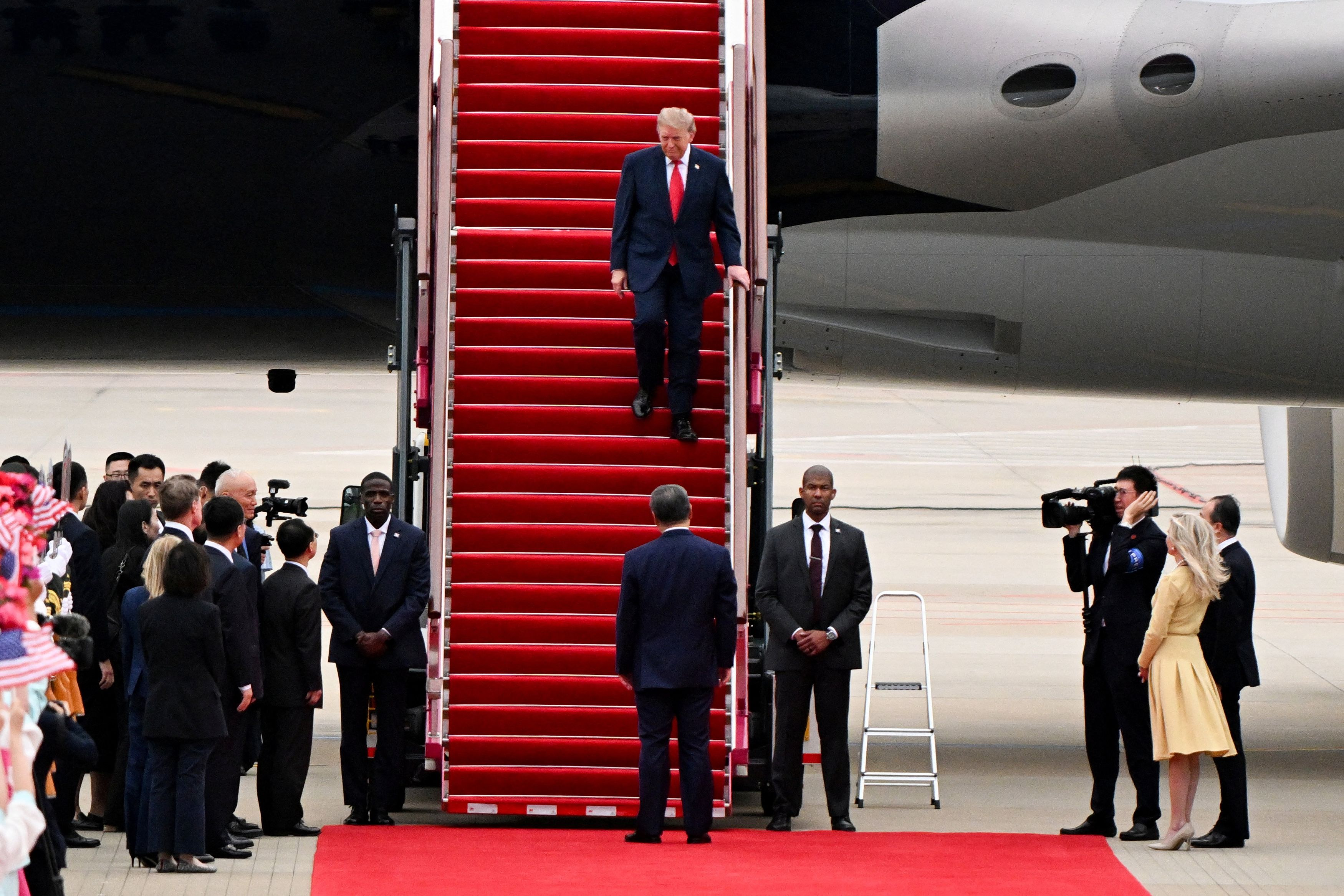
Xi Breaks Protocol to Personally Welcome Trump in China; Putin Joins High-Stakes Three-Way Summit SHENZHEN, November 18: Chinese President Xi Jinping departed from customary diplomatic protocol on Wednesday to personally welcome US President Donald Trump at Shenzhen Bao’an International Airport, offering an unusually warm reception that included a handshake and an embrace. The gesture came as Trump arrived in China for the Asia-Pacific Economic Cooperation (APEC) summit, ahead of an unprecedented trilateral meeting involving Russian President Vladimir Putin.
Xi’s decision to receive Trump personally on the airport tarmac has attracted international attention, highlighting the importance Beijing is attaching to the American president’s visit. The two leaders met at the bottom of the stairs of Air Force One, exchanged greetings and shook hands before embracing in front of cameras and officials.
The airport reception featured a ceremonial red carpet, Chinese and American flags, and groups of performers waving colourful pom-poms as Trump stepped off his aircraft. The elaborate arrangements created a high-profile welcome for the US president, whose visit comes at a critical moment in relations between Washington and Beijing.
According to reports, the gesture also reflected diplomatic reciprocity. Trump had personally welcomed Xi during the Chinese president’s state visit to Washington in September 2026. By appearing at the airport himself, Xi returned the courtesy, offering a symbolic display of diplomatic respect between the two leaders.
The reception was particularly noteworthy because Xi had not personally greeted Trump during his earlier visit to Beijing in May. The contrast has raised questions about the significance Beijing attaches to the latest engagement and the potential diplomatic outcomes of Trump’s visit.
Trump Arrives in China Amid Global Political Tensions
Trump reached Shenzhen after completing engagements in the Philippines, where he participated in meetings with regional leaders. His arrival coincided with the opening of the 33rd APEC Economic Leaders’ Meeting, being hosted by China on November 18 and 19.
The summit brings together leaders and representatives from economies across the Asia-Pacific region to discuss economic development, international trade, technological innovation and regional cooperation.
China is hosting the gathering under the theme of building an Asia-Pacific community for shared prosperity. Issues such as artificial intelligence, supply-chain resilience, investment and market access are expected to remain central to the discussions.
However, Trump’s presence has given this year’s gathering an additional geopolitical dimension. Washington and Beijing continue to face disagreements over tariffs, semiconductor exports, technology restrictions and their competing economic interests.
The two countries are also seeking to prevent their strategic rivalry from escalating into a wider confrontation. Consequently, Trump’s discussions with Xi could have implications extending beyond bilateral trade relations.
Putin Meets Xi Ahead of Trilateral Summit
Russian President Vladimir Putin is also in Shenzhen for the APEC gathering and the proposed three-way meeting with Trump and Xi on Thursday, November 19.
Putin was received separately from Trump when he arrived in the Chinese city. Xi did not personally appear at the airport to welcome the Russian president, with senior Chinese official Cai Qi representing the host leadership.
On Wednesday, Xi and Putin also held bilateral discussions ahead of the planned meeting with Trump. Their engagement provided an opportunity to discuss relations between Beijing and Moscow and coordinate positions on major international developments.
Putin has described the forthcoming trilateral discussions as potentially useful, while Chinese officials have confirmed that the three presidents will meet on the sidelines of the APEC summit.
The meeting will bring together the leaders of three countries with enormous influence over international security, global markets, energy supplies and nuclear weapons policy. It is therefore attracting attention well beyond the Asia-Pacific region.
According to reporting by Reuters and other international media, the discussions are expected to cover nuclear arms control, the conflicts involving Ukraine and Iran, international trade and competition over advanced technologies.
Nuclear Arms Control Could Become a Major Discussion Point
One of the most important issues likely to feature in the trilateral discussions is nuclear security.
The United States and Russia possess the world’s largest nuclear arsenals, while China is also expanding its strategic military capabilities. Any conversation involving the three countries could therefore carry considerable significance for international arms-control efforts.
Trump has expressed interest in reducing nuclear weapons globally and has indicated that the subject will be part of his discussions with the other leaders.
However, achieving an agreement will not be straightforward. Washington, Moscow and Beijing have different positions on nuclear deterrence, weapons modernisation and the conditions necessary for arms-control negotiations.
China has previously maintained that the United States and Russia should first address their substantially larger nuclear stockpiles before Beijing enters comparable negotiations.
Whether the three presidents can identify common ground remains uncertain. Nevertheless, even an agreement to continue discussions could provide a diplomatic opening for future negotiations.
Ukraine and Iran Add Complexity to the Talks
The Russia-Ukraine war is another issue attracting international attention ahead of the meeting.
Washington and Moscow have sharply different positions on the conflict, while China maintains significant political and economic ties with Russia. Beijing has repeatedly called for a political settlement, although its relationship with Moscow has drawn criticism from Western governments.
A discussion involving Trump, Putin and Xi could potentially create opportunities for diplomatic engagement. However, any meaningful progress would also depend on the involvement and positions of Ukraine and other directly affected parties.
European governments are particularly concerned that discussions among major powers could influence the future of European security without sufficient participation from Kyiv and European capitals.
Iran is another important subject, amid continuing regional tensions and concerns about the wider consequences for international stability, energy markets and security.
The three governments have different strategic interests in the Middle East. Their discussions could therefore explore ways to prevent further escalation, although substantial differences are likely to remain.
Trade and Artificial Intelligence: Another Major Area of Competition
Beyond security issues, economic competition between Washington and Beijing is expected to feature prominently in the discussions.
The United States has introduced restrictions affecting China’s access to advanced semiconductor technology, particularly chips and equipment relevant to artificial intelligence and high-performance computing.
China, meanwhile, has sought to strengthen its domestic technology industry and reduce dependence on foreign suppliers.
Trade restrictions, tariffs and access to critical materials have become important points of disagreement between the two economic powers.
For Trump, securing favourable trade arrangements and protecting American technological interests remain important objectives. For Xi, maintaining China’s economic growth and technological development is equally significant.
The discussions could help both sides identify areas where cooperation remains possible, even as competition continues.
What Does the Meeting Mean for the Future of Global Politics?
The proposed Trump-Xi-Putin meeting could become an important moment in international diplomacy, particularly because it brings together three leaders whose decisions can influence global security and economic conditions.
For the United States, direct engagement with China and Russia offers an opportunity to discuss strategic disagreements at the highest political level.
For China, hosting the gathering reinforces its diplomatic role and provides an opportunity to demonstrate its influence in international affairs. Xi’s personal welcome to Trump also adds a symbolic dimension to Beijing’s efforts to maintain communication with Washington.
For Russia, the meeting provides an opportunity to engage directly with the American president while maintaining its close relationship with China. Moscow is also likely to use the discussions to raise issues involving sanctions, international trade and the Ukraine conflict.
However, the gathering should not automatically be interpreted as a sign of a new strategic partnership among the three countries. Their interests often overlap, but significant disagreements remain.
Smaller countries and regional powers will also be watching the discussions carefully. Decisions concerning Ukraine, Iran, nuclear security and international trade could have consequences for countries that are not represented at the table.
For India, developments involving the three major powers will be particularly relevant because of their implications for regional security, energy markets, technology supply chains and the wider Indo-Pacific balance.
Ultimately, the success of Thursday’s meeting will depend on whether the three presidents can move beyond diplomatic gestures and agree on practical steps.
Xi’s unusual airport welcome and the presence of Trump and Putin in Shenzhen have already made the gathering a major international diplomatic event. The more consequential question, however, is whether their discussions can produce tangible progress on the conflicts, economic disputes and security challenges shaping the international order.
As the world awaits the three-way summit on November 19, attention will remain focused on whether this unusual diplomatic encounter marks the beginning of more sustained cooperation or simply another round of high-level discussions between competing global powers. Can Apple’s Siri AI Make Its Upcoming Smart Glasses the Next Big Tech Revolution? | Maya