Ancient Civilizations of the World: Timeline, Culture & Achievements- The story of human civilization spans thousands of years, beginning when people shifted from nomadic life to settled communities supported by farming, trade, and organized leadership. Across continents, early societies developed unique cultures, writing systems, technologies, and belief structures that helped shape the modern world. Understanding the major ancient civilizations gives students insight into how human progress unfolded and how shared ideas traveled from one region to another. This guide explores the timelines, cultural features, and major achievements of several influential ancient civilizations.
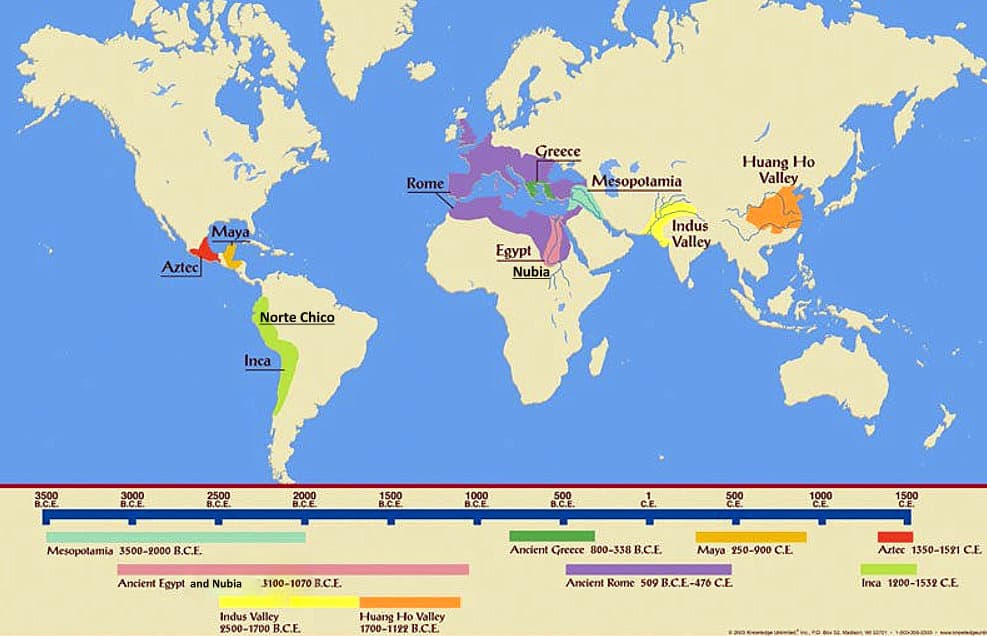
1. Mesopotamia: The “Cradle of Civilization” (c. 3500–500 BCE)
Mesopotamia, located between the Tigris and Euphrates Rivers in what is now Iraq and parts of Syria, is often called the “Cradle of Civilization” because it is one of the earliest places where cities and complex societies emerged.
Culture
Mesopotamians built city-states such as Ur, Babylon, and Sumer. Religion played a central role in their daily lives, and each city worshipped a specific patron god. They built large stepped temples known as ziggurats, and priests held high status in society.
Achievements
-
Writing system: The Sumerians developed cuneiform, one of the world’s first writing systems, using wedge-shaped marks on clay tablets.
-
Laws and governance: King Hammurabi of Babylon introduced the Code of Hammurabi, one of the earliest legal codes.
-
Mathematics & astronomy: They created a base-60 number system, which is why we have 60 seconds in a minute.
-
Agriculture: Irrigation systems and organized farming boosted food production and population growth.
Mesopotamia laid foundational ideas for law, trade, and urban government that influenced later civilizations.
2. Ancient Egypt: The Kingdom of the Nile (c. 3100–30 BCE)
Ancient Egypt arose along the Nile River, whose yearly floods enriched the soil and made farming reliable. This stability allowed powerful kingdoms and cultural achievements to flourish for thousands of years.
Culture
Egyptian society was structured around the pharaoh, believed to be both a king and a living god. Religion, art, and architecture were deeply tied to beliefs about the afterlife. The Egyptians wrote in hieroglyphics, a picture-based script carved on temple walls and written on papyrus.
Achievements
-
Architecture: The pyramids of Giza, temples of Karnak, and the Sphinx show their mastery of engineering.
-
Medicine: They recorded medical knowledge in texts and performed surgery with surprising skill.
-
Calendar & mathematics: The solar calendar and geometry helped them track the Nile’s floods and build massive structures.
-
Art & literature: Detailed tomb paintings, sculptures, and stories like the Book of the Dead highlight a rich intellectual tradition.
Egypt’s stable government and advances in science, engineering, and writing left an enduring mark on human history.
3. Indus Valley Civilization: The Urban Pioneers (c. 2600–1900 BCE)
The Indus Valley Civilization, located in present-day Pakistan and northwest India, created some of the earliest planned cities in the world.
Culture
Cities like Harappa and Mohenjo-Daro were built on grids with baked-brick houses and advanced drainage systems. This civilization had a highly organized society, though its writing system remains undeciphered. Evidence suggests they practiced trade, agriculture, and crafts like bead-making and pottery.
Achievements
-
Urban planning: Streets laid out in right angles, public baths, and drainage systems far ahead of their time.
-
Trade links: They traded cotton, beads, and metals with Mesopotamia and Central Asia.
-
Craftsmanship: Skilled work in metal, terracotta, jewelry, and stone sculptures.
Their focus on hygiene, organization, and city planning influenced later Indian cultures, even though the civilization declined mysteriously.
4. Ancient China: A Civilization of Dynasties (c. 2000 BCE–220 CE)
Ancient China grew along the Yellow River (Huang He), where farming communities gradually formed into powerful dynasties such as the Shang, Zhou, Qin, and Han.
Culture
Chinese society valued family, harmony, and respect for ancestors. Philosophies like Confucianism and Daoism shaped government and daily life. Writing evolved from pictographs into complex characters that are still recognizable in modern Chinese.
Achievements
-
Inventions: Paper, silk, the compass, cast iron tools, and early forms of printing.
-
Government & philosophy: The concept of the Mandate of Heaven explained the rise and fall of rulers.
-
Engineering: The early construction of the Great Wall and canals.
-
Science: Detailed records of astronomy and medicine.
China’s innovations spread across Asia and eventually influenced cultures around the world.
5. Ancient Greece: The Birthplace of Democracy (c. 800–146 BCE)
Ancient Greece, made up of independent city-states like Athens and Sparta, contributed enormously to politics, philosophy, science, and art.
Culture
Greek culture valued inquiry, debate, and human potential. Religion involved gods like Zeus and Athena, and festivals such as the Olympic Games united the Greek world. Greek architecture, especially temples and theatres, emphasized balance and proportion.
Achievements
-
Democracy: Athens introduced one of the first systems of citizen-led government.
-
Philosophy: Thinkers like Socrates, Plato, and Aristotle shaped Western thought.
-
Arts & literature: Epic poems like the Iliad, tragedies, sculpture, and architecture still inspire modern artists.
-
Science & mathematics: Contributions from Pythagoras, Archimedes, and Hippocrates.
Greek ideas about politics, learning, and artistic beauty strongly influence modern education and culture.
6. Ancient Rome: The Empire Builders (c. 753 BCE–476 CE)
Rome began as a small city and grew into one of the largest empires in history, covering much of Europe, North Africa, and the Middle East.
Culture
Roman culture blended traditions from earlier civilizations with innovations of its own. Latin, the Roman language, influenced many modern languages. Romans built massive roads, aqueducts, and public structures like amphitheatres.
Achievements
-
Government & law: The Roman Republic introduced elected representatives and legal principles still used today.
-
Engineering: Roads, bridges, aqueducts, and concrete changed construction forever.
-
Military organization: A disciplined army helped expand and defend the empire.
-
Art & literature: Roman sculptures, mosaics, and writers like Virgil and Cicero shaped Western heritage.
Roman achievements influenced modern law, architecture, and political systems.
7. Ancient Mayans: The Mathematicians of the Americas (c. 2000 BCE–1500 CE)
In Mesoamerica, the Maya developed a sophisticated civilization known for its scientific and artistic achievements.
Culture
The Maya built city-states such as Tikal and Palenque, each ruled by nobles and priests. They created a writing system of glyphs and left behind detailed stone carvings and codices. Religion guided daily life, astronomy, and architecture.
Achievements
-
Mathematics: They developed the concept of zero independently.
-
Astronomy: Their calendars were highly accurate and used to plan ceremonies and farming cycles.
-
Architecture: Pyramids, temples, and observatories aligned with celestial movements.
-
Art: Painted murals, pottery, and jade sculptures show great skill.
Their knowledge of astronomy and mathematics remains remarkable today.
Conclusion:
From the fertile plains of Mesopotamia to the forests of Mesoamerica, ancient civilizations helped shape the world we live in. Their innovations—writing, government, mathematics, architecture, agriculture, and engineering—continue to influence modern society. Although separated by geography and time, these cultures shared a drive to organize life, understand the world, and express human creativity. Studying ancient civilizations allows us to appreciate our shared human past and recognize the foundations of today’s global civilization.
Regulatory T Cells Win Big: Nobel Prize 2025 in Medicine | Maya