When Shiva Tested Rama as a Hunter
The Kiratamurti Encounter – A Rare Shaiva Ramayana Episode
Most people who love Indian epics know the famous Kirata episode—Shiva disguising himself as a tribal hunter to test Arjuna in the Mahabharata. But far fewer have heard of an equally profound and far rarer version: Shiva testing Rama himself, long before Rama meets Hanuman or crosses the ocean to Lanka.
This episode survives not in the mainstream Valmiki Ramayana narrative, but in Shaiva-leaning Purāṇic traditions, fragments of the Vayu Purana, and regional Shaiva Ramayanas from South India and Kashmir. It is subtle, philosophical, and deeply moving—because here, God tests God, not through power, but through humility.
Setting the Scene: Rama in the Forest of Doubt
After Sita’s abduction, Rama wanders the dense forests of Dandaka and Kishkindha, torn between grief and duty. This is the Rama we don’t often pause to reflect on—not the ideal king or the victorious hero, but the seeker, weighed down by loss and uncertainty.
Shaiva tellings emphasize that before destiny sends Hanuman, Rama must first confront something within himself:
-
His grief
-
His pride as an avatar
-
His reliance on righteousness as identity
It is at this moment that Mahadeva intervenes—not as a god, but as a mirror.
The Hunter Appears
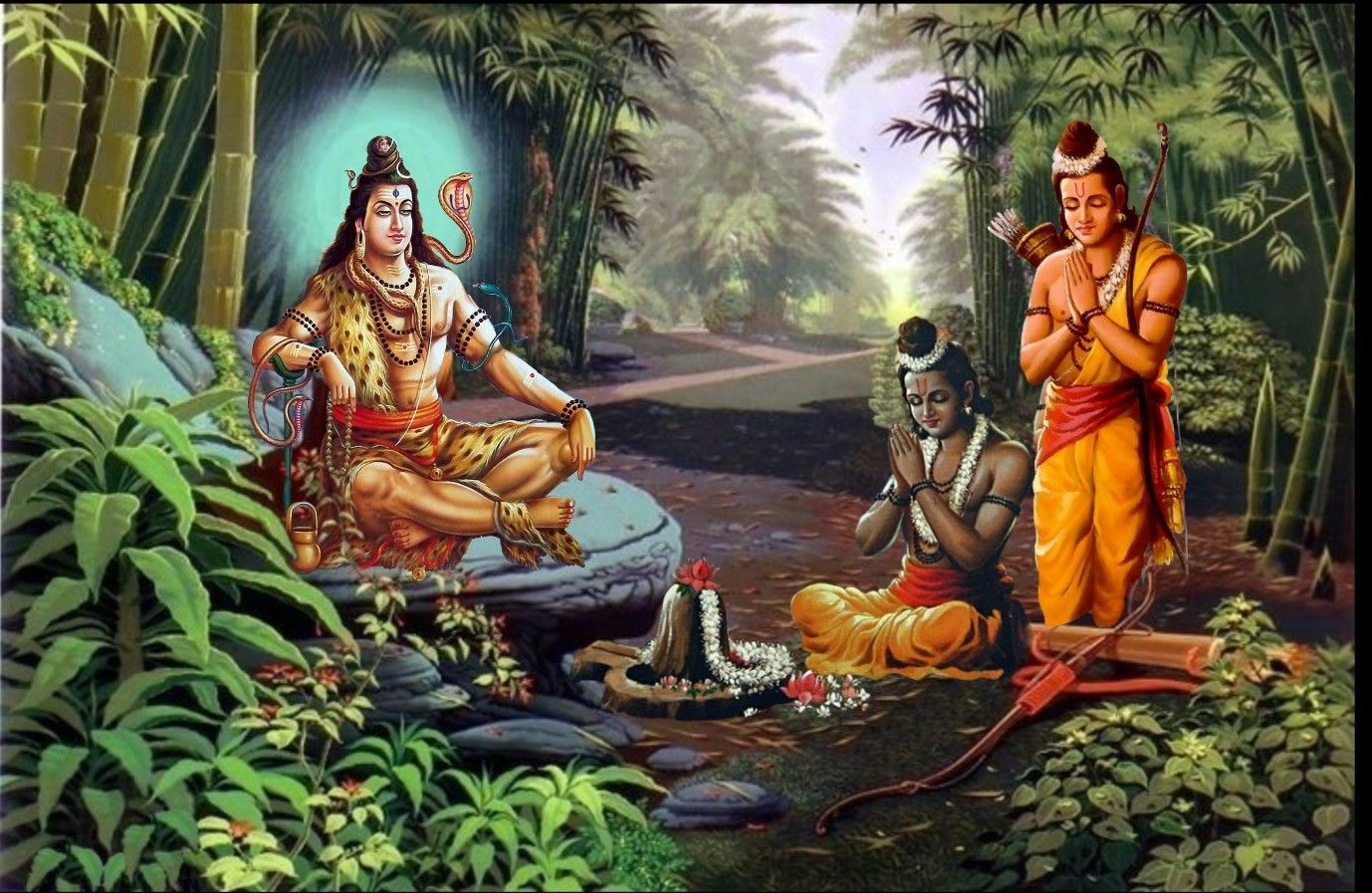
One evening, Rama encounters a wild hunter (Kirāta) deep in the forest.
He is dark-skinned, ash-smeared, clothed in animal hide, with matted hair and fierce eyes. His presence is unsettling. Lakshmana immediately senses danger and places his hand on his bow.
But the hunter smiles—not kindly, not cruelly, but knowingly.
He questions Rama bluntly:
“You claim to uphold dharma, yet you wander armed in the forest like a king of violence. Tell me, prince—who gives you the right to kill in the name of righteousness?”
This is no ordinary challenge. This is Shiva’s voice, sharp and unflinching.
The Test of Righteousness
The hunter accuses Rama of hypocrisy:
-
Killing forest dwellers in the name of protecting sages
-
Carrying royal weapons while pretending to live as an ascetic
-
Mourning Sita while clinging to worldly attachment
In some Shaiva versions, the hunter even questions Rama’s divinity:
“If you are truly righteous, why does suffering follow you?
If you are divine, why do you grieve like a man?”
This strikes Rama deeply.
Unlike Arjuna, who reacts with anger in the Mahabharata Kirata episode, Rama does not raise his weapon.
Instead, he bows slightly.
Rama’s Response: Humility Over Authority
Rama answers not as an avatar, but as a seeker:
“If I have erred, teach me.
If I have acted in pride, correct me.
If dharma itself appears cruel, I wish to understand it.”
This moment is crucial.
Shaiva philosophy emphasizes that true devotion is not obedience, but surrender of ego. Rama, despite being Vishnu incarnate, submits himself to judgment.
The hunter laughs—loud, thunderous, unsettling.
The Divine Revelation
The hunter challenges Rama to a symbolic contest—sometimes described as an archery test, sometimes as a philosophical duel.
In one version preserved in regional oral lore:
-
Rama’s arrows vanish mid-air
-
The forest trembles
-
Time itself seems suspended
Finally, Rama realizes the truth.
He lowers his bow, folds his hands, and says:
“You are not of this forest.
You are the Lord of it.”
At that moment, the hunter transforms.
The ashes glow. The matted hair blazes like fire. The crescent moon appears. Serpents coil as ornaments.
Shiva stands revealed as Kiratamurti.
Why Shiva Tests Rama
In the Vayu Purana–associated Shaiva interpretation, Shiva explains his purpose:
“I did not come to test your strength, Rama.
I came to test whether even righteousness can bow.”
Shiva reminds Rama of a profound truth:
-
Dharma without compassion becomes arrogance
-
Divinity without humility becomes distance
Only after Rama passes this test—by choosing humility over authority—does Shiva bless him.
The Blessing That Follows
Shiva grants Rama clarity, not weapons.
In some traditions, he says:
“The one who will help you find Sita already walks toward you.
Recognize him not by form, but by devotion.”
This is a subtle foreshadowing of Hanuman.
In Shaiva thought, Shiva does not interfere directly in Vishnu’s avataric mission—but he removes inner obstacles.
The meeting ends not with victory, but with silence.
Shiva vanishes into the forest, leaving Rama transformed.
Why This Story Is Rare
There are several reasons this episode remains obscure:
-
Vaishnava retellings emphasize Rama’s perfection, while Shaiva traditions allow him moments of questioning.
-
The story blurs sectarian boundaries—Shiva teaching Vishnu’s avatar.
-
It survives mainly in regional oral traditions, not standardized Sanskrit texts.
Yet its philosophical depth is undeniable.
The Deeper Meaning
This Kiratamurti encounter tells us something radical:
-
Even avatars pause
-
Even righteousness must be examined
-
Even gods bow to wisdom
It reminds readers that spiritual maturity is not certainty—it is openness.
Shiva does not oppose Rama. He refines him.
Closing Thoughts
In a forest far from thrones and armies, Shiva met Rama not as a god, but as a question.
And Rama answered—not with arrows, but with humility.
Perhaps that is why Hanuman soon appears after—because devotion arrives only when ego departs.
This rare Shaiva Ramayana episode may be little known, but it offers one of the most beautiful spiritual lessons in Indian mythology:
Before you meet your destiny, you must first meet yourself.