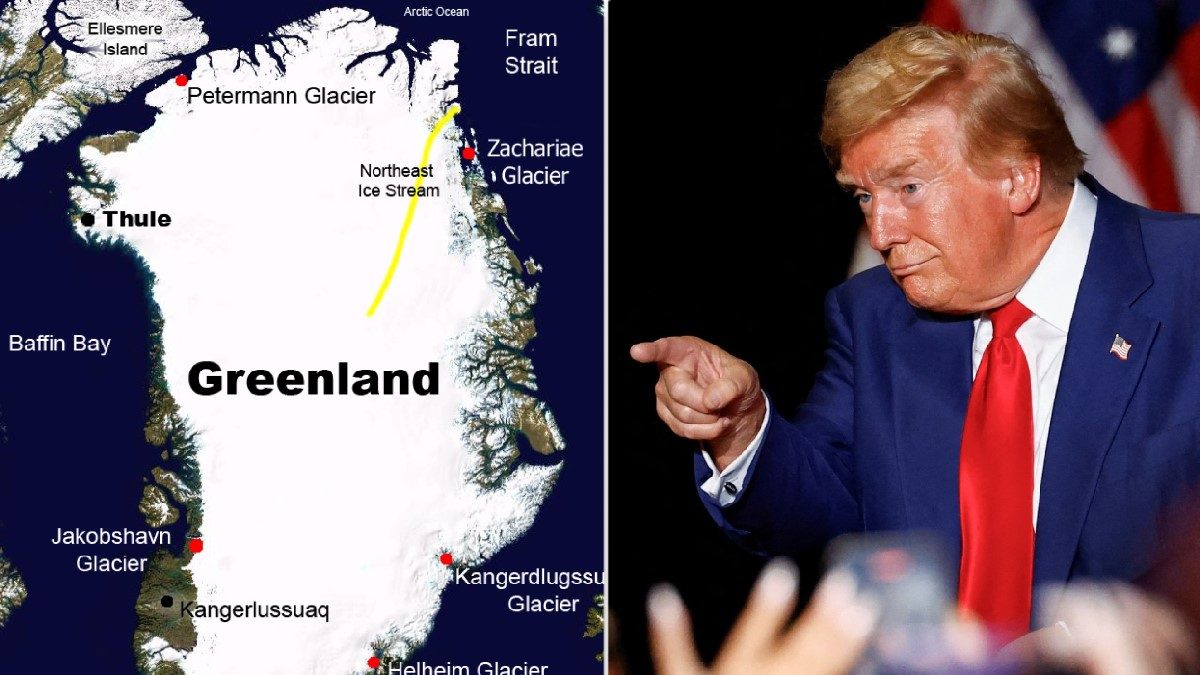
What Does Donald Trump Really Want From Greenland? Donald Trump’s renewed fixation on Greenland has once again pushed a remote Arctic territory into the center of global geopolitics — raising uncomfortable questions about sovereignty, security, and the future of Western alliances.
Only days after Trump’s dramatic move to remove Venezuela’s president Nicolás Maduro, the former U.S. president pivoted quickly to another long-running obsession: Greenland. Speaking publicly last weekend, Trump declared that the United States needed Greenland “very badly,” a remark that immediately reignited tensions with both Denmark and Greenland’s autonomous government.
Greenland, the world’s largest island, is part of the Kingdom of Denmark. While it governs most of its internal affairs, Copenhagen still controls its foreign policy and defense. Trump’s remarks were therefore interpreted not just as rhetoric, but as a direct challenge to a NATO ally — something Danish leaders have warned could fracture the post-war security order.
Danish Prime Minister Mette Frederiksen reacted sharply, stating that a U.S. attack or forced takeover of Greenland would effectively spell the end of NATO itself. Greenland’s prime minister, Jens-Frederik Nielsen, went even further, urging Trump to abandon what he called “fantasies about annexation.” European leaders quickly closed ranks, repeating a clear message: Greenland belongs to its people, not to foreign powers.
Despite the diplomatic backlash, Trump’s inner circle appears undeterred. Stephen Miller, one of Trump’s closest advisers, has claimed that the administration believes Greenland can be acquired without military force — a statement that has only deepened uncertainty about Washington’s intentions.
Why Greenland — and why now?
Trump’s interest in Greenland is not new, but his reasoning has shifted over time. During his first term in 2019, he framed the idea of acquiring the island as a straightforward business transaction, likening it to a “large real estate deal.” Earlier this year, he described Greenland as vital to “economic security.” Now, his language has evolved again, emphasizing “national security,” even as critics argue such a move would destabilize NATO and undermine U.S. credibility abroad.
So what has changed? Greenland’s strategic importance has grown dramatically as Arctic ice melts, opening new shipping routes and exposing vast reserves of rare earth minerals, oil, and gas. The Arctic has become a new arena of competition between global powers, particularly the U.S., China, and Russia. From Washington’s perspective, Greenland’s location offers unparalleled military and surveillance advantages in the High North.
But critics ask whether strategic interest justifies rhetoric that appears to dismiss Greenlandic self-determination — or whether Trump’s comments reflect a broader worldview that treats territory as something to be acquired rather than negotiated.
Denmark, Greenland, and a complicated past
Greenland’s relationship with Denmark is already fraught. Indigenous Inuit peoples have lived on the island for thousands of years, long before Norse settlers arrived in the first millennium. Modern colonization began in the 18th century, and Greenland remained under Danish control through centuries of political and cultural upheaval.
During World War II, when Denmark was occupied by Nazi Germany, the United States temporarily occupied Greenland — a historical precedent some Trump allies quietly reference. After the war, the island returned to Danish rule, eventually becoming an official part of the kingdom in 1953. Home rule was introduced in 1979, followed by expanded self-government in 2009.
Yet deep wounds remain. Investigations into forced contraceptive programs imposed on Greenlandic women in the 1960s and 70s, as well as policies that separated children from their families, have fueled anger and strengthened calls for independence. Denmark has apologized and agreed to compensation, but trust has not been fully restored.
Against this backdrop, Trump’s comments have had an unexpected effect: they have united Greenland’s political landscape. Earlier this year, Greenland formed a rare four-party coalition government, emphasizing national unity. The opening line of its coalition agreement was blunt: “Greenland belongs to us.”
Independence — and new uncertainties
Support for Greenlandic independence has been steadily growing, but independence itself remains complex. Under a 2009 agreement, Greenland must hold and win a referendum before declaring sovereignty. Even then, questions remain about economic sustainability, defense, and international alignment.
Ironically, Trump’s pressure may accelerate debates Greenland had hoped to approach on its own terms. Some Greenlanders worry that independence could make the island more vulnerable to outside influence, including from the U.S. Others argue that remaining tied to Denmark leaves Greenland exposed to decisions made far from Nuuk.
What happens next?
Trump’s rhetoric raises uncomfortable questions for the international community. Can NATO survive if one member openly threatens another? How should small nations protect themselves as great-power competition intensifies? And where does Greenland’s right to self-determination fit into a world increasingly driven by strategic rivalry?
For now, Denmark and Greenland are standing firm. But as Arctic geopolitics heat up, Greenland’s future — and its place between Washington, Copenhagen, and the wider world — looks more uncertain than ever.