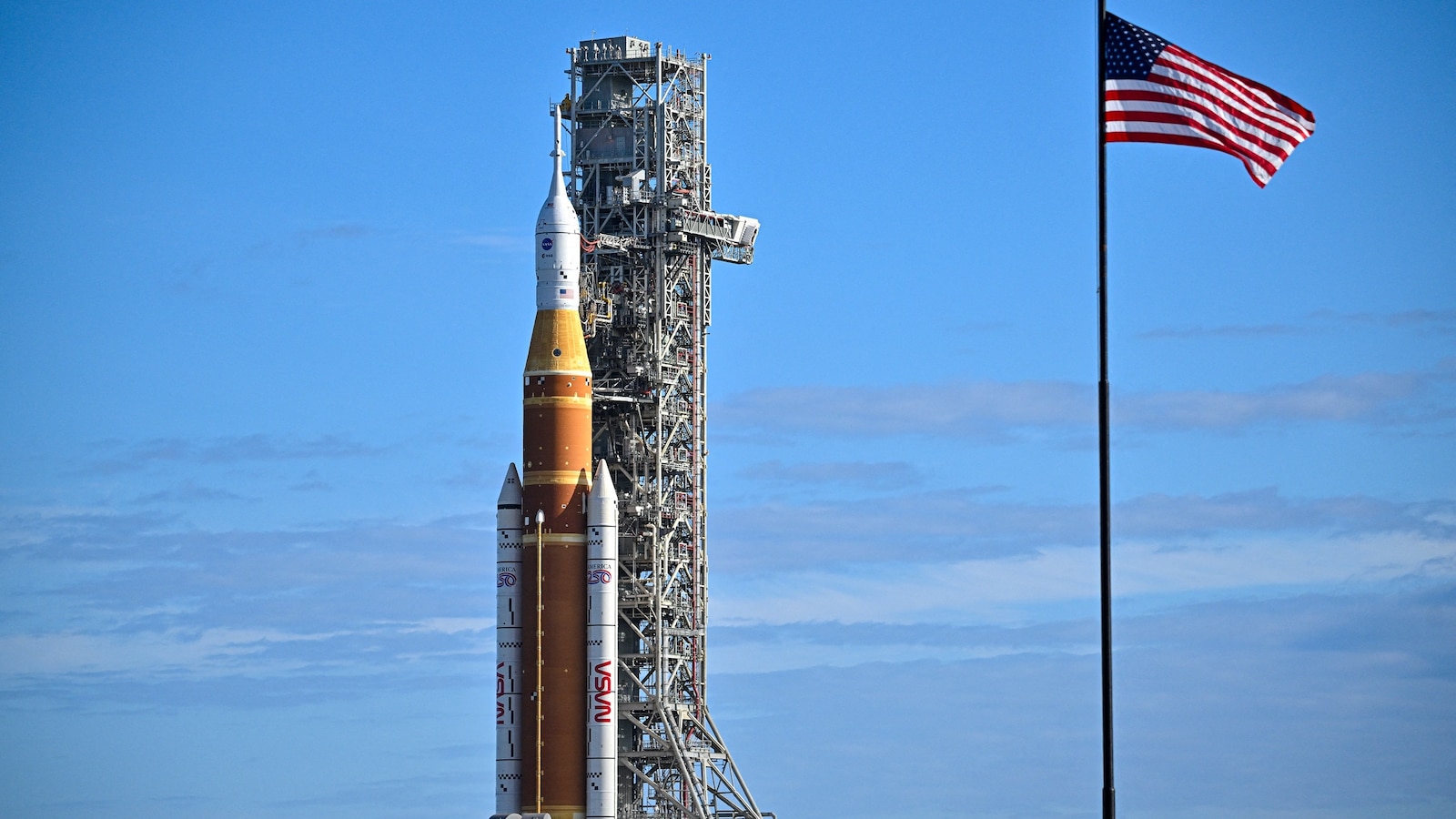
Moon Mission Nears as NASA Rocket Reaches Launchpad
NASA has taken a decisive step toward sending astronauts back into deep space as its next-generation Moon rocket completed its journey to the launchpad at Kennedy Space Center in Florida. The move signals that preparations are entering their final phase for a landmark mission that will carry humans around the Moon for the first time in more than 50 years.
The enormous Space Launch System (SLS) rocket, standing nearly 98 metres (322 feet) tall, rolled out from the Vehicle Assembly Building shortly after sunrise. Mounted atop a massive crawler-transporter, the rocket crept along at little more than walking speed, covering the four-mile route to the pad over the course of the day. By nightfall, the vehicle was securely positioned at Launch Complex 39B, the same historic site used for Apollo missions and more recently for NASA’s Artemis programme.
A Long-Awaited Moment
For many at the space center, the rollout was more than just a technical milestone. Thousands of NASA employees, contractors, and their families gathered in the early morning cold to watch the slow procession, some having waited years to see the rocket leave the assembly building. The event marked the culmination of decades of planning, development, and testing aimed at restoring America’s ability to send astronauts beyond low Earth orbit.
The Vehicle Assembly Building itself is steeped in history. Constructed in the 1960s, it was originally designed to house the Saturn V rockets that powered the Apollo missions, which carried 24 astronauts to the Moon between 1968 and 1972. Seeing a new lunar rocket emerge from the same doors underscored the continuity between past achievements and NASA’s future ambitions.
NASA’s new administrator, Jared Isaacman, was among those present for the rollout, joined by all four astronauts assigned to the upcoming mission. Their presence highlighted how close the programme is to transitioning from preparation to execution.
The Mission Ahead
The flight, known as Artemis II, will be the first crewed mission under NASA’s Artemis programme. While it will not involve a Moon landing, the mission is designed to test the systems and procedures needed for future lunar surface expeditions.
During the roughly 10-day journey, the astronauts will travel thousands of kilometres beyond Earth orbit, loop around the far side of the Moon, and return home. The mission will put the Orion spacecraft’s life-support, navigation, propulsion, and communication systems through their paces in the harsh environment of deep space — something no human-rated spacecraft has done since the Apollo era.
The crew consists of four astronauts: a commander, a pilot, a mission specialist from NASA, and a mission specialist from the Canadian Space Agency. Their flight will mark Canada’s first participation in a crewed lunar mission, reflecting the increasingly international nature of modern space exploration.
The Power Behind the Journey
At the heart of the mission is the Space Launch System, the most powerful rocket NASA has ever built. Designed specifically for deep-space missions, SLS generates more thrust at liftoff than any rocket currently in operation. Its core stage is powered by four RS-25 engines, evolved from those used on the Space Shuttle, while two massive solid rocket boosters provide the majority of the initial lift needed to escape Earth’s gravity.
Sitting atop the rocket is the Orion spacecraft, a capsule built to carry astronauts farther from Earth than ever before. Orion is equipped with advanced heat shields capable of withstanding the intense temperatures generated during high-speed re-entry, as well as systems designed to keep crews safe during extended missions in space.
The rollout to the launchpad allows engineers to begin a series of final tests that cannot be conducted inside the assembly building. These include full fueling simulations, countdown rehearsals, and integrated checks between the rocket, spacecraft, and ground systems.
Final Testing and Countdown Preparations
With the rocket now at the pad, NASA teams will conduct what is known as a wet dress rehearsal. During this process, the rocket’s tanks are filled with super-cold liquid hydrogen and liquid oxygen, and engineers practice the procedures that will be used on launch day. The goal is to identify and resolve any remaining issues before astronauts are on board.
Such tests are especially critical for a rocket as complex and powerful as SLS. Previous Artemis missions have demonstrated that small technical problems can cause significant delays, and NASA has emphasized a cautious, safety-first approach for its first crewed flight.
Astronaut training has also intensified in recent months. The crew has been rehearsing launch and landing procedures, emergency scenarios, and in-flight operations using high-fidelity simulators. These preparations ensure that both humans and machines are ready for the demands of deep-space travel.
Part of a Bigger Vision
Artemis II is not an isolated mission but a key step in a broader strategy to establish a long-term human presence beyond Earth. NASA’s Artemis programme aims to return astronauts to the Moon, explore new regions such as the lunar south pole, and use the Moon as a testing ground for future missions to Mars.
The follow-up mission, Artemis III, is planned to land astronauts on the lunar surface later in the decade. That mission is expected to include the first woman and the first person of colour to walk on the Moon, reflecting NASA’s emphasis on a more inclusive era of exploration.
In parallel with crewed missions, NASA is supporting a growing number of robotic lunar flights through partnerships with private companies. These missions are delivering scientific instruments, testing new technologies, and scouting potential landing sites for future astronauts.
Recent NASA and Space Developments
The lunar push comes amid a busy period for NASA and the global space community. The James Webb Space Telescope continues to deliver unprecedented views of distant galaxies, star-forming regions, and exoplanet atmospheres, reshaping scientists’ understanding of the universe.
Closer to home, NASA and its partners have maintained a continuous human presence aboard the International Space Station for more than two decades. Recent missions have focused on studying the effects of long-duration spaceflight on the human body, research that is critical for future journeys to the Moon and Mars.
NASA is also expanding its Earth-science missions, launching new satellites to monitor climate change, track extreme weather, and study Earth’s oceans and ice sheets. These efforts demonstrate how space exploration benefits life on Earth as well as beyond it.
Commercial spaceflight continues to play a growing role as well. Private companies are regularly transporting astronauts and cargo to the space station, freeing NASA to focus more heavily on deep-space exploration. This partnership model is central to the Artemis programme, which relies on both government and commercial technologies.
Looking Forward
As the SLS rocket stands on the launchpad, it represents more than steel, fuel, and electronics. It symbolizes a renewed commitment to exploration and a bridge between the achievements of the Apollo era and the ambitions of the future.
If the upcoming mission launches successfully, it will mark humanity’s return to the vicinity of the Moon after a gap of more than half a century. More importantly, it will pave the way for sustained exploration beyond Earth orbit, setting the stage for new discoveries, international cooperation, and the next giant leap — not just back to the Moon, but onward to Mars and beyond.
Wave Ripples on Mars Rock Could Rewrite the History of Water on the Red Planet | Maya