
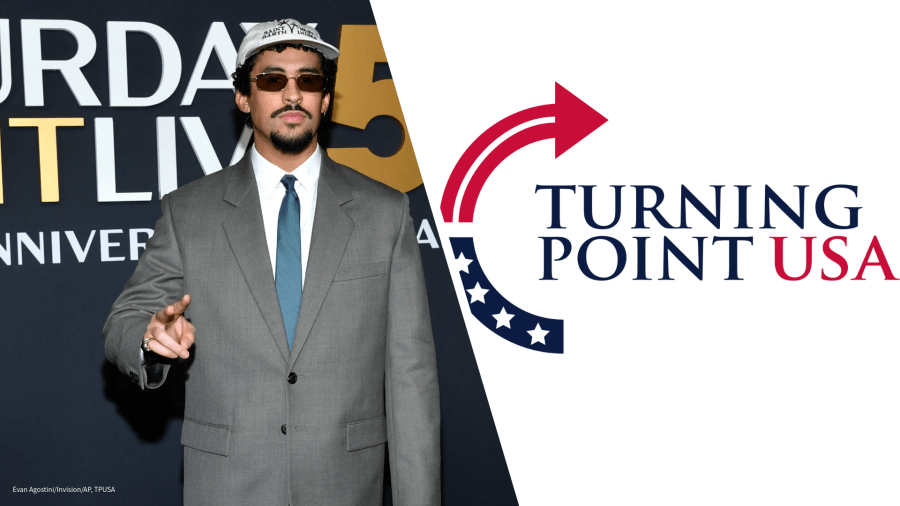
Bad Bunny vs. Turning Point: How a Political Alternative Took Over the Super Bowl Halftime
This year’s Super Bowl halftime show wasn’t just about music—it became a flashpoint in America’s ongoing culture wars. While millions tuned in to watch Latin music superstar Bad Bunny perform at the official halftime show, a rival broadcast was running online: Turning Point USA’s “All-American Halftime Show,” a politically charged alternative that drew attention for all the wrong reasons.
The Spark Behind the Showdown
Bad Bunny, the Puerto Rican singer known for reggaeton, Latin trap, and high-energy performances, was chosen to headline the Super Bowl halftime show. While globally celebrated, his selection sparked backlash among some conservative circles, many of whom objected to his Spanish-language songs and outspoken views.
In response to this outrage, Turning Point USA (TPUSA), a conservative nonprofit organization, created an alternate halftime event aimed at viewers who felt alienated by the NFL’s choice. Marketed as an “All-American” show, the online broadcast streamed simultaneously with the official halftime performance.
A Patriotic, Politically Infused Performance
Unlike the NFL’s show, which featured cutting-edge production, choreography, and international appeal, Turning Point’s broadcast leaned heavily on patriotism and conservative messaging. Performers included country and rock artists, all singing in English, reinforcing the organization’s theme of “traditional American values.”
The show opened with a countdown and a recurring banner on the screen, encouraging viewers to purchase merchandise and sign up for text alerts. This constant marketing underscored that the event was as much a promotional vehicle as it was a musical performance.
Outrage as a Selling Point
The TPUSA broadcast was clearly built around the controversy surrounding Bad Bunny. Rather than directly criticizing the singer, the event emphasized vague appeals to patriotism, national pride, and family values. Surveys conducted by the organization had even asked fans what type of music they preferred, with one option listed simply as “Anything in English,” highlighting the language-driven motivation behind the show.
While the performers were competent, the overall energy and cohesion of the event fell short compared to the spectacle viewers had come to expect from the Super Bowl. Critics argued that the focus on ideology and marketing overshadowed the music itself, leaving the show feeling like a political statement rather than genuine entertainment.
Audience Reaction and Cultural Divide
The broadcast drew mixed reactions. Some conservative viewers applauded the attempt to create a patriotic alternative to the official halftime show, appreciating the inclusion of familiar music genres and the nods to American identity. However, many others mocked the performance as forced and overly commercialized, criticizing the heavy focus on merchandise and ideological messaging.
This dual response highlighted the growing divide in American entertainment. While the NFL show represented global pop culture and diversity, the Turning Point broadcast catered to a niche audience defined by political identity and cultural preference.
Viewership and Cultural Impact
Although viewership of the Turning Point event did not rival the tens of millions watching the official halftime show, it still attracted a notable audience online. The broadcast became a talking point across social media, amplifying the debate over what it means to represent American culture in a mainstream venue like the Super Bowl.
Meanwhile, Bad Bunny’s official performance received acclaim for its energy, creativity, and cross-cultural appeal, underscoring the contrast between global entertainment and politically targeted programming. The two shows reflected vastly different approaches to the same event—one emphasizing artistic expression, the other cultural signaling.
Entertainment Meets Politics
This year’s twin halftime broadcasts illustrate how deeply intertwined entertainment and politics have become. The official show celebrated diversity, international music, and pop culture influence, while the TPUSA show focused on signaling specific cultural and political values. For viewers, the experience depended less on the music and more on the ideology it represented.
Critics argue that political counterprogramming risks reducing shared cultural events into battlegrounds, while supporters claim it provides a platform for audiences who feel overlooked in mainstream media. Regardless, the Super Bowl, often billed as a unifying spectacle, has now also become a stage for broader cultural and political commentary.
A Reflection of the Times
In the end, both halves of the halftime story—the official performance by Bad Bunny and the Turning Point alternative—offer a glimpse into America’s cultural dynamics. Music remained at the heart of the spectacle, but the surrounding discourse revealed deep divides over language, identity, and values.
Whether celebrated for inclusivity or critiqued for political signaling, the Super Bowl’s halftime this year proved that even entertainment’s biggest nights are not immune to the country’s ongoing culture wars. As audiences continue to fragment along political and cultural lines, shared moments like the halftime show may increasingly serve as mirrors of societal tension rather than purely celebratory experiences.
Can Urban Electromagnetic Pollution Disrupt Quantum Biology? | Maya


