
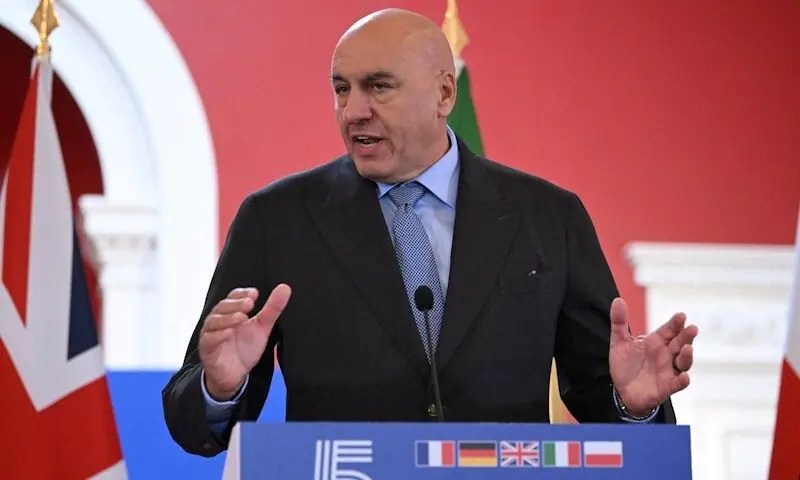
Italian Defence Minister Says US‑Israeli Strikes on Iran Breach International Law: ROME — Italian Defence Minister Guido Crosetto issued a sharp rebuke of recent military strikes carried out by the United States and Israel against Iran, calling the attacks a clear violation of international law and warning of their potentially serious consequences for global stability. Speaking to parliament on Thursday, Crosetto’s remarks marked the strongest criticism to date from Italy’s right-wing government toward Washington and Tel Aviv, longstanding allies with which Rome has traditionally maintained close ties.
“The strikes carried out by the United States and Israel are, of course, outside the rules of international law,” Crosetto told lawmakers. He stressed that the attacks occurred without prior consultation with Italy or other international partners, leaving Europe and the wider world to confront the aftermath of a conflict they did not instigate. According to Crosetto, the international community is now forced to manage a crisis sparked unilaterally, highlighting the dangers of military action taken without broader oversight or clear legal justification.
Italy’s comments are particularly notable because the government, led by Prime Minister Giorgia Meloni, has historically sought to strengthen its relationship with the United States. Despite this political alignment, Crosetto did not hesitate to openly challenge the legality of the strikes, reflecting growing unease in some European capitals about the strategic and humanitarian repercussions of the escalating conflict in the Middle East.
The U.S. and Israeli operations, launched in the past week, targeted multiple sites in Iran, reportedly aimed at curbing military capabilities and preempting potential threats. While supporters of the strikes argue they were justified under a preemptive self-defense rationale, critics question whether the attacks meet the strict conditions set out under international law, which generally allows the use of force only in response to an armed attack or with explicit authorization from the United Nations Security Council.
Crosetto’s warning comes amid a tense period in the region, as Iran has already retaliated with missile and drone attacks targeting Israeli and allied positions, raising fears of a broader regional escalation. The Italian minister underscored the urgency of diplomatic engagement to prevent the conflict from spiraling further, noting that unilateral military actions carry risks not only for those directly involved but for neighboring countries and global security more broadly.
In his parliamentary address, Crosetto outlined measures Italy is taking in response to the heightened tensions, including bolstering air-defense support for Gulf allies and deploying naval forces to strategic positions in the eastern Mediterranean. He emphasized that while Italy maintains strong alliances with both the United States and Israel, it also has a responsibility to uphold international norms and promote stability, warning that ignoring legal obligations could set a dangerous precedent.
Analysts say Italy’s statement highlights a delicate balancing act: preserving close strategic ties with traditional allies while asserting an independent stance on issues of international law. Crosetto’s remarks signal that European partners may increasingly demand transparency and coordination before military interventions, especially in situations with the potential to ignite broader conflict.
The minister also stressed the human cost of the strikes, noting that any escalation in the region threatens civilian populations and could disrupt global trade, particularly the movement of energy resources through key shipping routes. This framing underscores the broader economic and humanitarian stakes that European countries face when conflicts erupt in the Middle East.
While the U.S. and Israel have defended their operations as necessary to neutralize imminent threats and protect national security interests, Crosetto’s public condemnation illustrates the tension between unilateral action and adherence to international norms. His criticism resonates with legal experts who argue that preemptive military operations must meet stringent conditions under international law, and that failure to do so undermines global legal frameworks designed to prevent unchecked aggression.
Italy’s stance may also influence discussions within NATO and the European Union, where countries are grappling with how to respond to the crisis. Diplomatic efforts are underway to de-escalate tensions and encourage dialogue, but the path to a resolution remains uncertain, especially as retaliatory measures and military posturing continue to unfold.
Crosetto concluded his remarks by urging all parties to prioritize diplomacy and restraint, warning that further escalation could destabilize not only the Middle East but the broader international order. His message reflects a growing recognition that the world cannot rely solely on the actions of a few powerful states and that adherence to international law is essential for long-term security and stability. Is the UK Trying to Balance Tough Borders and Human Rights? | Maya

