How does ozone act differently in the Ozone Layer and at ground level? There is a molecule in our atmosphere that simultaneously saves lives and threatens them. Depending on where it sits in the sky, ozone (O₃) can be the reason life on Earth thrives — or one of the reasons urban lungs struggle to breathe. Same chemical formula, same reactive personality, wildly different consequences. Understanding this duality is one of the more fascinating puzzles in environmental science.
What Ozone Actually Is
Ozone is simply oxygen with a third atom attached. Where ordinary oxygen gas (O₂) holds two oxygen atoms in a stable bond, ozone carries three, making it chemically restless and highly reactive. That reactivity is exactly what makes it useful in the stratosphere and dangerous at street level.
It forms naturally when ultraviolet (UV) radiation strikes oxygen molecules, splitting them apart. The freed oxygen atoms then collide with intact O₂ molecules to produce O₃. This process happens constantly in the upper atmosphere — and, under different conditions involving pollution, also in the air we breathe at ground level.
Ozone in the Stratosphere: The Shield Above Us
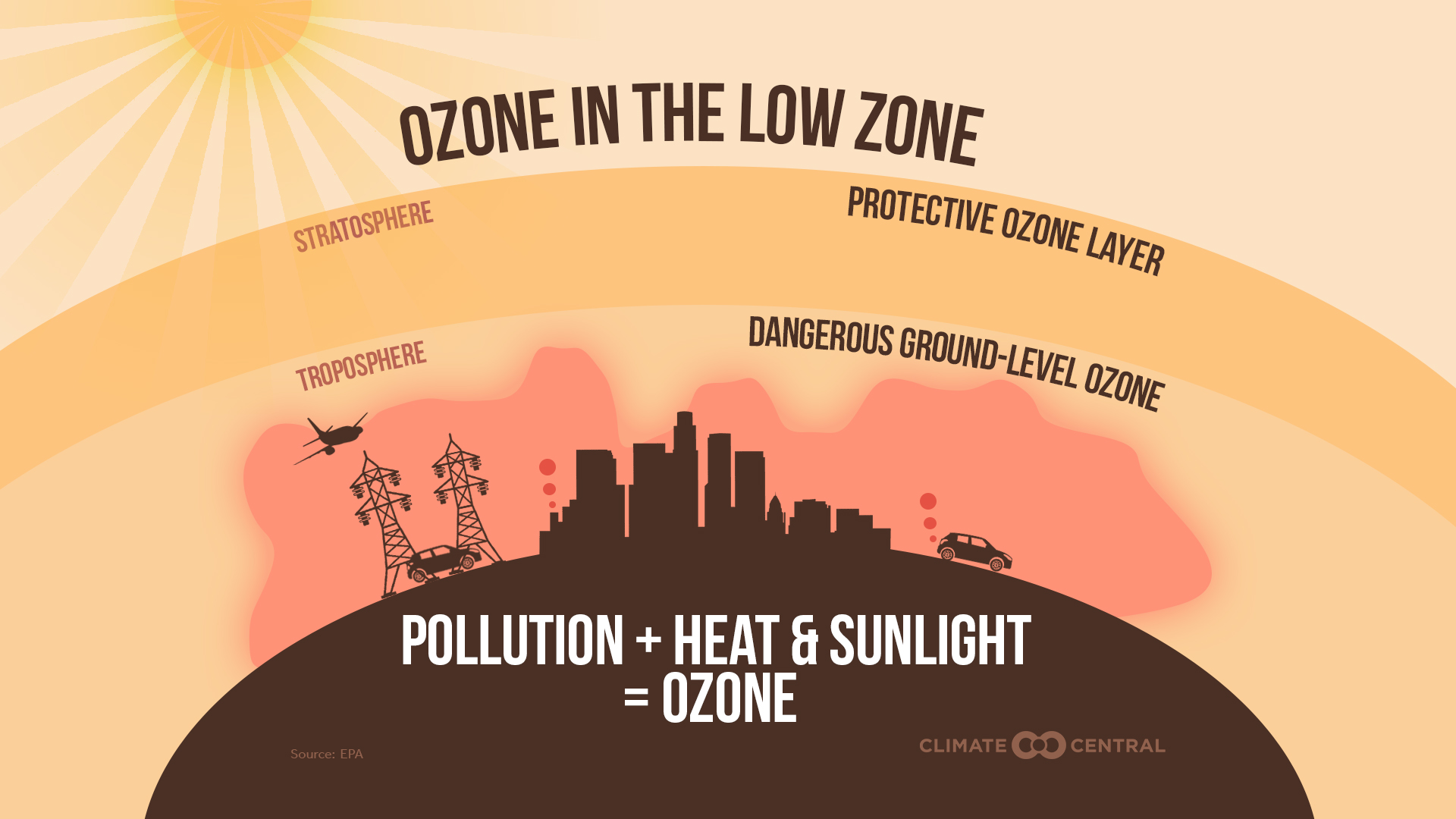
Roughly 15 to 35 kilometres above the Earth’s surface lies the stratosphere, and within it, a diffuse band of ozone molecules known as the ozone layer. Despite spanning such an enormous altitude range, the total amount of ozone is surprisingly thin — if you compressed it to sea-level pressure, it would be no thicker than 3 millimetres. Yet this slender shield is one of the most important features of the planet’s atmosphere.
The stratospheric ozone layer performs a single, vital function: it absorbs ultraviolet-B (UV-B) and UV-C radiation from the sun before it reaches the surface. UV-B radiation in particular is biologically destructive. It damages DNA strands, causes skin cancers and cataracts, suppresses immune responses in humans and animals, and disrupts photosynthesis in phytoplankton — the tiny marine organisms that form the base of aquatic food chains and produce a significant portion of Earth’s oxygen.
Without the ozone layer interceding, unfiltered UV-B would reach the surface at intensities that most complex life forms could not endure. The molecule’s reactivity, which makes it a nuisance at ground level, is precisely what qualifies it for this protective role. When UV radiation collides with an ozone molecule in the stratosphere, the molecule absorbs the energy and breaks apart — converting harmful radiation into heat. The resulting oxygen atoms and molecules then reform into ozone, and the cycle continues.
This absorption-and-reformation cycle is not perfect or infinite. Certain synthetic chemicals — particularly chlorofluorocarbons (CFCs), once widely used in refrigerants and aerosol sprays — interfere with it badly. When CFC molecules drift into the stratosphere and are broken down by UV light, they release chlorine atoms that catalytically destroy ozone in chains. A single chlorine atom can destroy tens of thousands of ozone molecules before it is deactivated.
The damage became visible in the 1980s when scientists discovered a growing hole in the ozone layer over Antarctica. The international response — the 1987 Montreal Protocol, which phased out ozone-depleting substances — is widely regarded as one of the most successful environmental agreements in history. The ozone layer is slowly recovering, though it will likely take decades more to return to pre-1980 levels.
Ozone at Ground Level: A Pollutant in Disguise
Now bring the same molecule down to the surface, and the story reverses completely.
Ground-level ozone, also called tropospheric ozone, is not emitted directly from any source. Instead, it is a secondary pollutant — meaning it is created through chemical reactions between other pollutants that are already in the air. The primary culprits are nitrogen oxides (NOₓ) and volatile organic compounds (VOCs), which are released by vehicle exhaust, industrial emissions, power plants, and even paints and solvents.
When these precursors bake under sunlight, particularly on hot, still summer days, they react to form ozone. This is why ground-level ozone tends to peak in the afternoon and spikes during heatwaves. It is the central ingredient in the brown, hazy smog that blankets many cities during warm months.
At this altitude, ozone’s reactive nature has no protective role to play. Instead, it attacks whatever biological tissue it touches. When inhaled, ozone irritates the airways, triggers inflammation, and damages the delicate cells lining the lungs. Even short exposures at elevated concentrations cause chest tightness, coughing, and shortness of breath. Prolonged or repeated exposure has been linked to the onset and worsening of asthma, reduced lung function, and increased hospital admissions for respiratory and cardiovascular conditions. Children, the elderly, people with pre-existing respiratory conditions, and outdoor workers face the greatest risk.
Ozone is also hard on ecosystems. It enters plant tissue through tiny pores called stomata, where it generates reactive molecules that damage cell membranes, impair photosynthesis, and reduce crop yields. Studies have found that ground-level ozone causes significant losses in staple crops like wheat, rice, soybean, and maize every year — a threat to food security that rarely makes headlines.
Why the Same Molecule Behaves So Differently
The contrast comes down to location and context, not chemistry. Ozone itself does not change; what changes is the environment it operates in and the biological systems it encounters.
In the stratosphere, ozone’s reactivity is harnessed at a safe distance from living tissue. It intercepts radiation before it can do harm and converts that energy into warmth. Its restlessness is channelled into protection.
At ground level, that same reactiveness has no buffer. It encounters lungs, leaf tissue, and sensitive ecosystems directly. The very quality that allows ozone to absorb UV radiation — its tendency to break down and react aggressively with whatever it meets — is the same quality that makes it an irritant and a hazard when mixed into the air at street level.
There is also a spatial irony worth noting: the two ozone problems are largely independent of each other. Ground-level ozone does not drift up to replenish the ozone layer, and stratospheric ozone does not filter down to help clean up urban smog. Each exists in its own atmospheric compartment, governed by its own chemistry and pressures.
In Summary: Context Is Everything
Ozone is neither a hero nor a villain — it is a molecule whose effects depend entirely on where you find it. High above the surface, it is an irreplaceable shield that makes complex life possible. Down in the air we breathe, it is a pollutant with real consequences for human health, agriculture, and biodiversity.
The lesson is one that environmental science keeps returning to: molecules do not have intentions, but their locations, concentrations, and interactions with living systems determine whether they sustain life or threaten it. In the case of ozone, the atmosphere hands us both possibilities at once.