Can solar storms disable all satellite navigation temporarily? A navigation system on Earth suddenly drifts off by hundreds of meters. A flight crew notices small inconsistencies in positioning data. A shipping vessel sees its route wobble slightly on digital maps. Nothing has physically moved—but something in space is interfering with the signals we rely on.
This is the kind of disruption that can happen during strong solar storms.
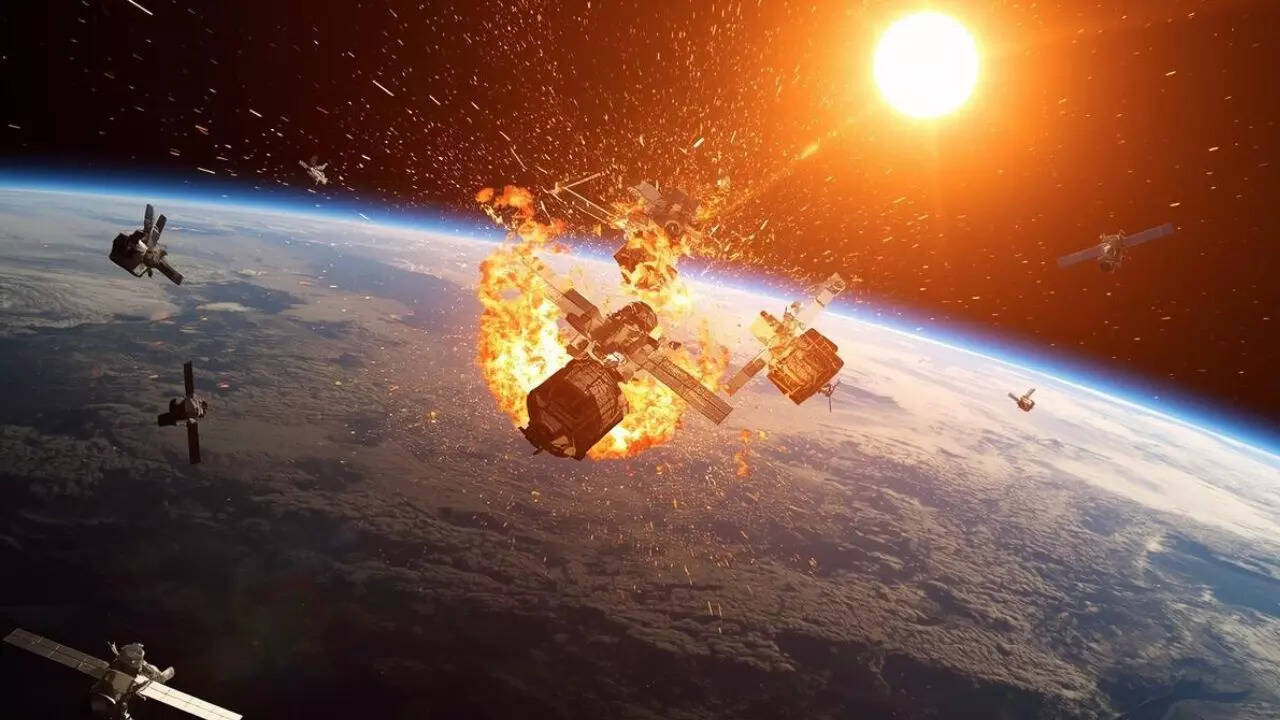
Yes, solar storms can temporarily degrade or even partially disrupt satellite navigation systems, but they do not usually “disable everything worldwide at once.” The impact depends on storm intensity, timing, and which part of Earth is facing the Sun at that moment.
To understand this properly, we need to look at what solar storms are doing to space, how navigation satellites work, and why Earth’s atmosphere becomes the weak link.
What solar storms actually are
Solar storms come from the Sun in the form of:
- Solar flares (sudden bursts of radiation)
- Coronal mass ejections (large clouds of charged particles)
When these reach Earth, they interact with our planet’s magnetic field and upper atmosphere.
This interaction is what causes space weather effects.
Why navigation satellites are vulnerable
Systems like GPS rely on a network of satellites orbiting Earth. These satellites continuously send timing and positioning signals to receivers on the ground.
A well-known example of a space-based navigation system is the Global Positioning System.
For navigation to be accurate, two things must remain stable:
- The satellite signals must travel through the atmosphere without distortion
- The timing of those signals must remain precise
Solar storms interfere with both.
The real problem: Earth’s upper atmosphere becomes unstable
The main disruption happens in a region called the ionosphere, part of Earth’s upper atmosphere filled with charged particles.
During solar storms:
- The ionosphere becomes highly energized
- Its density changes rapidly and unevenly
- Signal paths become distorted or delayed
Satellite signals passing through this region can:
- Slow down slightly
- Bend unpredictably
- Scatter or weaken
Even tiny errors in timing can translate into large positioning errors on the ground.
What happens to navigation during a strong solar storm?
The effects are usually gradual and uneven rather than total failure.
1. Reduced accuracy
Instead of pinpoint accuracy:
- Positioning may drift by several meters
- In severe cases, errors can grow larger
This matters for aviation, shipping, and precision agriculture.
2. Signal instability
Receivers may:
- Lose signal lock temporarily
- Switch between weaker satellites
- Show fluctuating accuracy readings
3. Regional impact
Solar storm effects are not uniform:
- The sunlit side of Earth is usually more affected
- Polar regions experience stronger disturbances
- Some areas remain relatively unaffected
So navigation systems rarely fail everywhere at once.
Can it completely disable satellite navigation?
In extreme cases, solar storms can cause widespread disruption, but “complete global shutdown” is unlikely.
Even during very strong events:
- Some satellites remain usable
- Alternative signals may still function
- Systems degrade rather than fully collapse
For example, aviation and maritime systems may switch to backup navigation methods when GPS accuracy becomes unreliable.
Dark Matter Satellites: Could We Map Invisible Mass in the Solar System? | Maya
Why Earth is not fully defenseless
Modern navigation systems are designed with resilience in mind.
1. Multiple satellite constellations
Besides GPS, there are other systems such as:
- Galileo (Europe)
- GLONASS (Russia)
- BeiDou (China)
Receivers often use multiple systems at once, so failure in one does not mean total loss.
2. Ground-based corrections
Correction networks help reduce atmospheric errors by:
- Measuring ionospheric changes
- Sending adjustment data to receivers
- Improving accuracy in real time
3. Inertial backup systems
Aircraft, ships, and spacecraft often have:
- Internal navigation systems
- Gyroscopes and accelerometers
- Dead-reckoning methods
These allow temporary navigation without satellite input.
Why solar storms affect signals so strongly
Satellite navigation depends on extremely precise timing. Signals travel at the speed of light, so even microsecond-level delays matter.
When the ionosphere becomes disturbed:
- Signal speed changes slightly
- Path length effectively increases or bends
- Timing errors accumulate
A small delay in space can become a large position error on the ground.
A real-world example of impact
During major solar storms:
- GPS accuracy can degrade significantly in polar flight routes
- High-frequency radio communication may also fail (often alongside navigation issues)
- Space missions like the International Space Station must adjust operations due to increased radiation and communication noise
These are typically temporary events lasting hours to a couple of days.
Why total failure is rare
For all satellite navigation systems to fail completely, several conditions would need to happen simultaneously:
- Extreme solar storm intensity
- Global ionospheric disruption
- Failure of multiple satellite constellations at once
- No backup systems available
This combination is highly unlikely.
Instead, what we usually see is:
- Degraded performance
- Temporary signal loss in some regions
- Increased error margins
A simple way to understand it
Think of satellite navigation like trying to hear music through water:
- On a calm day, the sound is clear
- During a storm, waves distort the sound
- You may miss parts of the music, but it does not stop completely everywhere
Solar storms are like space weather storms that ripple through the “water” of Earth’s ionosphere.
Final analysis
Solar storms can temporarily disrupt satellite navigation systems by disturbing the ionosphere, which distorts the signals traveling between satellites and receivers on Earth. This leads to reduced accuracy, occasional signal loss, and regional navigation errors.
However, complete global shutdown of all satellite navigation systems is extremely unlikely. Modern systems are built with redundancy, multiple satellite networks, and backup navigation methods that ensure continuous, if sometimes degraded, functionality.
In simple terms, solar storms can shake satellite navigation, but they rarely break it completely—they make it less precise rather than fully unusable.
Hidden Oceans in the Outer Solar System: Life Below the Ice of Europa and Enceladus | Maya