How the OpenAI Trial Exposed the Real AI Race- For years, the artificial intelligence industry sold the world a carefully crafted story. The most powerful minds in technology, we were told, were racing not for wealth or dominance, but for humanity’s future. Artificial general intelligence would transform civilization, and the companies building it claimed they were acting as responsible stewards of that future.
Then came the OpenAI trial.
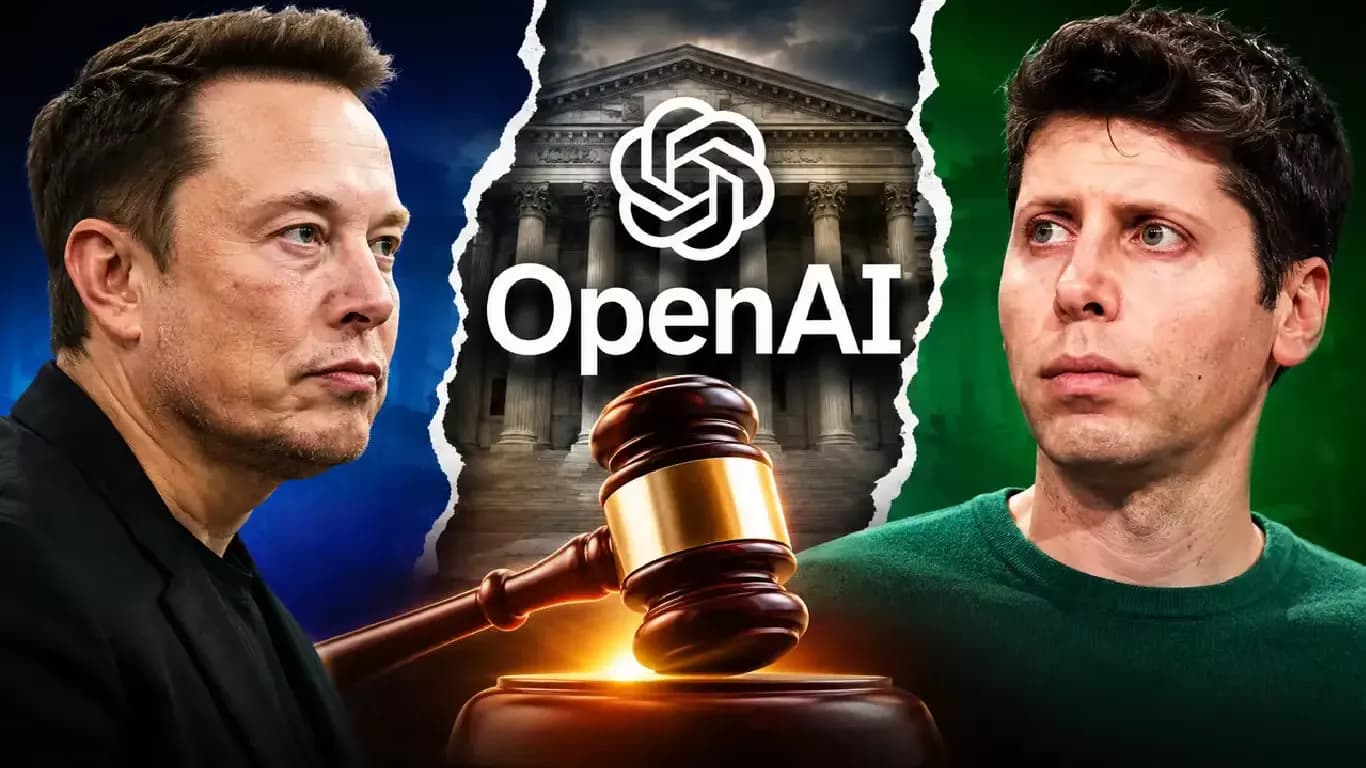
What began as a legal battle involving OpenAI, Elon Musk, Sam Altman, Microsoft, and questions about nonprofit governance quickly evolved into something much larger. The courtroom drama did not just expose disagreements over contracts or corporate restructuring. It revealed the uncomfortable truth behind the modern AI industry: the race for artificial intelligence is increasingly about power, control, influence, and survival.
The trial may have ended on procedural grounds, but the public saw something far more important than a verdict. It saw the inner workings of an industry that once positioned itself as morally different from traditional Big Tech, yet now appears consumed by many of the same instincts.
The Original Promise of AI Idealism
When OpenAI was founded in 2015, its mission sounded radically different from the Silicon Valley playbook. The organization was introduced as a nonprofit dedicated to ensuring that artificial general intelligence would benefit humanity rather than enrich a single corporation.
At the time, fears were growing around the concentration of AI talent and computing power inside major technology companies. OpenAI’s founders framed the organization as a counterweight to monopolistic control, particularly against the growing dominance of Google DeepMind.
The message resonated because it tapped into something larger than technology. AI was not presented as just another software industry. It was framed as a civilization-level transformation requiring ethical responsibility and restraint.
That vision attracted researchers, investors, and public admiration.
But as the trial revealed, maintaining idealism becomes significantly harder once billions of dollars, geopolitical stakes, and market leadership enter the picture.
The Trial Exposed the Human Side of AI Power
One of the most revealing aspects of the trial was not the legal arguments themselves, but the internal communications that surfaced.
Documents and testimony painted a picture of leaders struggling over influence, governance, and authority almost from the beginning. OpenAI executives reportedly worried that Elon Musk could become overly dominant within the organization. Internal messages reflected fears about concentrated control even while the organization publicly warned the world about the dangers of concentrated AI power.
The irony was difficult to ignore.
At the same time, text messages involving Sam Altman during his dramatic 2023 ouster showed another side of the industry: the intense fragility of leadership inside frontier AI companies. The CEO of one of the world’s most influential technology organizations was suddenly locked out of meetings, negotiating for information, and fighting for reinstatement in real time.
For the public, these revelations shattered the image of calm, carefully managed stewardship. Instead, the AI industry started to resemble every other high-stakes power struggle in Silicon Valley history — only with much larger consequences.
The Real AI Race Is About Infrastructure
The trial also highlighted a deeper reality that often gets ignored in public conversations about AI ethics.
Modern artificial intelligence is extraordinarily expensive.
Training frontier models requires massive computational infrastructure, elite research talent, global data pipelines, and billions in investment. This creates a structural dependency on large corporate partnerships and aggressive monetization strategies.
That is why OpenAI’s relationship with Microsoft became such a central issue in the case. Musk argued that OpenAI abandoned its nonprofit mission by accepting enormous commercial backing and building a for-profit structure around its technology.
Supporters of OpenAI counter that scaling advanced AI systems would have been impossible without commercial funding.
Both arguments contain truth.
The uncomfortable reality is that the companies building advanced AI cannot simultaneously remain small idealistic nonprofits and compete in a global technological arms race. The infrastructure demands are simply too large.
As a result, the race increasingly favors organizations with access to:
- massive cloud computing,
- global capital,
- strategic partnerships,
- and political influence.
That shifts AI away from an open scientific ecosystem and toward something resembling digital infrastructure controlled by a handful of dominant players.
From “Saving Humanity” to Competing for Dominance
Perhaps the most damaging outcome of the trial was not legal or financial. It was reputational.
For years, AI companies differentiated themselves by emphasizing safety, ethics, and responsibility. Their leaders often spoke about existential risks, alignment, and protecting humanity from dangerous outcomes.
But the courtroom narrative exposed another side entirely:
- executives maneuvering for control,
- billion-dollar partnerships,
- merger discussions,
- leadership purges,
- and internal distrust.
To critics, the contrast was stark.
The industry that warned humanity about concentrated AI power now appears increasingly concentrated itself. The organizations that once criticized closed ecosystems now fiercely protect proprietary models, infrastructure, and data advantages.
This contradiction is fueling public skepticism.
People are beginning to ask whether the language of “AI safety” sometimes functions not only as a genuine concern, but also as a strategic tool — one that can justify tighter control over models, computing resources, and market access.
That does not mean AI risks are fake. Many researchers sincerely believe advanced AI systems could create profound societal challenges. But the trial showed that idealism and institutional self-interest are now deeply intertwined.
The Crisis of Public Trust
The AI industry faces a growing trust problem.
Public confidence in artificial intelligence has weakened significantly as concerns grow around misinformation, job displacement, surveillance, copyright disputes, and concentrated corporate influence.
The OpenAI trial intensified those concerns because it transformed abstract fears into visible human conflict.
People no longer saw AI leaders as distant intellectual visionaries discussing the future of civilization. They saw executives battling over governance structures, influence, and billions of dollars in strategic advantage.
That shift matters.
Technology industries depend heavily on public legitimacy. Social media companies once promised global connection before becoming associated with polarization, manipulation, and data exploitation. Critics now fear AI may follow a similar trajectory: beginning with utopian promises before consolidating into systems optimized primarily for scale and profit.
The trial reinforced that fear.
Why Sam Altman Emerged Stronger
Despite the controversy, Sam Altman arguably emerged from the trial in a stronger position than Elon Musk.
Had Musk succeeded, OpenAI could have faced major restructuring pressure and potentially another leadership crisis. Instead, the organization can continue expanding with fewer immediate legal obstacles.
OpenAI remains one of the central players in the global AI race, and its partnerships, infrastructure, and product ecosystem continue to grow rapidly.
Meanwhile, Musk has launched his own AI ambitions through xAI, creating an even more direct rivalry between former allies.
This is another revealing aspect of the modern AI landscape: nearly every major figure warning about the dangers of concentrated AI power is also competing to build dominant AI systems themselves.
That contradiction sits at the heart of the entire industry.
The Bigger Question the Trial Could Not Answer
In the end, the lawsuit did not resolve the most important issue.
Who should control transformative artificial intelligence?
Should advanced AI systems operate like public infrastructure? Should they remain corporate property? Can nonprofit ideals survive inside trillion-dollar markets? Is open-source AI safer or more dangerous? Should governments regulate frontier models like nuclear technology, or should innovation remain largely market-driven?
The courtroom could not answer these questions because society itself has not answered them yet.
But the trial succeeded in doing something else: it stripped away much of the mythology surrounding the AI race.
Behind the language of saving humanity lies a competition shaped by the same forces that drive every major technological revolution — ambition, rivalry, money, influence, and fear of losing control.
The Future of AI May Depend on Governance, Not Technology
The most important lesson from the OpenAI trial is that the future of AI will likely depend less on whether the technology becomes powerful and more on who governs that power responsibly.
Artificial intelligence is no longer just a scientific project. It is becoming geopolitical infrastructure, economic leverage, and social architecture all at once.
That means the real AI race is not simply about building the smartest model.
It is about deciding:
- who owns intelligence,
- who benefits from it,
- who regulates it,
- and who gets excluded from it.
The OpenAI trial exposed that reality to the public in a way few events have before.
And while the legal case may be over, the struggle it revealed is only beginning. Apple’s Reported AirPods With Cameras Move Closer to Reality, Hint at New AI Wearables Era | Maya