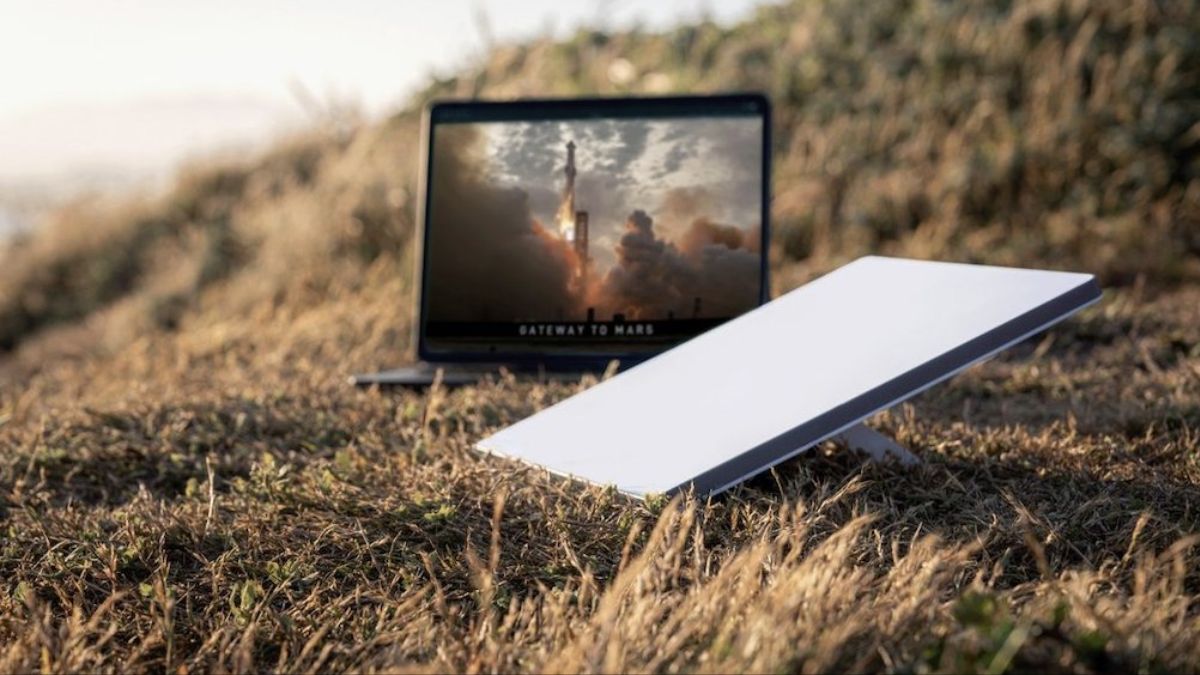
This Tiny Starlink Leak Could Change Internet on the Go Forever- A recent firmware analysis suggests that SpaceX may be working on a new version of the Starlink Mini that could include a built-in battery. If accurate, this would turn the device into a fully portable satellite internet system that does not depend entirely on external power banks or wall outlets.
The findings come from hidden software strings that reference internal battery tracking and multiple power configurations. While SpaceX has not officially confirmed anything, the technical clues strongly point toward ongoing development of a more self-contained design.
What the leak appears to show
Based on the firmware references, the upgraded version may introduce several new capabilities:
- Integrated battery system
- The software includes references to battery monitoring functions
- Mentions of charge level tracking suggest native hardware support rather than external add-ons
- Likely designed to show real-time battery status within the official app
- Flexible power operation modes
- USB-C direct power for continuous use
- Independent battery mode for wireless operation
- Combined mode where external power supports usage while preserving battery life
- Smarter energy management
- Indicators of pass-through charging support
- Potential optimization to reduce long-term battery degradation
- Better coordination between hardware and software power handling
- App-level integration
- Battery percentage and charging state could appear directly in the Starlink application
- More detailed diagnostics for power usage and health monitoring
Expected specifications (inferred estimates)
Although no official hardware details are available, the likely configuration can be estimated based on design constraints and current product trends:
- Battery capacity: approximately 99Wh, aligning with airline carry-on limits
- Estimated runtime: roughly 4 to 6 hours depending on network load and conditions
- Charging: USB-C based input, likely supporting fast charging standards
- Design impact: slightly thicker chassis compared to the current model to accommodate battery hardware
- Weight: moderate increase compared to the existing portable dish
Connectivity performance and coverage
Even with a built-in battery, the device would still rely on SpaceX’s satellite infrastructure:
- Network system: SpaceX Starlink constellation
- Satellite orbit: low Earth orbit, roughly 550 km altitude
- Typical latency: about 20 to 40 milliseconds under good conditions
- Download speeds: generally in the range of 50 to 150 Mbps depending on location and congestion
- Upload speeds: commonly around 10 to 20 Mbps
Coverage capability
Because it connects directly to satellites rather than ground towers, the system is effectively global:
- Usable in remote regions such as mountains, deserts, oceans, and rural zones
- Requires a clear line of sight to the sky for stable performance
- Independent of mobile networks or local broadband infrastructure
Why this matters
A built-in battery would significantly change how portable satellite internet is used. Instead of requiring external power solutions, the device could operate as a standalone connectivity unit.
Potential applications include:
- Mobile work setups in vehicles or remote locations
- Emergency communication during disasters or outages
- Field reporting and remote journalism
- Rural and off-grid connectivity solutions
- Outdoor content creation and streaming
What remains uncertain
At this stage, the feature is not confirmed by SpaceX. The evidence comes only from firmware-level references, which means:
- The design may still be in early development
- Features could change before any public release
- The concept may be tested internally without a consumer launch
Closing thoughts
If these software clues reflect real hardware plans, the next iteration of the Starlink Mini could become a major step toward fully portable satellite internet. By integrating power and connectivity into a single device, it would reduce dependence on external equipment and make high-speed internet access far more flexible in remote environments. Google’s New Gemini Compute Limits Spark User Backlash Over Rapid Usage Caps | Maya
Jeff Bezos Warns AI Could Trigger Labor Shortages and Deflation | Maya