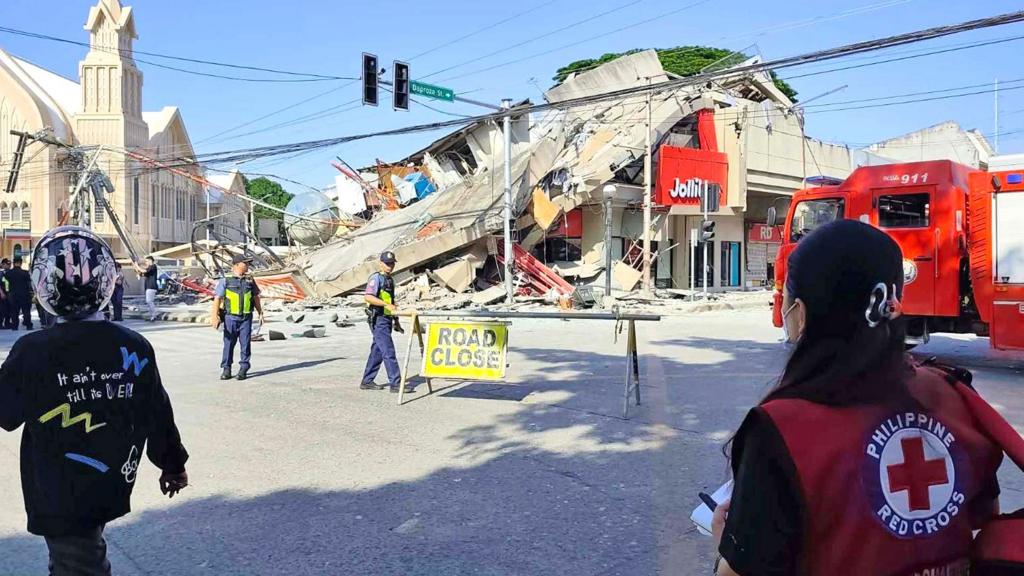
Powerful Earthquake Strikes Philippines, Leaving at Least 15 Dead- A powerful earthquake measuring 7.8 in magnitude struck off the coast of the southern Philippine island of Mindanao on Monday morning, killing at least 15 people, damaging infrastructure, and prompting tsunami warnings across parts of Asia before the threat gradually subsided.
The quake hit shortly before 7:40 a.m. local time, sending strong tremors across large areas of the southern Philippines and causing panic among residents who rushed out of homes, schools, offices, and commercial buildings in search of safety. According to seismic monitoring agencies, the earthquake originated offshore near Mindanao and was followed by a series of aftershocks that continued for more than an hour.
Authorities reported that the strongest impact was felt in General Santos City, a major urban center in southern Mindanao with a population of more than 700,000 people. Several buildings suffered structural damage, roads were cracked, and power interruptions were reported in parts of the city and surrounding areas.
Emergency response teams were quickly deployed to assess the extent of the destruction and assist affected communities. Rescue workers searched damaged buildings while local officials worked to account for residents in the hardest-hit areas. Hospitals treated people injured by falling debris, collapsing walls, and other quake-related incidents.
Initial reports indicate that at least 15 people lost their lives as a result of the earthquake, though officials cautioned that the death toll could rise as rescue and assessment operations continue. Many of the fatalities were linked to building collapses and falling structures during the strongest shaking.
The earthquake also triggered widespread concern over the possibility of a tsunami. Authorities in the Philippines and neighboring countries issued precautionary warnings shortly after the quake was detected. Coastal residents in vulnerable areas were advised to move to higher ground while emergency agencies monitored sea-level activity.
For several hours, officials tracked potential tsunami waves and urged the public to remain vigilant. However, as additional data became available, authorities gradually lifted or downgraded warnings, indicating that the immediate tsunami threat had largely receded. Even so, disaster management agencies continued to advise residents to stay away from coastlines until final safety assessments were completed.
Witnesses described scenes of confusion and fear as the ground shook violently. Residents reported furniture being thrown across rooms, windows shattering, and people struggling to maintain their balance during the strongest tremors. Many families gathered in open spaces after the quake, concerned about aftershocks and the possibility of further damage.
The Philippine Institute of Volcanology and Seismology (PHIVOLCS) confirmed that numerous aftershocks followed the main earthquake, a common occurrence after major seismic events. Experts warned that some aftershocks could still be strong enough to cause additional damage to weakened structures.
The Philippines is one of the world’s most earthquake-prone countries due to its location along the Pacific Ring of Fire, a region characterized by frequent seismic and volcanic activity. The country experiences thousands of earthquakes every year, although only a small percentage cause significant destruction.
Seismologists noted that offshore earthquakes of this magnitude have the potential to generate tsunamis and cause widespread structural damage, particularly in densely populated coastal regions. While the full scale of the disaster remains under assessment, experts emphasized the importance of preparedness and rapid emergency response in minimizing casualties.
Government agencies have begun coordinating relief efforts, including the delivery of emergency supplies, temporary shelters, medical assistance, and infrastructure inspections. Local authorities are also evaluating schools, hospitals, bridges, and public buildings to determine whether they remain safe for use.
As rescue operations continue and damage assessments expand across affected areas, officials are urging residents to remain alert for aftershocks and follow instructions from emergency services. The coming days are expected to provide a clearer picture of the earthquake’s overall impact on communities across Mindanao and neighboring regions.
The disaster serves as a reminder of the Philippines’ ongoing vulnerability to major natural hazards and the challenges faced by authorities in protecting millions of people living in earthquake-prone areas.