What Happens If Countries Fight Over Lunar Resources?
The Moon was once a symbol — proof of what humanity could achieve when it dared to look up. It is rapidly becoming something else: the most strategically valuable piece of real estate in the solar system, and nobody has agreed on who owns it.
A new race to the Moon is underway, and this one is not about planting flags for prestige. It is about water, fuel, rare isotopes, and the economic and military advantages that will accrue to whoever gets there first, builds first, and — crucially — controls access. The United States, China, Russia, India, Japan, and a growing constellation of private companies are all competing for resources concentrated in one of the most geographically limited regions off Earth: the permanently shadowed craters of the lunar south pole.
The legal architecture governing what happens when they arrive is, to put it diplomatically, not ready.
What Everyone Is Actually Racing For
Understanding the stakes requires understanding the resources themselves, because this is not abstract competition — it is a scramble for specific materials with specific strategic value.
Water ice is the first and most immediate prize. Trapped in permanently shadowed polar craters that have not seen sunlight in billions of years, lunar water ice can be split into hydrogen and oxygen — the two components of rocket fuel. A Moon with reliable water access becomes a cosmic refuelling station: rather than launching all the propellant needed for deep-space missions from Earth’s gravity well at enormous cost, spacecraft could fuel up in lunar orbit. Whoever controls water ice at the south pole controls a critical logistical chokepoint for the entire future of space exploration.
Helium-3 is the longer-range prize, but one that is already attracting serious money. This rare isotope — scarce on Earth, relatively abundant in lunar regolith — is a potentially transformative fuel for nuclear fusion reactors. In September 2025, Helsinki-based cryogenics firm Bluefors signed a deal with the US startup Interlune to purchase up to 1,000 liters of lunar helium-3 annually, in an agreement worth approximately $300 million. The same month, the US Department of Energy made the first-ever government purchase of an extraterrestrial resource — three liters of lunar helium-3 — to seed an early supply chain. These are not theoretical gestures; they are market signals.
A single ton of helium-3 could theoretically power a major city. Estimates suggest the Moon holds around a million tons. If fusion technology matures, whoever controls lunar helium-3 extraction holds leverage over the future of clean energy on Earth — leverage of a kind that would make the 20th century’s oil geopolitics look modest by comparison.
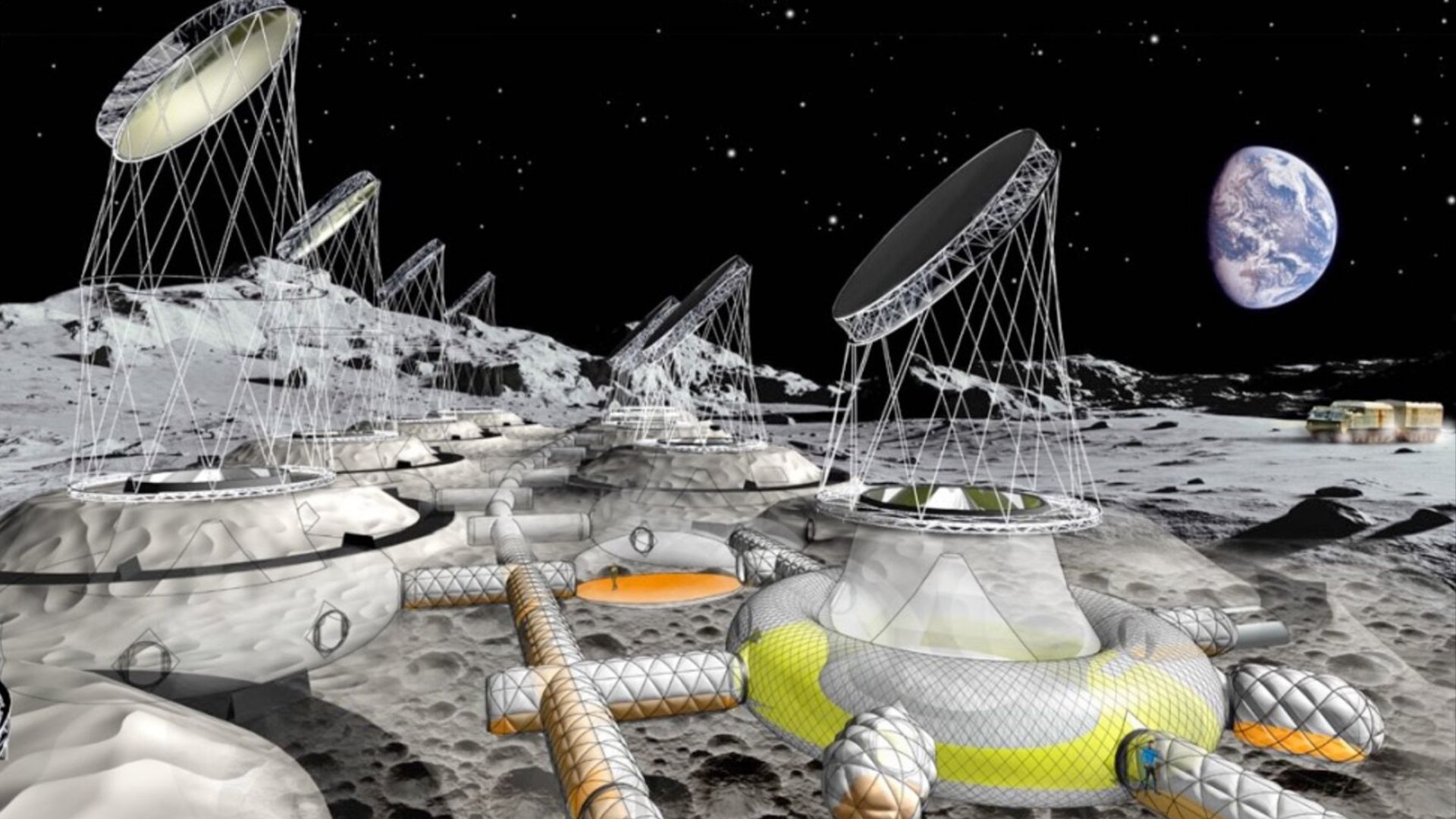
Beyond water and helium-3, the Moon’s surface contains platinum-group metals, titanium, uranium, and rare earth elements critical to advanced technology manufacturing. The Moon is, in short, the most resource-dense territory humanity has ever had within reach — and the south pole is where the most valuable deposits are concentrated, in a region small enough that competing installations could sit within line of sight of each other.
The Legal Vacuum at the Heart of the Race
Here is the central problem: the international legal framework governing lunar resources was written in a different era, by people who could not have imagined the present situation — and it is, in critical respects, broken.
The foundational document is the 1967 Outer Space Treaty (OST), which declares that no nation may claim sovereignty over the Moon or any other celestial body. Space is the “province of all mankind.” The treaty has been signed by all major spacefaring nations and remains in force. But it was written when only governments had rockets, and it did not contemplate commercial resource extraction. Does mining water ice constitute “national appropriation”? The treaty does not say.
A follow-up agreement, the 1979 Moon Agreement, tried to address exactly this gap by designating lunar resources as the “common heritage of mankind” and proposing an international body to govern their exploitation — essentially the model later used for deep-seabed mining under the Law of the Sea. It was a reasonable idea. It received fifteen ratifications, none from any spacefaring power. The United States, Russia, China, and every other nation with a serious space programme refused to sign, viewing it as a restriction on their technological advantage.
The vacuum left by the Moon Agreement’s failure has since been filled, incompletely, by competing national and bilateral frameworks. The US Commercial Space Launch Competitiveness Act of 2015 granted American citizens rights to extract and sell space resources. Luxembourg, the UAE, and Japan subsequently passed similar domestic legislation. None of these laws claim sovereignty over the Moon — they are careful on that point — but they do assert property rights over extracted materials, a distinction legal scholars continue to debate.
In 2020, the United States launched the Artemis Accords: a set of non-binding principles for lunar activity covering transparency, safety zones, interoperability, and data sharing. By early 2026, 61 countries had signed. The Accords are genuinely useful — but their limitations are as significant as their content. They are not a treaty. They are not binding. And, critically, China and Russia have not signed them, dismissing the framework as US-dominated. Both countries are instead developing their own parallel architecture through the International Lunar Research Station (ILRS) initiative, targeting a joint robotic base at the south pole by 2035 and human landings by 2030.
The result is a lunar governance landscape divided into two competing blocs — each with its own norms, its own safety-zone definitions, and its own answer to the question of who gets to go where.
What a Conflict Could Actually Look Like
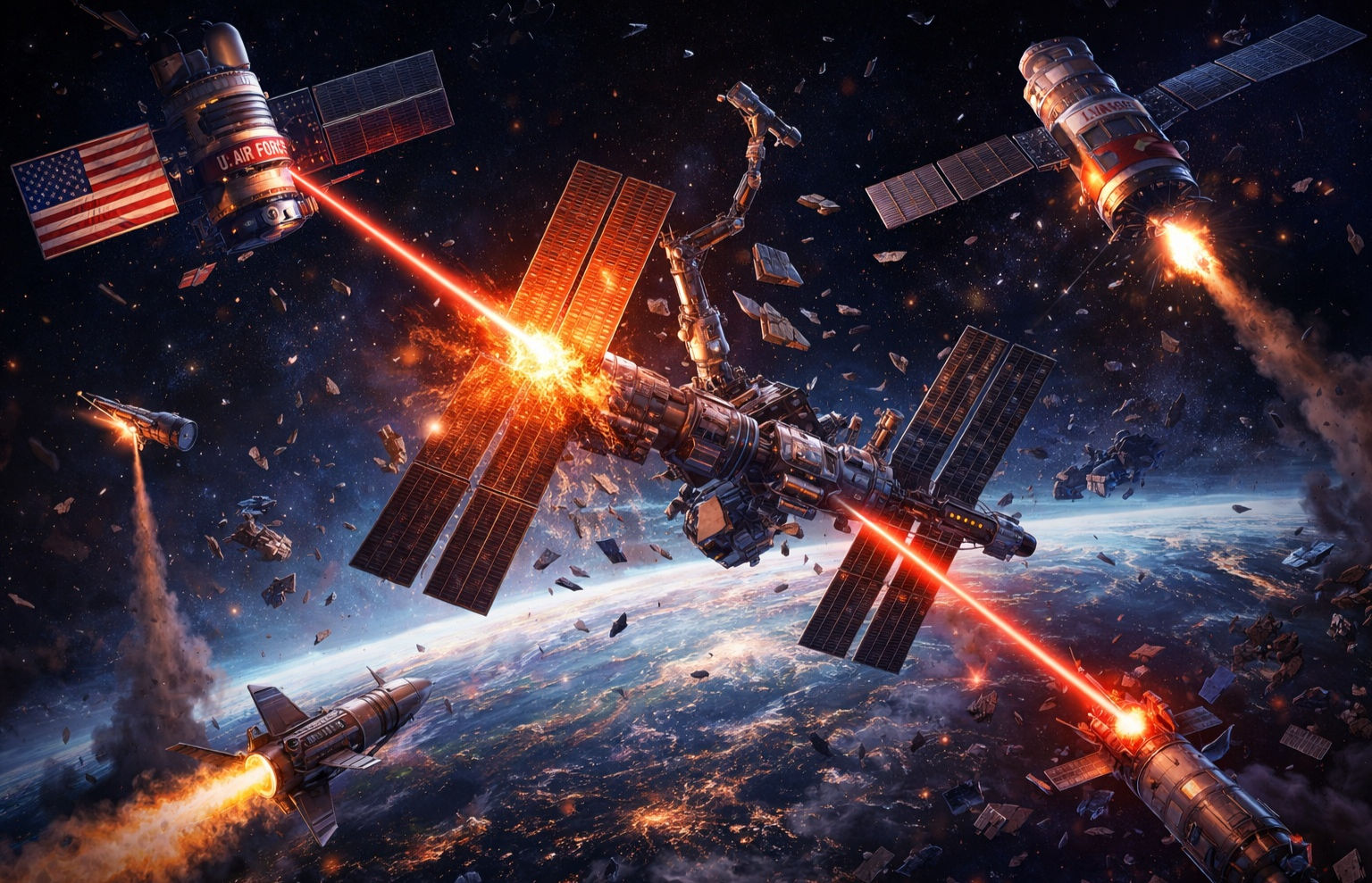
No serious analyst is predicting gun battles on the lunar surface. But the spectrum of conflict short of direct military confrontation is wide — and several scenarios are already taking visible shape.
The safety zone dispute is perhaps the most immediate flashpoint. The Artemis Accords establish the principle that operators can designate “safety zones” around their infrastructure, within which other actors agree not to interfere. This is reasonable — you do not want someone else’s rover driving through your construction site. But safety zones can expand. A large installation with sprawling surface operations could effectively claim exclusive control of a crater and its water ice deposits without ever asserting “sovereignty.” The line between operational safety and territorial exclusion is not clearly drawn, and no independent body currently has the authority to adjudicate it.
Orbital and communications interference provides another flashpoint below the threshold of direct conflict. Lunar orbit is not infinite. Communications frequencies, orbital slots for relay satellites, and the limited bandwidth of deep-space communication links are all finite resources subject to competing claims. The 2027 World Radio Communication Conference has already placed lunar spectrum allocation — covering over 80% of its agenda — at the centre of its agenda, a sign of how quickly the technical competition is escalating.
Economic exclusion may prove the most consequential slow-burn conflict. If one power establishes a dominant position at the south pole early — securing the best crater, building the largest water-extraction operation, establishing the primary refuelling depot — it acquires structural leverage over every subsequent actor. Nations and companies arriving later may find the choicest real estate already occupied, with no legal mechanism to challenge the occupation. This is, as some analysts have noted, the space-age equivalent of colonial land seizure, playing out in ultra-slow motion, in a jurisdiction with no courts.
The Two Blocs and the Gap Between Them
The clearest structural risk in the current situation is the hardening division between the US-led Artemis bloc and the China-Russia ILRS initiative. Both are targeting the same lunar south pole. Both are developing safety-zone concepts under incompatible legal frameworks. Both are accelerating their timelines.
Acting NASA administrator Sean Duffy recently framed the competition in openly adversarial terms, vowing the United States would beat China to the south pole and stating flatly that he would be “damned” if China arrived first. China has responded in kind, with its Chang’e missions systematically mapping helium-3 concentrations and its Long March 10 rocket and Lanyue lander undergoing key tests in preparation for crewed missions. China’s state nuclear corporation has explicitly identified helium-3 as an “ideal fuel” and is treating the Chang’e programme as foundational to a future energy strategy.
A Cambridge University study published in 2025 concluded that both powers are independently developing legal and operational frameworks with a “glaring lack of coordination,” and warned that this disjointed approach risks “escalating conflicts and undermining the overarching goal of peaceful and sustainable lunar exploration.” The concern is not merely academic: two large, incompatible installations operating in the same limited geographic area under irreconcilable governance assumptions is a recipe for incident.
Is There a Path to Cooperation?
The historical precedent that comes up most frequently in discussions of lunar governance is the Law of the Sea, which took decades of negotiation but ultimately produced a workable international framework for managing disputed ocean resources. The RAND Corporation and several international law scholars have proposed adapting elements of that model — including an international licensing body, benefit-sharing protocols, and binding arbitration — to the lunar context.
The Artemis Accords already contain some of these elements in embryonic form. Their data-sharing provisions, safety-zone principles, and transparency commitments could, in theory, form the foundation of a more comprehensive regime — if the major non-signatory powers could be brought in. That is a very large if. China and Russia have shown no appetite for joining a framework they perceive as having been designed to encode American advantages.
The narrow window for agreement may be closing. Once permanent installations exist, resource extraction is underway, and economic interests have been established on the surface, the political economy of negotiation shifts dramatically. Every year of continued legal ambiguity is a year in which facts on the ground — or rather, on the regolith — accumulate, making later agreement harder.
The Stakes Below the Surface
What makes this more than an abstract geopolitical chess match is what the resources actually represent. Water ice at the lunar south pole is not just water — it is the strategic key to the entire cislunar economy and beyond, determining who can reach Mars, who can sustain deep-space infrastructure, and who pays what for access to the solar system. Helium-3, if fusion energy matures, is potentially the most valuable energy resource in human history.
The Cold War, as one analyst has observed, stayed cold partly because nuclear weapons made direct conflict unthinkable. The lunar competition may follow a similar logic — too costly to fight directly, too valuable to ignore. But the Cold War also had decades of arms control negotiations, hotlines, and confidence-building measures. For the new space race, those mechanisms do not yet exist.
The Moon waited four billion years for humanity to arrive. The window for humanity to agree on rules before that arrival sparks conflict is measured, at this point, in years.
Is the Election Commission the Key to Fair Elections?Discover How It All Began! | Maya