
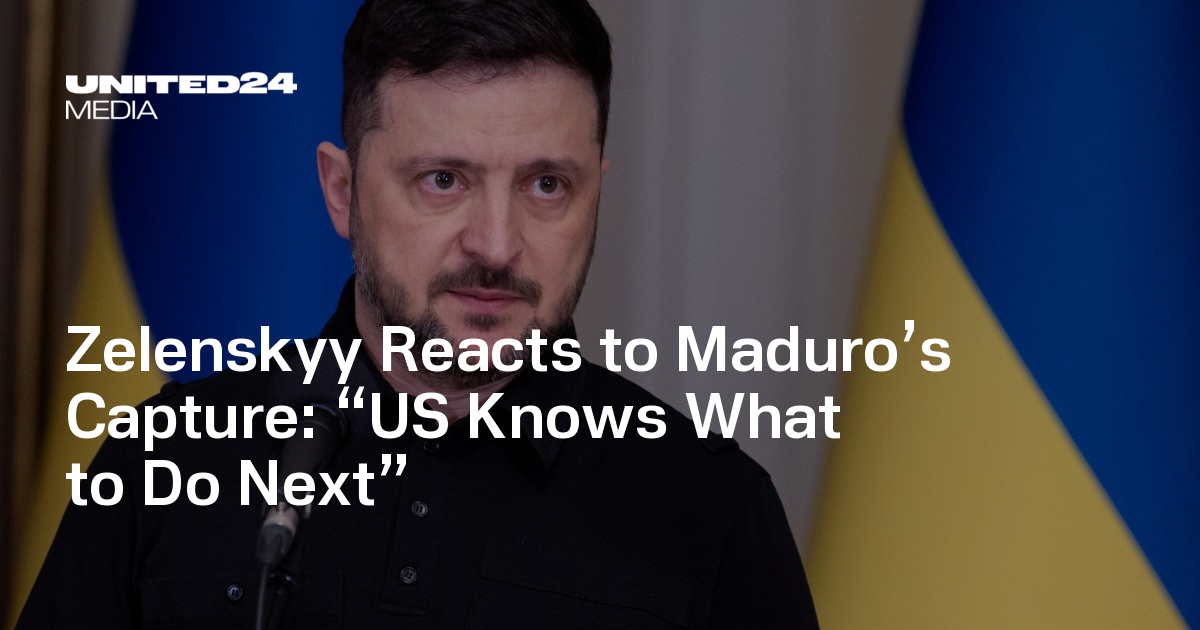
After Maduro, Putin? Zelenskyy’s Cryptic Message to the West
A single sentence from Ukrainian President Volodymyr Zelenskyy has sparked a global debate far bigger than its length. Following reports that U.S. forces captured Venezuelan leader Nicolás Maduro, Zelenskyy remarked that if dictators can be dealt with in this way, then the United States “knows what to do next.” He did not name anyone. Yet the message echoed loudly across Europe, Washington, and especially Moscow.
At a time when words from Kyiv are weighed as carefully as battlefield movements, Zelenskyy’s comment landed as more than a reaction to events in Latin America. It was a calculated piece of political signaling, shaped by years of war, stalled diplomacy, and frustration with the limits of international accountability.
A Shock That Reached Beyond Venezuela
The reported capture of Maduro itself marked a dramatic rupture with long-standing global norms. Rarely, if ever, has a sitting head of state been seized so directly by another power and taken abroad to face charges. The action immediately raised questions about sovereignty, legality, and precedent. For some, it represented overdue accountability for an authoritarian leader. For others, it crossed a dangerous line that could destabilize the international system.
Into this tense moment stepped Zelenskyy, whose country has lived under the consequences of an unpunished invasion for years. Ukraine has consistently argued that Russia’s leadership has avoided real consequences despite clear violations of international law. Against that backdrop, his remark sounded less like commentary on Venezuela and more like a reflection on global double standards.
Reading Between the Lines
Zelenskyy’s strength as a communicator lies in implication rather than explicit threats. By avoiding names, he allowed his audience to draw its own conclusions. Many observers understood the comment as an indirect reference to Vladimir Putin, whose war against Ukraine has reshaped European security and tested Western unity.
The message can be read on several levels at once. To Western allies, it was a reminder that decisive action is possible when there is political will. To global audiences, it raised uncomfortable questions about why some leaders face consequences while others remain shielded by power, influence, or nuclear deterrence. And to Moscow, it served as a psychological nudge—suggesting that even seemingly immovable rulers are not beyond the reach of history.
Symbolism, Not Strategy
It is important to separate rhetoric from reality. Zelenskyy was not proposing a military operation against Russia’s president, nor was he suggesting that Venezuela and Russia are comparable cases. Rather, his words functioned as symbolism—an attempt to reshape the moral narrative of the war in Ukraine.
For Kyiv, the conflict has never been only about territory. It is also about the principle that aggression should carry consequences. Zelenskyy’s comment fit neatly into this broader argument: if the world can act decisively in one case, why does it hesitate in another?
A Divided Global Reaction
Reactions to the statement reflected existing fault lines. Supporters of Ukraine praised Zelenskyy’s clarity and boldness, seeing the remark as a justified expression of frustration. Critics accused him of escalating rhetoric and undermining international stability. Others viewed it simply as a shrewd political move—one that keeps Ukraine at the center of global attention while reinforcing its call for stronger Western resolve.
Regardless of interpretation, the comment succeeded in its most basic goal: it reignited discussion about accountability, power, and the future rules of global order.
The Reality Check
Yet even as the phrase “After Maduro, Putin?” circulates in headlines and commentary, a crucial distinction remains. Russia is not Venezuela. Putin commands a nuclear-armed state, a permanent seat on the UN Security Council, and deep influence across global systems. Any comparison, while rhetorically powerful, breaks down when confronted with geopolitical reality.
Zelenskyy likely understands this better than anyone. His words were not a blueprint, but a provocation—meant to challenge assumptions, expose inconsistencies, and remind the world that impunity is a choice, not a law of nature.
The statement was brief, but its implications were vast. It underscored Ukraine’s ongoing struggle not only on the battlefield, but in the arena of global conscience. And it left one final, sobering truth hanging in the air:
Putin is not Maduro.
The World’s Largest Oil Treasure and the Geopolitical Crisis in Venezuela | Maya


Signed up for 50betlogin. The login process was straightforward, and the website is easy to navigate. Time to put my bets in. You should check them out here 50betlogin