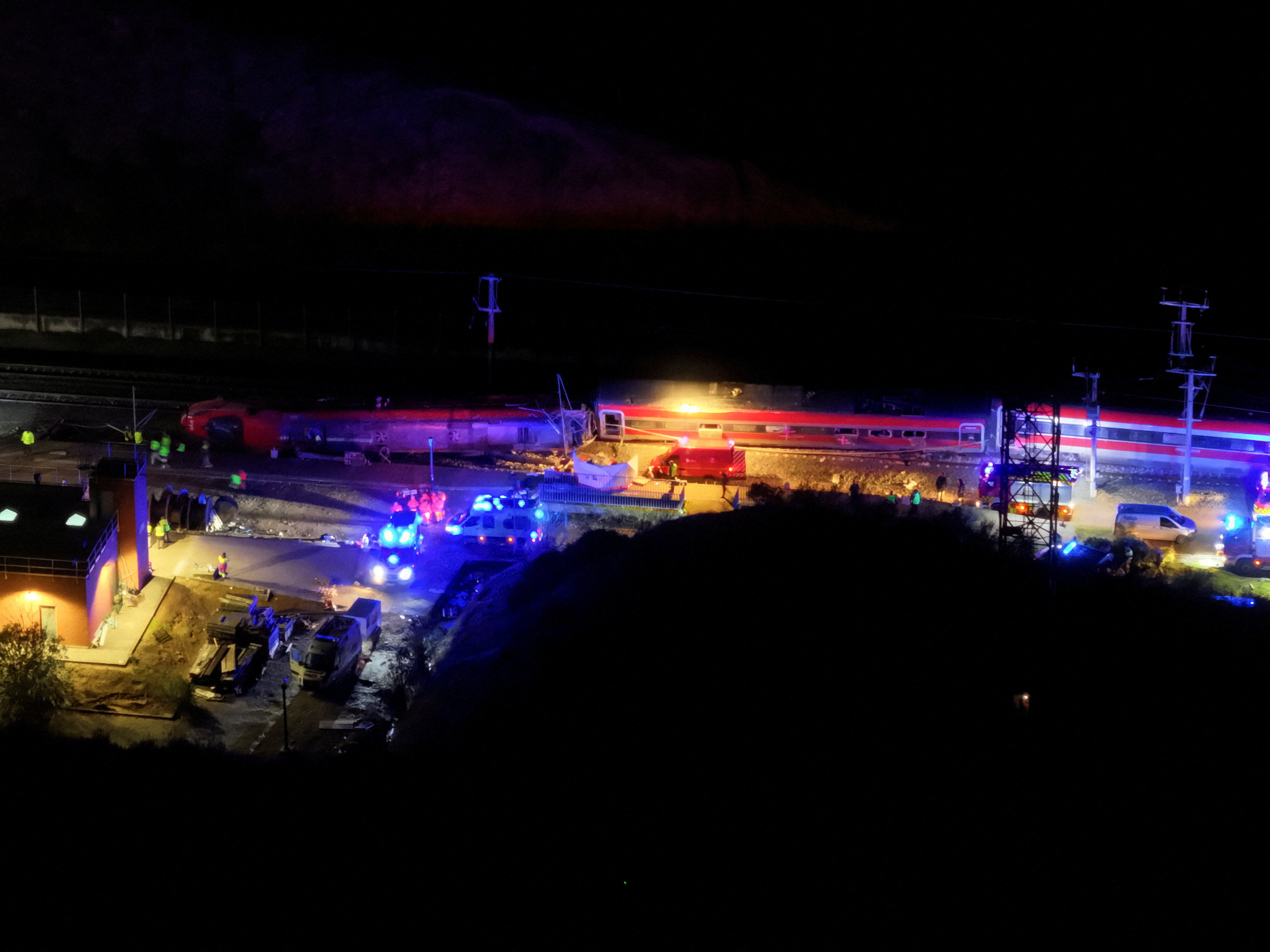
Deadly High-Speed Train Collision Kills 39 in Southern Spain- A devastating collision between two high-speed trains on Spain’s busy Madrid–Andalusia rail corridor has left at least 39 people dead and dozens injured, marking the country’s deadliest railway disaster in more than a decade.
The crash occurred late Sunday evening at approximately 7:45 p.m. local time in the southern province of Córdoba, near the town of Adamuz. Emergency responders rushed to the scene as mangled train cars lay scattered across the tracks and down a nearby embankment, while survivors were evacuated amid scenes of chaos and confusion.
According to preliminary reports, the incident began when a privately operated high-speed train traveling north from Málaga to Madrid derailed while passing through the area. Several of its rear carriages reportedly broke free and slid onto the opposite track, creating a catastrophic obstruction. Moments later, an oncoming Renfe-operated train heading west toward Huelva slammed into the derailed cars at speed.
The force of the impact caused the second train to derail as well, sending multiple cars tumbling down a roughly 13-foot embankment alongside the tracks. Passengers were thrown from their seats, luggage was hurled through carriages, and debris was scattered across a wide area.
Spain’s emergency services deployed large-scale rescue operations involving firefighters, medical teams, and civil protection units. Helicopters were dispatched to airlift the most critically injured to nearby hospitals, while others were treated at the scene or transported by ambulance. Officials confirmed that dozens of passengers suffered injuries ranging from fractures to severe trauma.
Authorities have described the crash as Spain’s worst rail disaster since 2013, when a high-speed train derailed near Santiago de Compostela, killing 80 people. That tragedy prompted nationwide reforms in rail safety oversight, making Sunday’s collision particularly alarming for both officials and the public.
The Spanish Ministry of Transport and Renfe released statements expressing condolences to the victims’ families and pledging full cooperation with investigators. “This is a heartbreaking day for Spain,” a Renfe spokesperson said, adding that all available resources were being directed toward rescue efforts and support for survivors.
The cause of the initial derailment remains unclear. Investigators are examining multiple possibilities, including mechanical failure, track conditions, signaling issues, and human error. Black box data recorders from both trains have been recovered and are expected to provide critical insight into the moments leading up to the crash.
Rail traffic along the Madrid–Andalusia corridor was immediately suspended, causing widespread travel disruptions. Thousands of passengers were left stranded as authorities worked to secure the crash site and remove damaged train cars. Officials warned that service interruptions could last several days.
Local residents described hearing a thunderous crash followed by sirens and emergency vehicles flooding the area. “It sounded like an explosion,” said one witness who lives near the tracks. “Then everything went silent, and a few minutes later the helicopters arrived.”
As Spain mourns the victims, questions are mounting about rail safety on one of the country’s most heavily traveled routes. Political leaders have called for a transparent investigation and vowed that any responsible parties will be held accountable.
For now, the nation waits for answers while families grieve and survivors recover from one of the darkest days in Spain’s modern transportation history.