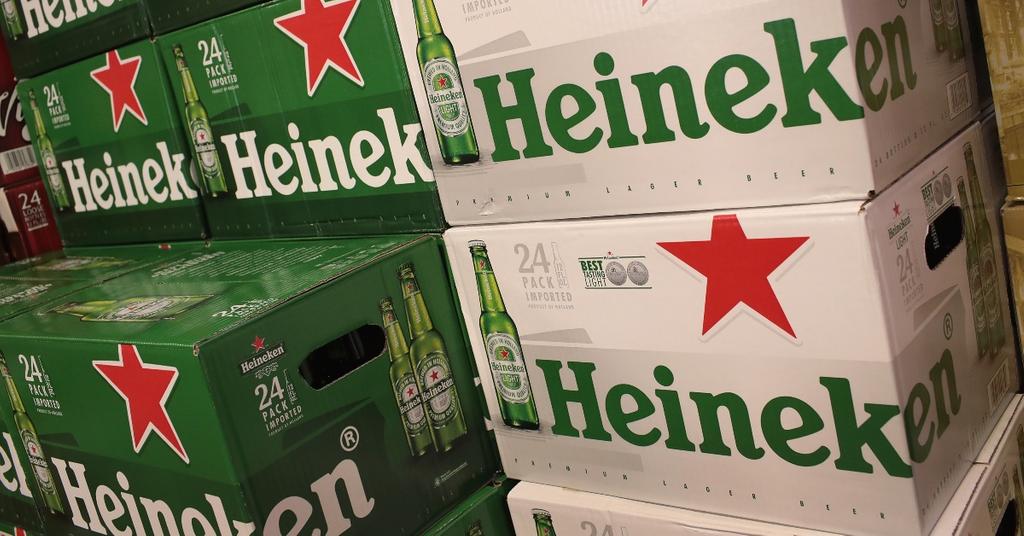
Heineken Announces Major Job Cuts as Volumes Decline- Heineken plans to eliminate up to 6,000 jobs — roughly 7 per cent of its global workforce — over the next two years as the Dutch brewer grapples with weakening beer demand in mature markets and embarks on a broad cost-cutting overhaul.
The reductions will span both brewing operations and corporate roles, reflecting what finance chief Harold van den Broek described as a restructuring effort that “really touches all levels in the organisation.” The company intends to streamline its operations through brewery closures and consolidation in Europe, the merging of smaller national units into regional “clusters,” and the centralisation of back-office and finance functions.
Artificial intelligence is also expected to play a role in reshaping the company’s shared services, with management signalling that automation will help improve efficiency and reduce overhead costs.
The move underscores mounting pressure on global brewers as consumer habits shift. Beer consumption has come under strain in several developed markets, where drinkers are moderating alcohol intake, trading down to cheaper brands, or switching to alternatives such as spirits, ready-to-drink beverages and non-alcoholic options. At the same time, brewers face persistent input cost volatility and more cautious spending by households amid uneven economic conditions.
Heineken reported that overall beer volumes fell 1.2 per cent last year, reflecting declines in Europe and the Americas. In Europe, volumes dropped 3.4 per cent, while the Americas saw a 2.8 per cent fall. These setbacks offset stronger performance in emerging markets, where rising populations and growing middle classes continue to provide pockets of expansion.
Despite lower volumes, the group managed to increase net revenue by 1.6 per cent to €28.9bn, buoyed by pricing actions and growth in markets such as Nigeria, Ethiopia, Vietnam and India. The results illustrate a broader industry trend: brewers are increasingly reliant on price increases and premiumisation to offset stagnating or declining consumption in traditional beer heartlands.
Investors responded positively to the restructuring plans and profit outlook, sending shares more than 4 per cent higher in Amsterdam. Over the past year, the stock has risen nearly 15 per cent, giving Heineken a market valuation of around €45bn.
For the coming year, the company forecast profit growth of 4.4 per cent, ahead of some expectations. However, it tempered its medium-term outlook, guiding for profit growth of 2 to 6 per cent in 2026 — a narrower and slightly lower range than previously indicated. Analysts suggested the more cautious tone may reflect both economic uncertainty and the impending leadership transition.
Last month, Heineken announced that chief executive Dolf van den Brink will step down in May after nearly six years at the helm. No successor has yet been named. Van den Brink described his departure as coming at a “logical transition moment,” coinciding with the launch of the company’s next five-year strategic plan.
His tenure has spanned a turbulent period for the global brewing industry, including pandemic-related bar closures, supply chain disruptions and sharp swings in commodity costs. Under his leadership, Heineken expanded its footprint in emerging markets and pushed further into premium and non-alcoholic segments, areas widely seen as critical for future growth.
The latest restructuring signals that the company is now entering a phase focused more squarely on operational discipline and margin protection. Heineken has historically operated as a highly decentralised organisation, with relatively autonomous national subsidiaries. The shift toward clustering markets and centralising administrative functions marks a notable change in emphasis, suggesting management sees greater efficiency in scale and integration.
For employees, however, the announcement brings uncertainty. Job losses tied to brewery closures and office consolidation are likely to be concentrated in Europe, where consumption trends have been weakest and duplication across markets is most apparent. The company has not yet detailed which locations will be affected.
Heineken’s decision mirrors a broader recalibration across the global beverage sector. As growth slows in core beer categories, major producers are seeking to defend profitability through automation, consolidation and tighter cost control — even as they continue investing selectively in faster-growing regions and alternative product lines.
Whether the job cuts and structural overhaul will be sufficient to reignite momentum remains to be seen. But the message from Amsterdam is clear: in a world of softer demand and shifting tastes, even one of the world’s largest brewers must adapt quickly to protect its margins and reassure investors.