How an Entire Library Disappeared: The Mystery of the Library of Alexandria- Imagine a place where the knowledge of the ancient world was collected under one roof: manuscripts, scrolls, and treatises on science, philosophy, medicine, literature, and magic. This was the Library of Alexandria, the jewel of the Hellenistic world. And then, almost as mysteriously as it appeared, it vanished. How could an entire library—possibly containing hundreds of thousands of scrolls—disappear from history? The story of the Library of Alexandria is a tale of ambition, war, neglect, and the fragility of knowledge.
The Glory of Alexandria
Founded in the 3rd century BCE in Egypt, under the reign of Ptolemy II Philadelphus, the Library of Alexandria was part of a larger research institution called the Mouseion, or Temple of the Muses. Its purpose was nothing less than monumental: to collect all the world’s knowledge.
-
Ships docking in Alexandria were required to surrender books so scribes could copy them. The originals were often kept in the library.
-
Scholars from Greece, Egypt, Babylon, India, and beyond studied mathematics, astronomy, medicine, literature, and philosophy.
-
Some of the greatest thinkers of antiquity, including Euclid and Archimedes, were associated with the library.
It was a center not just for storage of knowledge, but for research, discussion, and innovation—a symbol of human curiosity and intellectual ambition.
Theories Behind Its Disappearance
The Library of Alexandria did not vanish in a single night. Historians debate multiple events over centuries that likely contributed to its destruction:
1. Julius Caesar’s Siege of Alexandria (48 BCE)
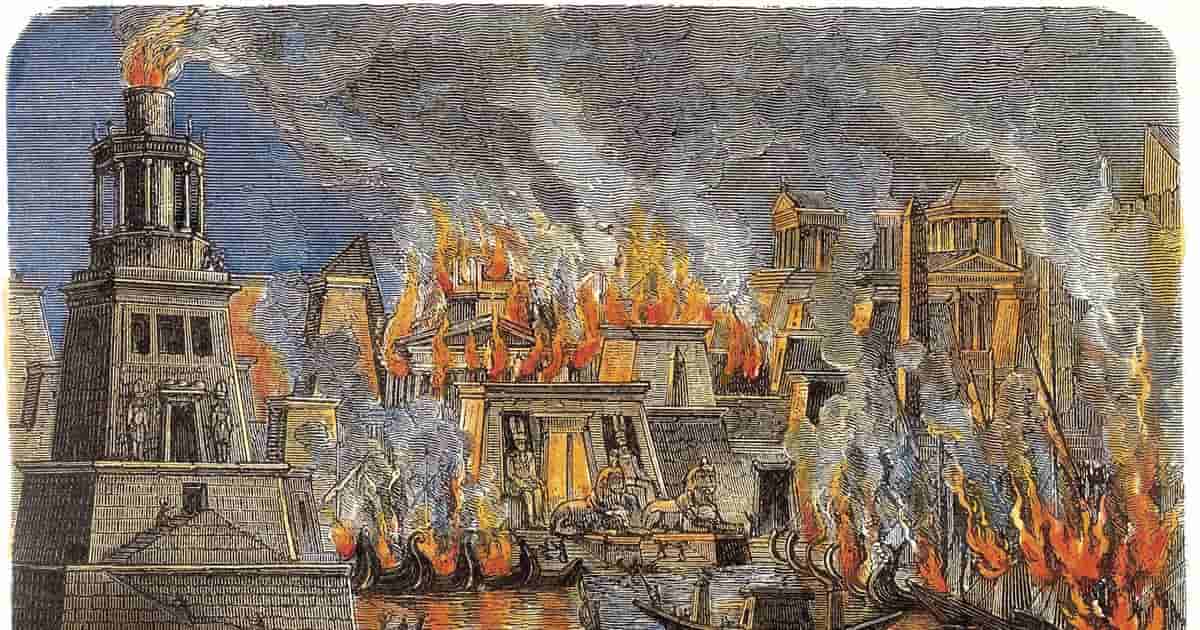
One widely cited event is Caesar’s civil war in Egypt. During the siege of Alexandria, Caesar set fire to ships in the harbor to prevent them from falling into enemy hands. Some ancient accounts suggest that the fire spread, engulfing parts of the city—including, possibly, the library or its stores.
-
Some scrolls may have survived, but the bulk of the collection may have been lost.
-
Contemporary sources are vague, leaving historians to speculate how much was destroyed.
2. Religious Conflicts
As Christianity became dominant in Egypt centuries later, some accounts claim that temples and pagan institutions were deliberately destroyed. While these claims are debated, religious zeal could have contributed to further losses of knowledge.
-
Scholars like Hypatia, a philosopher and mathematician in Alexandria, were murdered in 415 CE, symbolizing the suppression of classical learning.
-
Even if the library itself had survived earlier fires, neglect and destruction by later rulers may have sealed its fate.
3. Gradual Decay and Neglect
Some historians argue that the library simply eroded over time. Scrolls are fragile, made of papyrus, which deteriorates in heat and humidity. Political instability, lack of funding, and neglect over centuries could have slowly erased the collection.
-
By the time Alexandria fell under Roman control, much of its brilliance may have already been lost.
-
Successive fires, wars, and administrative indifference could have compounded the problem.
Why the Library’s Loss Was So Significant
The Library of Alexandria represents not just lost scrolls, but lost potential:
-
Medical treatises could have advanced knowledge of disease centuries earlier.
-
Mathematical and astronomical discoveries might have accelerated technological progress.
-
Philosophical works from cultures around the Mediterranean were lost, leaving gaps in the historical record.
The tragedy is amplified by the fact that few records from the library itself survive, so modern historians can only reconstruct its contents and methods from secondary sources.
Lessons from the Library’s Fate
The disappearance of the Library of Alexandria serves as a cautionary tale about the fragility of knowledge:
-
Physical Vulnerability: Scrolls and manuscripts are susceptible to fire, decay, and war. Even the greatest collections can vanish if not preserved.
-
Political Risk: Knowledge often relies on patronage. Shifts in power, ideology, or funding can threaten entire repositories of learning.
-
Cultural Loss: The library reminds us that the loss of information is not just academic—it affects civilization’s progress.
The Library of Alexandria is a stark example of how knowledge, unlike gold or land, can disappear if society does not actively protect it.
Could It Happen Today?
In a way, yes—but we have safeguards modern societies never had: digital storage, cloud backups, and redundant archiving. Still, even today, wars, natural disasters, and neglect threaten knowledge. The Library of Alexandria challenges us to ask: are we doing enough to preserve human understanding for future generations?
Conclusion
The disappearance of the Library of Alexandria was likely not a single event, but a series of disasters, neglect, and societal changes over centuries. From Julius Caesar’s fires to religious upheaval and decay, the library’s vast collections of scrolls were gradually lost to history.
Its story remains a powerful reminder that knowledge is both precious and precarious. The Library of Alexandria didn’t just vanish—it warns us that human achievement can be erased if vigilance, preservation, and respect for learning are abandoned.
Today, we can honor its legacy not just by imagining what was lost, but by committing to protect the knowledge we have, ensuring that no modern Alexandria disappears again.
Are There Hidden Cultural Links Between Mexico and the USA? | Maya