How the Space Economy Will Outgrow Earth Markets by 2030- Imagine a world where industries in orbit generate more revenue than some of the biggest markets on Earth. A place where satellites, space mining, orbital manufacturing, and even space tourism aren’t just niche ventures—they’re major economic drivers. By 2030, that future might be closer than we think.
The space economy is already booming, and emerging technologies suggest it could outgrow traditional Earth markets within the next decade. But how, exactly, will this happen—and what does it mean for businesses, governments, and ordinary people?
The Current Space Economy
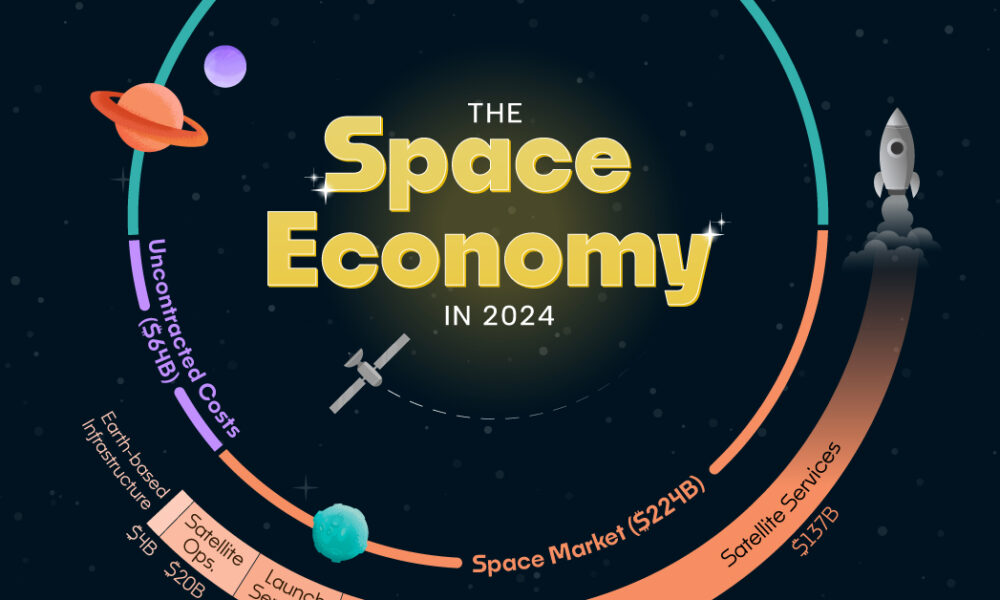
As of 2025, the global space economy is valued at roughly $450 billion per year, including satellite services, launch services, government spending, and emerging commercial sectors. Satellites dominate the market, powering everything from GPS navigation to internet connectivity.
But growth is accelerating. Analysts predict the space economy could exceed $1 trillion annually by 2030, driven by:
-
Reusable rockets – Dramatically lowering the cost of access to orbit.
-
Satellite megaconstellations – High-speed internet from space for the entire globe.
-
Orbital manufacturing – Producing materials impossible on Earth.
-
Space tourism – From suborbital flights to luxury orbital hotels.
Why Space Markets Will Outgrow Earth Markets
1. Reusable Launch Technology
Companies like SpaceX and Blue Origin have already proven that rockets can be reused. Each successful relaunch slashes costs, making orbital access far cheaper than ever before.
Impact: Lower launch costs mean more satellites, more research missions, and more private companies entering the space market. Essentially, space becomes a new real estate and industrial frontier—like Silicon Valley, but in orbit.
2. Satellite Services
We already depend on satellites for communication, navigation, and surveillance. By 2030, mega-constellations like SpaceX’s Starlink and Amazon’s Kuiper could provide high-speed internet to every corner of the globe, including previously unconnected regions.
Impact: Satellite-based services could generate hundreds of billions annually, rivaling or surpassing traditional telecommunications markets on Earth.
3. Orbital Manufacturing
Microgravity offers unique production advantages. Materials formed in space—like ultra-pure crystals, fiber optics, and advanced pharmaceuticals—can outperform Earth-made equivalents.
Impact: Companies producing high-value materials in orbit could tap into markets that dwarf conventional manufacturing sectors. In some cases, space-made products may be impossible to replicate on Earth, giving space industries a monopoly on certain high-tech goods.
4. Space Mining
Asteroids and the Moon hold trillions of dollars in raw materials—from platinum-group metals to rare earth elements. While still experimental, the first commercial missions to mine near-Earth asteroids could launch within this decade.
Impact: Space mining could supply global markets with critical resources, transforming the way industries operate on Earth. Imagine rare metals no longer constrained by terrestrial geology.
5. Space Tourism
What was once a billionaire novelty could become mainstream by 2030. Companies like Virgin Galactic and Blue Origin are already offering suborbital flights, and orbital hotels are in early design phases.
Impact: The experience economy of space could become a multibillion-dollar market, adding another revenue stream independent of Earth-based limitations.
Q&A: The Space Economy Explained
Q: How can space markets outgrow Earth markets?
A: Growth comes from accessibility and scarcity. Space provides new resources, unique production environments, and services that are impossible on Earth. Lower launch costs, reusable rockets, and advanced technology make these markets economically viable.
Q: Will space industries compete with Earth industries?
A: Sometimes, yes. Space manufacturing could compete with high-tech materials on Earth. But mostly, space industries complement Earth markets, creating new niches rather than directly replacing terrestrial businesses.
Q: Who benefits from a trillion-dollar space economy?
A: Governments, private companies, investors, and eventually consumers. Think global satellite internet, advanced medicines, and rare materials. But there will also be regulatory and geopolitical challenges to navigate.
Q: How soon will space mining become profitable?
A: Near-term missions (late 2020s to early 2030s) will focus on small-scale extraction, primarily for research and demonstration. Full-scale profitable mining could take longer, but even early missions may supply high-value metals for specialized industries.
Risks and Challenges
Even as the space economy grows, there are significant hurdles:
-
Regulation and governance – Space law hasn’t fully caught up with commercial opportunities. Who owns an asteroid? How do we prevent orbital conflicts?
-
High upfront costs – Even with reusable rockets, building orbital infrastructure is expensive.
-
Space debris – The more we launch, the higher the risk of collisions, threatening satellites and habitats.
-
Technical challenges – Mining, manufacturing, and long-term habitats require technologies still under development.
Yet despite these challenges, the potential returns are enormous, attracting both private investors and government funding.
Case Studies: Companies Leading the Space Economy
-
SpaceX – Revolutionized reusable rockets and satellite internet.
-
Blue Origin – Developing reusable rockets and space tourism initiatives.
-
Made In Space – Focused on orbital manufacturing, including 3D printing in microgravity.
-
Planetary Resources / TransAstra – Pioneering asteroid prospecting for rare metals.
These companies are setting the stage for a space economy that rivals global markets like automotive, energy, or tech.
How This Will Affect Earth
By 2030, the space economy won’t just exist “out there.” It will impact everyday life on Earth:
-
Faster, cheaper global internet through satellite networks.
-
Access to high-tech materials produced in microgravity.
-
Expansion of natural resources through space mining, reducing shortages of critical metals.
-
Opportunities for new industries and jobs in orbital construction, tourism, and research.
In short, space is no longer separate from the economy—it’s an extension of Earth’s markets into orbit.
The 2030 Vision
Imagine a 2030 where:
-
Space-based internet connects every village on Earth.
-
Orbital factories produce ultra-precise fiber optics and advanced pharmaceuticals.
-
Private space stations host researchers, tourists, and even businesses.
-
Asteroid mining begins supplying metals worth billions annually.
The space economy becomes not just a complement to Earth markets but a leading driver of innovation, jobs, and revenue.
Final Thoughts
The next decade could see the space economy surpass traditional Earth markets in influence and revenue, thanks to reusable rockets, satellite megaconstellations, orbital manufacturing, space mining, and tourism.
This isn’t just about science fiction. It’s about real economic opportunity, technological innovation, and a new frontier for humanity. By 2030, orbit may no longer be a distant frontier—it could be a thriving economic ecosystem, redefining the way we live, work, and invest on Earth.
The sky isn’t the limit anymore. In fact, it might just be the beginning.