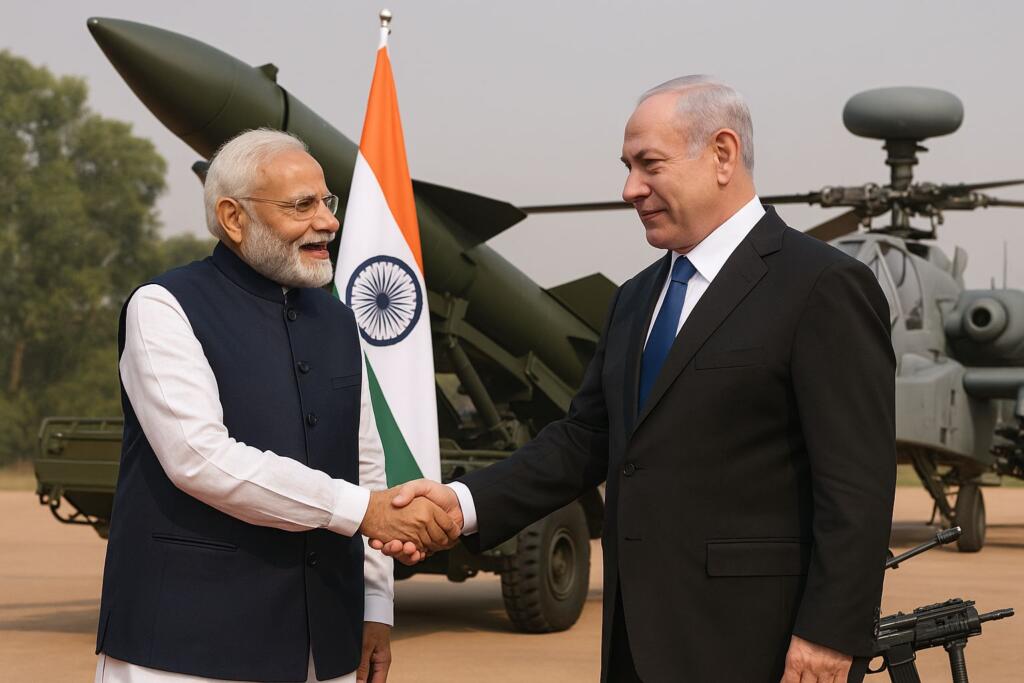
India–Israel Military Trade Grows Amid Strategic Realignment- Prime Minister Narendra Modi’s two-day visit to Israel beginning February 25 places defence cooperation at the heart of an already robust bilateral partnership. While India and Israel have steadily broadened engagement across agriculture, technology and innovation since establishing diplomatic ties in 1992, it is security collaboration that continues to anchor the relationship. Modi’s trip signals not only continuity but an effort to elevate cooperation to the next phase—one defined by joint development, local production and advanced systems integration.
Over the past three decades, Israel has emerged as one of India’s most significant defence suppliers. The partnership, initially driven by India’s urgent operational requirements in the 1990s and early 2000s, has since evolved into a multidimensional framework encompassing missile systems, air defence platforms, unmanned aerial vehicles (UAVs), radar technologies and electronic warfare capabilities. Israeli firms have played a visible role in strengthening India’s surveillance and precision-strike capacities, while quietly integrating into India’s broader defence modernisation plans.
Data from the Stockholm International Peace Research Institute (SIPRI) underscores the scale of this engagement. Between 2020 and 2024, India accounted for roughly 34 per cent of Israel’s total arms exports, valued at an estimated $20.5 billion. During the same period, Israel ranked as India’s third-largest supplier of military equipment after Russia and France, contributing about 13 per cent of India’s overall defence imports. These figures reflect not merely commercial transactions but a strategic alignment shaped by converging threat perceptions and complementary technological strengths.
Modi’s visit is expected to review progress on ongoing joint ventures and accelerate collaboration in cutting-edge domains such as advanced air defence systems, loitering munitions, and next-generation drones. A central theme of discussions is likely to be co-development and co-production under India’s push for Atmanirbharta, or self-reliance in defence manufacturing. Rather than relying solely on imports, New Delhi has sought deeper technology transfers and domestic assembly lines that can build indigenous capacity while retaining access to Israeli innovation.
This shift from a traditional buyer–seller model to a partnership model marks a significant transformation. Joint projects between Israeli defence companies and Indian public- and private-sector firms increasingly involve shared research, licensed production and integration with Indian platforms. For New Delhi, this approach serves the twin objectives of operational readiness and industrial growth. For Israel, India represents not only a major market but also a long-term strategic collaborator in Asia.
Modi’s itinerary is also symbolically important. High-level political engagement has been instrumental in normalising and expanding ties that were once conducted discreetly. Since Modi became the first Indian prime minister to visit Israel in 2017, bilateral relations have shed much of their earlier hesitation. Defence cooperation, though still characterised by a degree of confidentiality, now enjoys overt political endorsement. The February visit is expected to reaffirm this commitment and send a signal of stability to defence establishments on both sides.
Another highlight of the visit is likely to be expanded cooperation in emerging technologies. Both India and Israel have invested heavily in cyber capabilities, artificial intelligence applications in defence, border surveillance systems and counter-drone technologies. As warfare becomes increasingly technology-driven, collaboration in these areas carries strategic significance beyond immediate procurement contracts. Joint innovation frameworks could enable faster adaptation to evolving battlefield requirements, particularly in areas such as integrated air and missile defence networks.
Yet, despite its scale and strategic weight, the India–Israel military partnership remains comparatively opaque. Detailed disclosures of contracts, technology transfers and operational deployments are rare. Reciprocal visits by senior military officials, defence scientists and executives are typically kept low-profile. This discretion reflects a mix of domestic political sensitivities, regional diplomatic balancing and the inherently confidential nature of defence cooperation. Even so, the trajectory of engagement is unmistakably upward.
The broader geopolitical context further reinforces this alignment. As global power structures shift and supply chains become more contested, India has sought to diversify its defence partnerships while reducing overdependence on any single supplier. Israel, with its niche expertise in high-technology defence systems and proven track record of rapid delivery, fits well within this diversification strategy. At the same time, Israel benefits from stable, long-term collaboration with one of the world’s largest armed forces and fastest-growing major economies.
In essence, Modi’s February visit underscores a mature and strategically consequential partnership. It highlights a shared willingness to move beyond transactional exchanges toward deeper institutional integration. As India recalibrates its defence posture amid evolving regional challenges, and Israel continues to expand its global security footprint, military trade and technological collaboration will remain central pillars of bilateral ties.
The message from this visit is clear: India and Israel are not merely trading arms—they are reshaping the architecture of their defence relationship in line with a changing strategic landscape.