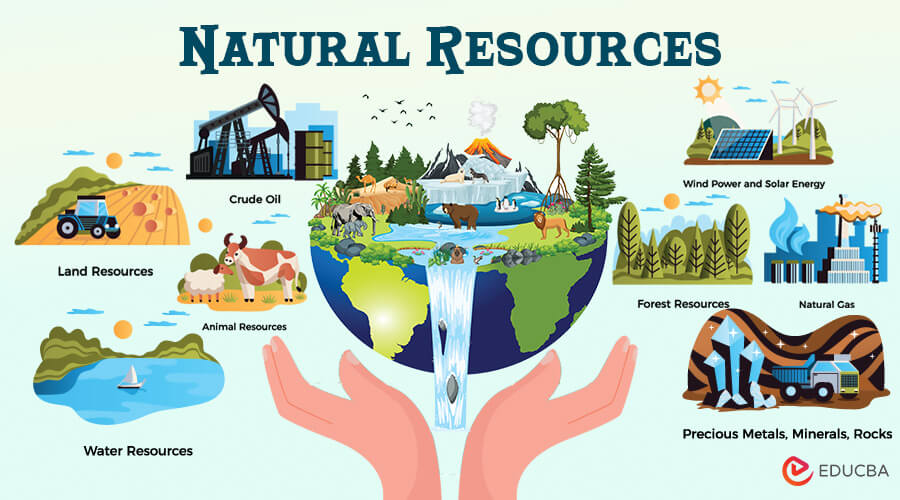
Natural Resources of the World: Distribution and Importance – Natural resources are the backbone of human civilization. They provide essential materials for survival, economic growth, and technological advancement. From the water we drink to the minerals that power industries, natural resources play a vital role in shaping societies. Understanding their global distribution and significance helps nations manage them sustainably and plan for future development.
What Are Natural Resources?
Natural resources are substances or materials that occur naturally in the environment and are used by humans for economic and social purposes. They are broadly classified into renewable and non-renewable resources:
-
Renewable Resources: These can regenerate naturally over time, such as forests, freshwater, wind, solar energy, and fish.
-
Non-Renewable Resources: These are finite and cannot be replaced once depleted, such as coal, petroleum, natural gas, minerals, and metals.
The availability and distribution of these resources are influenced by geological, climatic, and geographical factors.
1. Water Resources
-
Distribution: Freshwater constitutes about 2.5% of the world’s water, with the majority locked in glaciers, ice caps, and underground aquifers. Major rivers like the Nile, Amazon, Yangtze, and Mississippi provide freshwater to billions of people.
-
Importance: Water is essential for drinking, agriculture, industry, hydroelectric power, and transportation. Agriculture alone consumes over 70% of global freshwater.
-
Data: The annual renewable freshwater per capita varies widely. For instance, Canada has over 80,000 cubic meters per person, while countries like Egypt have less than 500 cubic meters per person.
Freshwater scarcity is a growing concern, with nearly 2 billion people globally lacking safe drinking water. Efficient management and conservation are critical for sustainable development.
2. Forests and Timber
-
Distribution: Forests cover approximately 31% of the Earth’s land area. The largest forested regions are:
-
Amazon Rainforest: South America (~5.5 million km²)
-
Congo Basin: Central Africa (~1.7 million km²)
-
Boreal Forests: Russia, Canada (~1.3 million km²)
-
-
Importance: Forests provide timber, fuelwood, medicinal plants, and habitat for biodiversity. They also act as carbon sinks, absorbing around 2.4 billion tons of CO₂ annually, which helps mitigate climate change.
-
Data: Tropical forests are disappearing at a rate of 10 million hectares per year, largely due to logging and agriculture. Sustainable forestry practices are essential to balance economic needs and ecological preservation.
3. Mineral Resources
Minerals are naturally occurring substances extracted for industrial and economic use. Their distribution depends on geological formations:
-
Iron Ore: Major producers include Australia (1.2 billion tons/year), Brazil (400 million tons/year), and China (340 million tons/year). Used in steel production, construction, and transportation.
-
Copper: Chile (5.8 million tons/year), Peru (2.4 million tons/year), and China (1.7 million tons/year) dominate global production. Copper is critical for electrical wiring, electronics, and renewable energy infrastructure.
-
Gold: South Africa, China, Australia, and Russia are leading producers. Gold has both industrial applications and cultural/economic significance.
-
Coal: Distributed in the USA, Russia, China, and India, coal remains a primary energy source, supplying about 27% of global electricity despite environmental concerns.
Mineral wealth often drives national economies but can also lead to environmental degradation if not managed responsibly.
4. Fossil Fuels (Oil, Natural Gas, and Coal)
Fossil fuels are non-renewable energy sources formed over millions of years.
-
Oil: Major reserves are in the Middle East (Saudi Arabia, Iran, Iraq, UAE), Venezuela, and Russia. Global consumption is approximately 100 million barrels per day, powering transportation, industry, and heating.
-
Natural Gas: Russia, the USA, and Iran hold the largest reserves. It is cleaner than coal and oil, widely used for electricity generation and heating.
-
Coal: Found abundantly in the USA, China, India, and Australia. Despite being abundant and cheap, coal combustion is a major contributor to greenhouse gas emissions.
The transition to renewable energy sources is critical to reduce dependence on fossil fuels and combat climate change.
5. Soil and Agricultural Resources
-
Distribution: Fertile soil is concentrated in river valleys, plains, and regions with moderate climates. The most productive soils include the Loess Plateau in China, Great Plains in the USA, and Indo-Gangetic Plain in India.
-
Importance: Soil supports agriculture, which feeds over 7.9 billion people. Nutrient-rich soil is critical for crop production, while poor soil management can lead to erosion, desertification, and loss of arable land.
-
Data: Approximately 33% of the world’s soil is moderately to highly degraded, posing risks to food security. Modern techniques like crop rotation, organic farming, and soil conservation are essential to sustain productivity.
6. Energy Resources (Renewable Sources)
-
Distribution: Renewable energy sources are unevenly distributed:
-
Solar Energy: Abundant in deserts and tropical regions, e.g., Sahara Desert (Africa) and Australian Outback.
-
Wind Energy: Coastal regions and plains are ideal, such as the USA’s Great Plains and northern Europe.
-
Hydropower: Rivers with high flow and elevation drops, like the Yangtze, Amazon, and Congo, are prime locations.
-
-
Importance: Renewable energy reduces carbon emissions, combats climate change, and decreases dependence on finite resources. Global renewable energy capacity reached over 3,000 GW in 2023, with solar and wind leading the expansion.
7. Marine and Fishery Resources
-
Distribution: Oceans, seas, and rivers provide fish, crustaceans, and other aquatic resources. Major fishing zones include the Northwest Pacific, Southeast Atlantic, and Indian Ocean.
-
Importance: Fisheries support the livelihoods of over 60 million people globally and provide essential protein for billions. Marine resources also contribute to pharmaceuticals, tourism, and transport.
-
Data: About 34% of global fish stocks are overexploited, emphasizing the need for sustainable fishing practices.
Conclusion
Natural resources form the foundation of human life and economic development. Their distribution varies due to geological, climatic, and geographical factors, but all resources are interconnected with human well-being. Water, forests, minerals, fossil fuels, soil, and marine resources not only support daily life but also drive global industries and technological progress.
Sustainable management of these resources is essential, as overexploitation and environmental degradation threaten future availability. Countries must balance development with conservation through policies, innovation, and international cooperation. By understanding the global distribution and importance of natural resources, societies can make informed decisions, ensuring a secure and prosperous future for generations to come.
The Major Physical Features of the Earth: A Complete Guide for Students | Maya