
SpaceX Pushes Starlink Expansion With Polar Orbit Launch
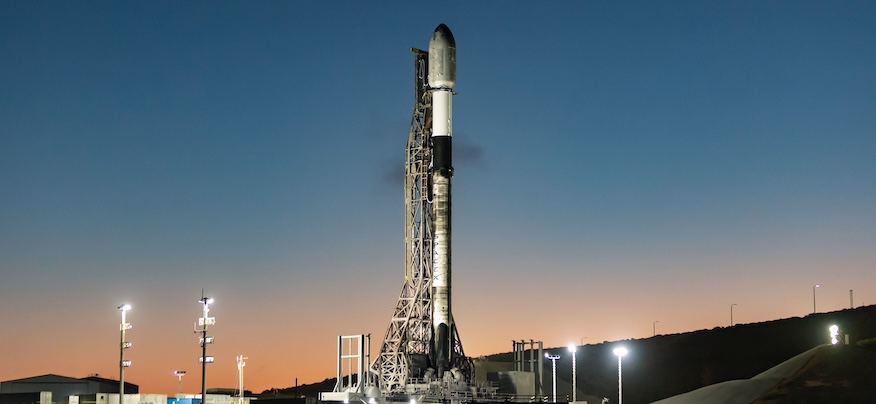
SpaceX is continuing its aggressive expansion of the Starlink satellite network with a nighttime launch from California, marking the company’s first West Coast Starlink mission of the year. The upcoming flight highlights both SpaceX’s growing launch cadence and its ability to support a wide range of orbital inclinations using reusable hardware.
The mission, designated Starlink 17-30, will lift off from Space Launch Complex 4 East at Vandenberg Space Force Base. Once airborne, the Falcon 9 rocket will follow a southerly trajectory, sending its payload into a polar low Earth orbit. This type of orbit allows satellites to pass over nearly every point on Earth as the planet rotates beneath them, making it especially valuable for global coverage, including high-latitude and remote regions.
Onboard the rocket are 25 Starlink V2 Mini Optimized satellites, the latest evolution of SpaceX’s broadband spacecraft. These satellites are designed to deliver improved performance while remaining compact enough to be launched in large numbers aboard Falcon 9. With this mission, SpaceX continues to build out the density and resilience of its megaconstellation, which already numbers in the thousands of operational satellites.
The launch is scheduled for 9:30:10 p.m. Pacific Standard Time, a timing that often produces dramatic visuals along the West Coast. Polar launches from Vandenberg frequently generate glowing exhaust plumes that can be visible across large portions of California and neighboring states, especially during twilight or nighttime conditions. While visually striking, the trajectory is carefully chosen to ensure the rocket travels safely over the Pacific Ocean.
This flight will be SpaceX’s sixth Starlink mission of 2026, underscoring the company’s steady pace as it works to expand global internet coverage. Unlike many Starlink launches from Florida, which typically head eastward into lower-inclination orbits, missions from California play a crucial role in filling orbital planes that serve northern and southern latitudes.
Powering the mission is Falcon 9 first stage booster B1093, which is flying for the tenth time. The booster’s previous missions include two launches for the Space Development Agency and seven earlier Starlink flights. Its continued reuse is another example of how SpaceX has normalized rapid booster turnaround as part of its routine operations, significantly reducing launch costs and increasing flexibility.
Shortly after stage separation, B1093 will perform a series of maneuvers to guide itself back to Earth. Just over eight minutes after liftoff, the booster is expected to attempt a landing on the drone ship “Of Course I Still Love You,” stationed in the Pacific Ocean. A successful touchdown would mark the 172nd landing on this particular vessel and the 562nd orbital-class booster recovery overall for SpaceX—figures that would have seemed nearly impossible during the early days of orbital rocketry.
Meanwhile, the Falcon 9 upper stage will continue on its mission, deploying the 25 satellites into their intended orbit roughly an hour after launch. Once released, the satellites will begin a checkout process before gradually maneuvering into their operational positions within the Starlink network.
Polar orbit Starlink missions play a key role in SpaceX’s long-term strategy. By diversifying orbital coverage, the company can improve service reliability, reduce congestion, and expand availability in regions that are traditionally harder to serve with geostationary or lower-inclination satellite systems. This is particularly important for users in northern Canada, Alaska, parts of Europe, and the Southern Hemisphere.
As SpaceX maintains a high launch tempo in 2026, missions like Starlink 17-30 demonstrate how the company is balancing scale, reliability, and reusability. With each successful flight and recovery, SpaceX moves closer to its goal of providing near-global broadband coverage while refining the systems that will eventually support even larger launch vehicles and more ambitious missions.
The Starlink 17-30 launch is another step forward in that effort—quietly expanding a space-based infrastructure that is becoming an increasingly integral part of global communications.


:max_bytes(150000):strip_icc()/GettyImages-151541875-adcfc13d221e40e4946f571b57180f3d.jpg "How Sputnik 1 Sparked the Space Race")