
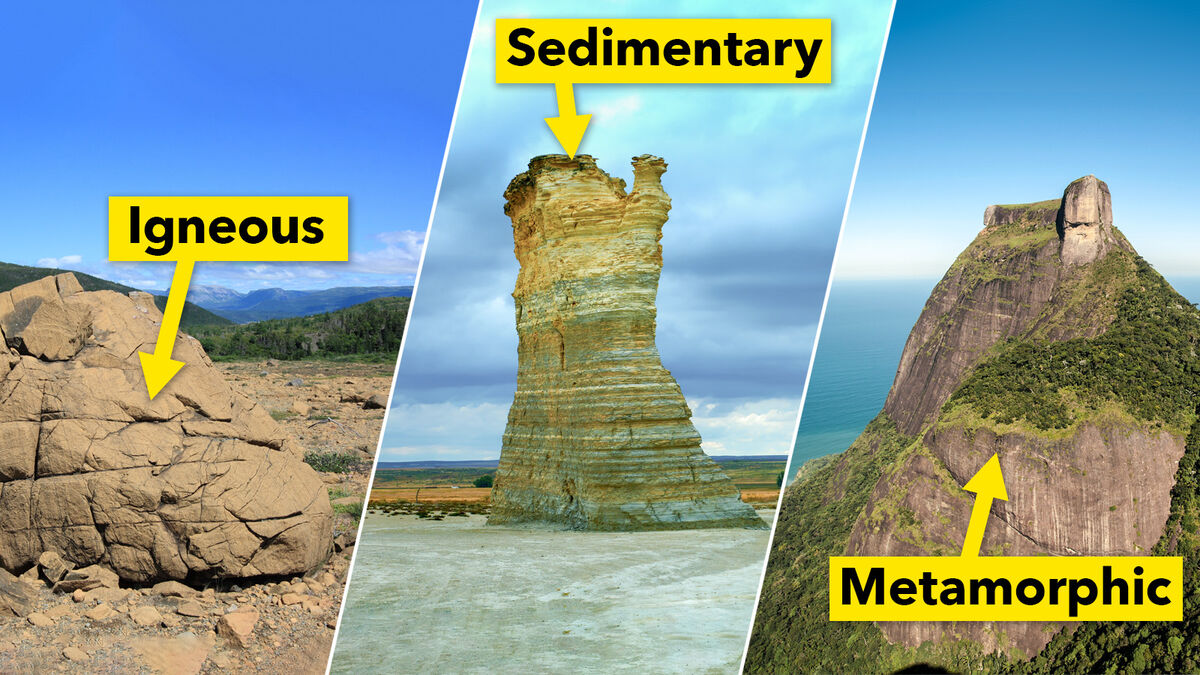
Types of Rocks and Their Formation: Igneous, Sedimentary, Metamorphic- Rocks are the building blocks of the Earth’s crust and provide essential insights into the planet’s geological history. They are naturally occurring solid aggregates of minerals or mineral-like substances and form through a variety of processes over millions of years. Understanding rock types and their formation is fundamental in fields such as geology, environmental science, and natural resource management. Rocks are broadly classified into three main categories: igneous, sedimentary, and metamorphic. Each type has distinct characteristics, origins, and uses.
1. Igneous Rocks
Formation
Igneous rocks form from the cooling and solidification of molten rock, known as magma when beneath the surface and lava when it erupts on the Earth’s surface. The rate of cooling determines the texture of the rock:
-
Intrusive (Plutonic) Igneous Rocks: Formed from magma that cools slowly beneath the Earth’s surface, resulting in coarse-grained textures.
-
Extrusive (Volcanic) Igneous Rocks: Formed from lava that cools quickly on the surface, producing fine-grained or glassy textures.
Characteristics
-
Hard and durable due to interlocking mineral crystals
-
Often contain minerals like quartz, feldspar, mica, and olivine
-
Can be light-colored (felsic) or dark-colored (mafic), depending on mineral composition
Examples
-
Granite: Coarse-grained, light-colored, widely used in construction and monuments.
-
Basalt: Fine-grained, dark-colored, forms from lava flows, common in oceanic crust.
-
Obsidian: Glassy texture, formed from rapid cooling of lava.
Importance
Igneous rocks are a source of many industrial minerals like feldspar and mica. They also provide building materials, including granite countertops and basalt aggregates for roads. Moreover, studying igneous rocks helps geologists understand volcanic activity and plate tectonics.
2. Sedimentary Rocks
Formation
Sedimentary rocks form from the accumulation and cementation of sediments derived from pre-existing rocks, minerals, or organic material. These sediments are transported by water, wind, or ice and deposited in layers called strata. Over time, the sediments undergo compaction and cementation, turning them into solid rock.
Types of Sedimentary Rocks
-
Clastic Sedimentary Rocks: Formed from fragments of other rocks. Examples include sandstone, shale, and conglomerate.
-
Chemical Sedimentary Rocks: Formed from minerals precipitated from solution, such as limestone (calcium carbonate) and rock salt (halite).
-
Organic Sedimentary Rocks: Formed from the accumulation of plant or animal debris, such as coal (from plant material) and certain limestones (from shells and corals).
Characteristics
-
Usually layered or stratified
-
May contain fossils, preserving evidence of past life
-
Softer than igneous and metamorphic rocks in general
-
Colors range from light beige to dark brown depending on composition
Examples
-
Sandstone: Made of sand-sized mineral particles, often used in building.
-
Limestone: Composed mainly of calcium carbonate, widely used in cement and agriculture.
-
Shale: Fine-grained rock, splits easily into thin layers, often found in river deltas.
-
Coal: Derived from plant remains, used as an energy source.
Importance
Sedimentary rocks are crucial for fossil preservation, allowing scientists to study the Earth’s history. They also contain natural resources like coal, oil, natural gas, and groundwater reservoirs. Sedimentary rocks are extensively used in construction, cement production, and decorative stones.
3. Metamorphic Rocks
Formation
Metamorphic rocks form from existing rocks (igneous, sedimentary, or even other metamorphic rocks) that undergo physical and chemical changes due to high temperature, high pressure, or chemically active fluids. Unlike igneous rocks, metamorphic rocks do not melt; instead, their minerals recrystallize, creating new textures and structures.
Types of Metamorphism
-
Contact Metamorphism: Occurs when rocks are heated by nearby magma or lava, typically producing small-scale changes.
-
Regional Metamorphism: Occurs over large areas due to tectonic forces, such as mountain-building, leading to high pressure and temperature conditions.
-
Dynamic Metamorphism: Caused by mechanical deformation along fault zones with minimal temperature increase.
Characteristics
-
Often show foliation (layered or banded appearance) due to mineral alignment under pressure
-
Denser and harder than their parent rocks
-
May exhibit crystalline textures with new mineral formations
Examples
-
Marble: Formed from limestone, used in sculptures and buildings.
-
Slate: Derived from shale, splits into thin, durable sheets, used for roofing.
-
Gneiss: Banding of light and dark minerals, formed from granite or sedimentary rocks, often used in construction.
-
Quartzite: Formed from sandstone, extremely hard and resistant to weathering.
Importance
Metamorphic rocks are essential in architecture and art, providing durable and aesthetically appealing materials. They also indicate tectonic activity and geological history, helping geologists understand mountain-building processes and crustal deformation.
Comparison of Rock Types
| Feature | Igneous | Sedimentary | Metamorphic |
|---|---|---|---|
| Formation Process | Cooling and solidification of magma/lava | Deposition, compaction, cementation of sediments | Alteration of existing rocks under heat/pressure |
| Texture | Coarse-grained (intrusive) or fine-grained (extrusive) | Layered, sometimes fossiliferous | Foliated or non-foliated, crystalline |
| Hardness | Hard | Softer | Very hard and dense |
| Examples | Granite, Basalt, Obsidian | Sandstone, Limestone, Shale, Coal | Marble, Slate, Gneiss, Quartzite |
| Uses | Construction, monuments, industrial minerals | Construction, cement, fossil fuel extraction | Architecture, sculpture, flooring |
Conclusion
The three main types of rocks—igneous, sedimentary, and metamorphic—represent the dynamic processes that shape the Earth’s crust. Igneous rocks form from molten materials, sedimentary rocks from accumulated sediments, and metamorphic rocks from the transformation of pre-existing rocks. Each type has distinct characteristics, origins, and economic significance.
Understanding rock formation is crucial for geologists, engineers, architects, and environmental scientists. Rocks not only tell the story of the Earth’s geological past but also provide essential resources for human civilization. By studying rocks, we gain insights into volcanic activity, mountain formation, fossil records, and resource distribution. The rock cycle, connecting these three types, illustrates the continuous and dynamic nature of Earth’s crust, emphasizing the interconnectedness of natural processes that have been ongoing for billions of years.

