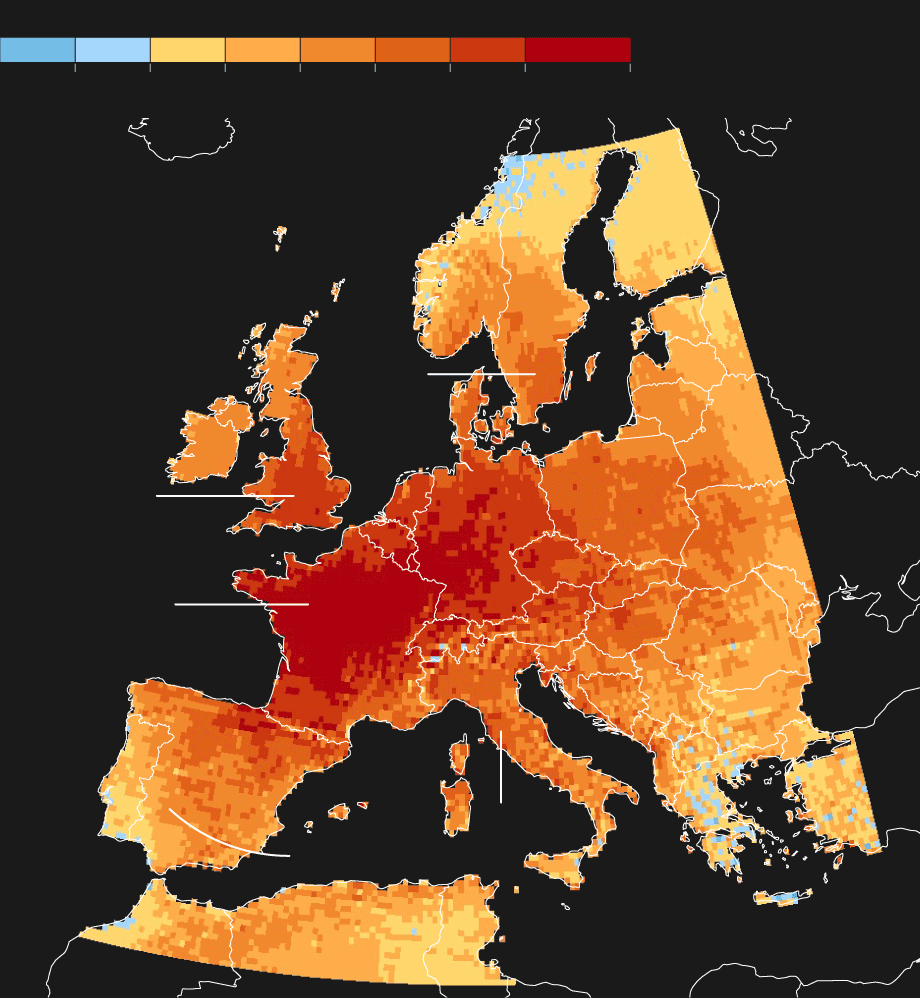
1,300 Deaths in Days: Inside Europe’s Sudden Climate Apocalypse- The phrase “once-in-a-generation” has lost all meaning. What used to be a statistical anomaly—a rare, terrifying spike on a meteorological chart—has transformed into an annual summer ritual. Across the European continent, a historic and devastatingly early heatwave has claimed more than 1,300 excess lives in a matter of days. As the mercury shatters long-standing records from the Atlantic coast to the borders of Eastern Europe, the World Health Organization (WHO) has issued a stark warning: Europe is facing a full-blown public health crisis driven by a rapidly destabilizing climate.
With Germany hitting an unprecedented daytime record of 41.7°C, France recording over 1,000 heat-related fatalities, and public infrastructure buckling under the stress, the continent is waking up to a grim reality. Europe is the fastest-warming continent on Earth, heating at twice the global average. This is no longer a localized weather event; it is a preview of a climate apocalypse happening in real time.
The Silent Killer Claims Its Toll
In public health circles, extreme heat is frequently referred to as the “silent killer.” Unlike a dramatic flood, a violent hurricane, or a roaring wildfire, a heatwave does not leave behind a visible trail of twisted steel or shattered timber. Instead, its destruction takes place quietly, behind closed doors, in un-air-conditioned apartments, hospital wards, and care homes.
According to data compiled by the WHO, more than 1,300 excess deaths have been directly linked to high temperatures across the continent in an incredibly tight window since June 21. The speed of the mortality spike has stunned health officials.
France has borne the heaviest initial brunt of this disaster. Public Health France reported roughly 1,000 more deaths than expected in just a matter of days. The demographics of the crisis are tragically predictable: roughly 85% of the victims in France were elderly citizens aged 65 and over. During the peak of the heat, authorities logged a massive 40% increase in the number of people dying at home, particularly in the densely populated Paris region. For a nation still deeply scarred by the historic 2003 heatwave—which claimed 15,000 lives across France—the current trajectory feels like a terrifying echo of past trauma.
Redefining the Absolute Limits: 41.7°C and Counting
As the heat dome shifted its weight eastward across Central Europe, it left a trail of smashed records in its wake. Germany, a country accustomed to mild summers and dependable rainfall, bore witness to a historic meteorological event.
In Germany, the German Weather Service (DWD) watched in disbelief as national highs fell on consecutive days. The streak culminated in the rural Brandenburg settlement of Coschen, near the Polish border, which registered a staggering 41.7°C. To put this in perspective, temperatures of this magnitude are typically associated with sub-Saharan climates or mid-summer afternoons in Death Valley—not the agrarian heartlands of Northern and Central Europe.
The crisis forced local authorities into unprecedented emergency interventions. In Berlin, municipal police deployed water cannons—typically reserved for severe riot control—into public spaces and outdoor venues to spray fine mists of water over sweltering crowds in a desperate bid to prevent mass heat stroke.
Meanwhile, just across the border, the Czech Republic recorded an even higher peak of 41.9°C in Doksany, while Poland surpassed its historic thresholds with a 40.5°C reading in the western border town of Słubice.
Built for a World That No Longer Exists
Why is a temperature of over 41°C so profoundly deadly in Europe, whereas similar temperatures in parts of Arizona, Australia, or the Middle East are managed as part of daily life? The answer lies in architectural and systemic vulnerability.
“Heat stress is a silent killer, and European homes, workplaces, and schools were not built for these temperatures.”
Tedros Adhanom Ghebreyesus, WHO Director-General
For centuries, European architecture was meticulously designed to solve a completely different problem: retaining heat. Traditional brick, stone, and heavy insulation were engineered to keep interiors warm during long, biting winters. Combined with a historically low penetration of residential air conditioning—fewer than 5% of European homes possess central cooling systems—these buildings act like greenhouses during a prolonged heat dome. They absorb immense thermal energy during the day and fail to shed it at night.
The danger multiplies exponentially when nighttime temperatures fail to drop. Over the weekend, the German town of Kubschütz recorded a nighttime low that never dipped below 29.4°C. Without a nocturnal cooling window, the human body never gets a chance to recover. Core body temperatures remain elevated, forcing the heart to pump harder to cool the skin, eventually leading to cardiovascular collapse, severe dehydration, and organ failure in vulnerable populations.
Infrastructure on the Brink of Collapse
The human body is not the only thing buckling under the heat; the very infrastructure holding modern European society together is fracturing.
The Transportation Grid: Rail networks have suffered severe systemic shocks. Steel railway tracks, engineered to expand and contract within strict historical parameters, began to buckle and warp under direct solar radiation. Poland’s long-distance rail operator, PKP Intercity, reported massive disruptions, with departure boards in Warsaw showing compounding delays of over four hours.
The Energy Sector: Power grids are feeling the dual squeeze of soaring demand and crashing supply. While millions of citizens look for any available cooling mechanism, driving electricity demand to record heights, the energy supply chain is failing. In Switzerland, operators were forced to throttle or shut down reactors at Europe’s oldest nuclear power plants because the river waters used to cool the systems had grown dangerously warm. Discharging boiling coolant water back into these fragile aquatic ecosystems would have caused total ecological collapse.
Emergency Logistics: In France, emergency services became so completely saturated by heat-related distress calls that major public gatherings, including regional Pride marches and cultural festivals, had to be abruptly cancelled or strictly curtailed simply because there were no ambulance crews left to staff them.
The Verdict of Science: “Virtually Impossible”
The most unsettling aspect of this crisis is its timing. This level of extreme, multi-national heat is hitting the continent in *June*—the very gateway of summer.
A rapid attribution analysis conducted by the World Weather Attribution network concluded that a heatwave of this intensity, breaking out so incredibly early in the season, would have been **”virtually impossible”** in a world untouched by human-induced climate change. Their modeling indicates that greenhouse gas emissions have made an extreme event of this nature at least 200 times more likely than it was just twenty short years ago.
Europe’s current crisis is an active demonstration of compounding climate feedbacks. The continent is warming at double the global rate, largely due to its proximity to the rapidly melting Arctic and changes in jet stream behavior that trap high-pressure systems over landmasses for weeks at a time.
The Road Ahead: Adaptation or Ruin
As the heat dome slowly migrates further east into the Balkans, the immediate crisis may begin to ease in Western Europe, but the underlying vulnerability remains unaddressed. French paleoclimatologist Jean Jouzel warned against the dangerous cycle of collective amnesia that follows these events: “People are closing their eyes—but it is extremely serious. Political attention shifts the moment the temperature drops.”
The World Health Organization is actively pushing European member states to transition from reactive disaster management to permanent, structural adaptation. This means rewriting building codes to prioritize passive cooling, aggressively investing in urban green spaces to combat the “urban heat island” effect, and treating extreme heat with the same level of civic urgency as a military defense emergency.
The 1,300 souls lost over the past week are a grim testament to a harsh reality: the climate apocalypse isn’t a distant threat scheduled for the end of the century. It has arrived at Europe’s doorstep, and the continent is running out of time to adapt.