6G and AI Inference Inside the Network: Why China’s Telcos Are Already Testing
The Quiet Revolution in China’s Telecom Infrastructure
While the world still debates the commercial timeline for 6G, China’s telecommunications operators have moved past the theoretical stage and are actively testing networks where artificial intelligence inference runs natively inside the network fabric itself. This isn’t merely an incremental upgrade to existing infrastructure—it’s a fundamental architectural shift that positions China’s telecom networks as distributed computing platforms, not just communication pipes.
In April 2026, China launched its first Pre-6G test network in Nanjing, Jiangsu Province, marking a decisive transition from isolated technology trials to full system-level capability verification. The network integrates 6G innovations into an existing 5G framework and delivers capabilities reportedly up to ten times those of current 5G networks, featuring high bandwidth, long-distance coverage, deterministic low latency, and—critically—built-in AI integration.
This isn’t a laboratory curiosity. The test network has already been deployed for systematic verification across four demanding domains: low-altitude drone inspections, industrial manufacturing, embodied intelligence, and holographic communications. These aren’t use cases selected for their simplicity; they represent some of the most computationally intensive and latency-sensitive applications imaginable. That China’s operators are already validating them in live network conditions speaks volumes about the maturity of their underlying infrastructure.
From Connectivity to Computation: The AI-Native Network
The architectural philosophy driving these tests represents a departure from how telecom networks have been designed for decades. Traditional networks were built to move data from point A to point B as efficiently as possible. The AI-native 6G vision, as articulated by China Telecom’s chief technologist Yue Wang, reimagines the network as a three-layered system spanning infrastructure, operations, and services—where compute resources are orchestrated alongside connectivity from the ground up.
Wang’s analysis cuts to the heart of the limitation facing current networks: they were never designed for AI workflows. Existing telecom architectures rely on deterministic interfaces, rules-based logic, and predefined control mechanisms engineered by human designers. AI services, by contrast, require dynamic resource allocation, real-time decision-making, closed-loop control, and AI lifecycle management—capabilities that simply cannot be bolted onto legacy infrastructure.
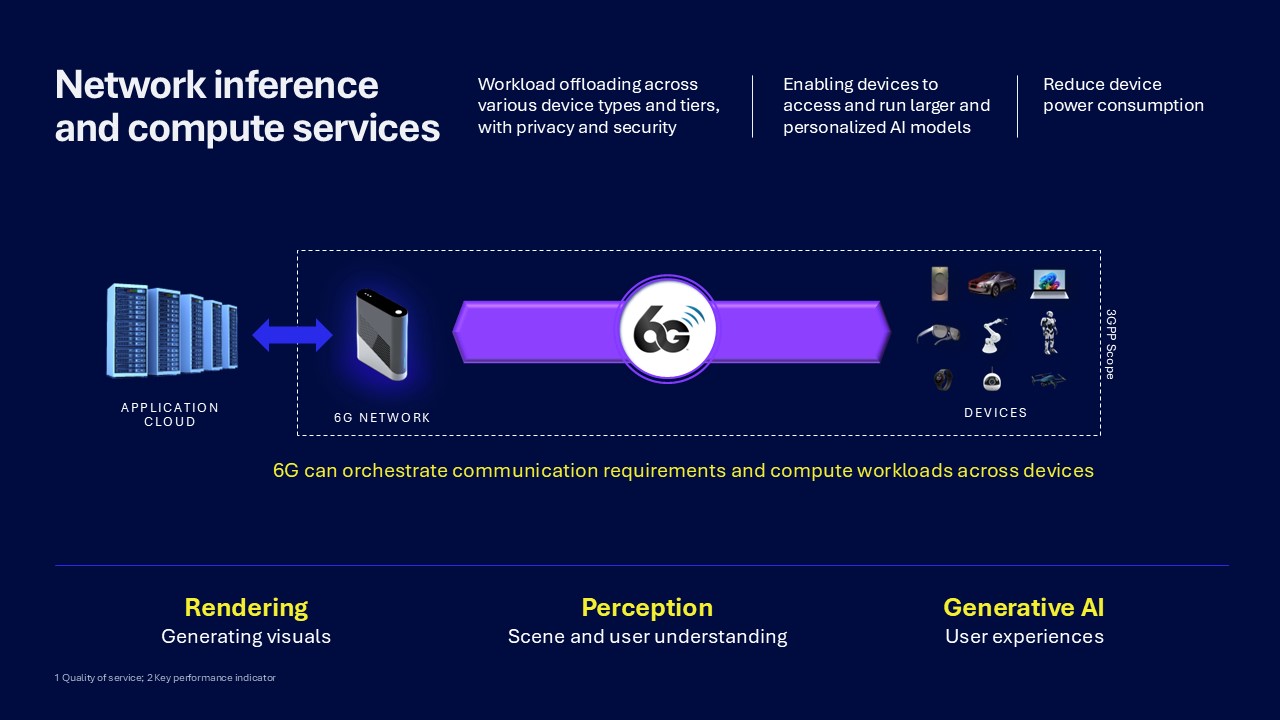
The implications are profound. In an AI-native 6G network, every network unit—base stations, terminals, core networks—carries built-in AI computing power. As Zhou Xu, director at the Chinese Academy of Sciences’ Computer Network Information Center, explained at the 2026 Zhongguancun Forum, “AI agents won’t just live in distant data centers. They’ll be right beside you—in your phone, on the base station you’re connected to, even on routing nodes.”
This distributed intelligence model solves a problem that centralized AI architectures cannot: latency. When you interact with today’s AI assistants, the perceptible delay between query and response stems from the physical distance your data must travel to centralized data centers and back. In the 6G architecture being tested in China, inference happens at the network edge—on the base station you’re connected to, or even on your device itself—reducing response times to the point where the experience becomes genuinely seamless.
Why China Moved First: Infrastructure Meets Ambition
China’s head start in testing AI-integrated 6G networks isn’t accidental. It emerges from a convergence of structural advantages that few other nations can replicate simultaneously.
First, scale. China operates the world’s largest 5G network, with nearly five million base stations deployed nationwide as of early 2026. 5G-Advanced coverage has already reached 330 cities, with over ten million users by mid-2025. This massive installed base provides the physical foundation onto which 6G capabilities can be layered incrementally, rather than requiring a greenfield buildout.
Second, patent leadership. As of mid-2024, China held the leading global position in 6G-related patent applications. Researchers at Purple Mountain Laboratories have pioneered spacetime two-dimensional channel coding—a breakthrough that resolves the historical “impossible triangle” of balancing latency, reliability, and throughput in wireless communications.
Third, and perhaps most importantly, China’s operators have spent years preparing the computing substrate that AI-native networks require. China Mobile’s edge computing architecture, developed through its “Pioneer 300” initiative and Open Laboratory program, has already deployed testbeds across smart cities, intelligent manufacturing, live gaming, and vehicle interconnection—fifteen distinct projects with partners including Huawei, Tencent, Intel, and Baidu. These weren’t vanity projects; they were deliberate steps toward building an “all-access computing plane” that sits atop the network plane, creating what China Mobile describes as “end-to-end computing resources coverage.”
The Technical Architecture: How Inference Moves Into the Network
The mechanics of running AI inference inside the network involve several interconnected innovations that China’s operators are currently validating.
At the infrastructure layer, China Mobile is building what it calls a unified “computing network” anchored by large-scale intelligent computing centers, organized in an “edge-to-core” hierarchical architecture. This isn’t cloud computing as traditionally understood—it’s a deliberately distributed system where inference workloads are placed according to latency, bandwidth, and computational requirements. Some models run on user devices. Others run on edge servers in city-level equipment rooms. The most demanding training workloads still go to centralized intelligent computing centers. But the key insight is that inference—the real-time application of trained models—can be distributed throughout this hierarchy.
China Telecom’s deployment in Shanghai illustrates what this looks like in practice. The operator launched what the GSMA described as China’s first commercial “5G-Advanced × AI massive-uplink network,” upgrading more than 5,000 sites to deliver peak uplink speeds of 1 Gbps and continuous 20 Mbps uplink coverage in key urban areas. The emphasis on uplink capacity matters enormously for AI inference: while traditional consumer applications are dominated by downloads, AI services require substantial upload bandwidth as devices send sensor data, video streams, and contextual information to edge inference nodes.
The research community has formalized these concepts under the framework of “Mobile Edge Generation” (MEG), where generative AI models are distributed across edge servers and user equipment to enable joint execution of generation tasks. Rather than transmitting full inputs and outputs across the network, MEG protocols transfer compressed “seeds” or “sketches” between distributed model components—reducing communication overhead dramatically while maintaining generation quality even under extremely poor signal conditions.
From Theory to Application: What the Tests Are Actually Validating
The Pre-6G test network in Nanjing isn’t running abstract benchmarks. It’s validating four specific application domains that stress-test different aspects of AI-integrated network infrastructure.
Low-altitude inspections test the network’s ability to support real-time computer vision and navigation for drone fleets operating beyond visual line of sight. These applications require the network to process video feeds, run object detection models, and transmit control commands with millisecond-level latency—all while the aircraft moves at speed through three-dimensional space.
Industrial manufacturing validates how AI inference at the network edge can support real-time quality control, predictive maintenance, and adaptive process optimization. In these environments, a delayed inference result isn’t merely inconvenient—it can mean defective products rolling off production lines or machinery failures causing costly downtime.
Embodied intelligence—the integration of AI into physical robotic systems—represents perhaps the most demanding test case. As noted in China’s 6G vision documentation, future networks could enable embodied AI robots to “offload computation-intensive tasks to nearby 6G base stations, yielding lighter, more durable, and cost-effective units.” This isn’t speculative; it’s the difference between robots that can operate autonomously in the field versus those tethered to local computing infrastructure.
Holographic communications push the network’s bandwidth and latency boundaries simultaneously. Real-time holographic presence requires not just raw throughput but synchronized, low-latency transmission of volumetric data that current networks simply cannot support.
The Global Implications
The convergence of wireless networks and AI inference carries geopolitical and economic weight that extends far beyond technical specifications. As analysts at the Center for Strategic and International Studies have observed, “with 6G, there may be a convergence of computing and communications, making mobile networks a distributed and global inference engine.”
Centralized data centers will retain significant roles in AI training and large-scale data processing. But wireless networks are poised to capture a growing share of the inference and rendering computation ecosystem—particularly for applications where latency, privacy, or connectivity constraints make cloud-only architectures impractical.
China’s early testing program gives its operators, equipment vendors, and standards bodies practical experience that will shape international 6G standards discussions. When the 3GPP and ITU begin formal 6G standardization processes in earnest, China’s representatives will be arguing from positions validated in live network deployments rather than theoretical simulations.
The integrated sensing and communications (ISAC) capabilities being tested alongside AI inference add another dimension. The same networks that transmit data will also gather localized environmental information—enabling applications from drone detection to health monitoring to emergency response. These aren’t features that can be easily retrofitted onto existing infrastructure; they require the kind of fundamental architectural rethink that China’s Pre-6G tests are currently validating.
The Road Ahead: Commercial Reality by 2030
Chinese experts project early commercialization of 6G by 2030—a timeline that once seemed aggressive but now appears increasingly plausible given the pace of testing and validation. The current phase, running through 2028, focuses on integrating individual validated technologies into real devices and end-to-end systems.
For China’s operators, the business logic is compelling. Running AI inference inside the network transforms telecom infrastructure from a cost center into a revenue-generating compute platform. Rather than merely charging for data transit, operators can offer inference-as-a-service, edge AI hosting, and real-time intelligent network optimization to enterprise customers. The “token supermarket” model that China Mobile’s MoMA platform hosts—offering over 300 mainstream AI models for enterprise adoption—suggests the commercial framework is already taking shape.
The transition won’t be frictionless. Yue Wang’s assessment that “AI systems must meet telecom requirements because live carrier networks are critical infrastructure and cannot rely on uncontrolled decisions” highlights the reliability challenge. AI models that behave unpredictably—hallucinating, generating inconsistent outputs, or failing silently—pose unacceptable risks when embedded in network control planes. The testing phase currently underway is as much about validating AI reliability under telecom-grade constraints as it is about proving raw performance.
Yet the direction is unmistakable. While other nations debate 6G timelines and research priorities, China’s telecommunications operators are already running AI inference workloads on live network infrastructure, validating the architecture that will define the next generation of mobile communications. The question is no longer whether AI belongs inside the network—it’s how quickly the rest of the world can catch up to the standards and capabilities being established in Chinese testbeds today.