SpaceX Rocket Stage Confirmed to Have Crashed Into the Moon, Creating a New Lunar Crater and Opening a Rare Scientific Opportunity
Published: August 6, 2026
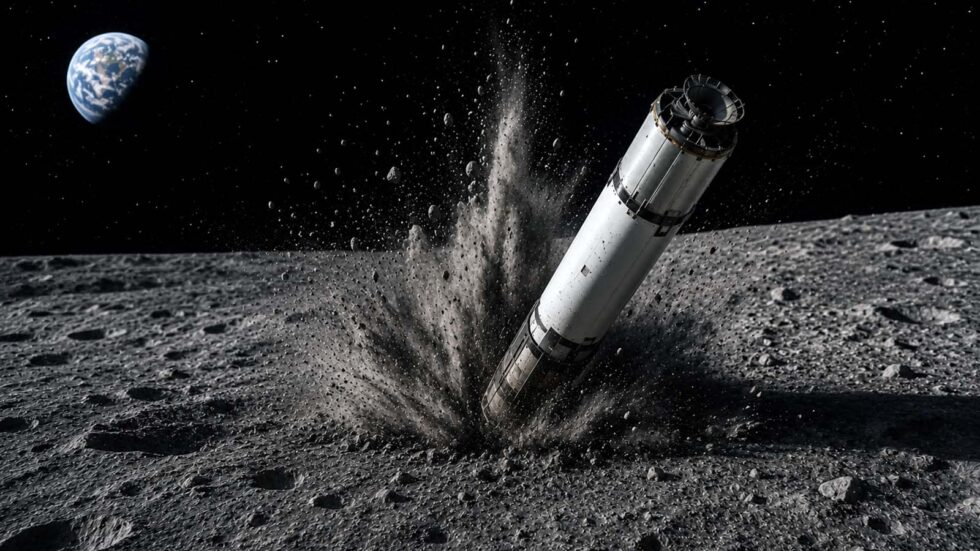
A piece of a SpaceX rocket that spent more than a year drifting through deep space has officially slammed into the Moon, leaving behind a newly formed crater and giving scientists an unexpected chance to study one of the rarest types of impacts ever observed.
NASA has now confirmed that the upper stage of a Falcon 9 rocket struck the lunar surface after tracking its predicted trajectory and analyzing post-impact observations. Although the collision posed no threat to Earth or future lunar missions, it marks one of the few accidental impacts of a large human-made object on the Moon.
Unlike the countless meteoroids that strike the lunar surface every year, this was an impact involving modern space hardware—an event researchers say will improve understanding of lunar geology, impact physics, and the growing challenge of managing space debris beyond Earth.
A Mission That Didn’t End After Launch
The object that struck the Moon was the upper stage of a SpaceX Falcon 9 rocket launched in January 2025. The mission successfully delivered two commercial lunar landers toward their destinations, while the rocket’s reusable first stage safely returned to Earth.
The upper stage, however, continued its journey after completing its final engine burn. Normally, SpaceX performs carefully planned disposal maneuvers for such stages, ensuring they move into safe orbits or are directed away from operational spacecraft.
According to mission officials, those procedures were carried out successfully. But space is far from static.
Over the following months, subtle gravitational forces from the Earth and Moon, combined with changing solar activity, gradually altered the rocket stage’s orbit. The cumulative effect eventually redirected the four-tonne spacecraft toward an unavoidable collision with the Moon.
Rather than correcting its course, the empty booster became an unintentional lunar impactor.
A High-Speed Collision
NASA confirmed the impact occurred in the Moon’s northern hemisphere near the Einstein Crater, a large impact basin on the lunar far side.
Traveling at nearly 8,700 kilometers per hour (about 5,400 mph), the approximately 4,000-kilogram rocket stage slammed into the surface with enormous kinetic energy.
Even though the booster was relatively small compared to natural asteroids, its tremendous speed ensured a powerful collision capable of excavating a fresh crater and ejecting significant amounts of lunar material into space.
Scientists expect the newly formed crater to measure several meters across, though precise dimensions will depend on the angle of impact, the structure of the lunar soil, and the condition of the rocket stage at the moment of collision.
NASA Captures the Aftermath
The confirmation came after spacecraft orbiting the Moon photographed the impact site.
NASA’s Lunar Reconnaissance Orbiter, which has spent years mapping the Moon in extraordinary detail, identified a new scar on the lunar surface consistent with pre-impact predictions.
South Korea’s Pathfinder Lunar Orbiter also contributed observations that helped scientists verify the exact location.
Researchers are now comparing before-and-after images to calculate the crater’s size, analyze the surrounding ejecta field, and better understand how artificial objects behave when they strike airless planetary bodies.
Unlike impacts on Earth, where weather quickly erases fresh craters, the Moon preserves these features for millions—even billions—of years.
The Falcon 9 upper stage has therefore become a permanent part of the lunar landscape.
An Unexpected Science Experiment
Although accidental, researchers say the collision provided an unusually valuable scientific opportunity.
Most lunar impacts happen without warning because they involve tiny meteoroids arriving unpredictably from space.
In this case, scientists knew the object’s mass, approximate shape, speed, and expected impact location months in advance.
That allowed observatories around the world to prepare telescopes, cameras, and instruments before the collision occurred.
Professional astronomers joined amateur skywatchers in attempting to observe the flash of impact and the cloud of dust thrown into sunlight.
Whether the dust plume reached the brightness predicted by computer models remains under investigation, but early observations are expected to help refine future impact simulations.
Researchers believe these findings could improve preparations for upcoming lunar exploration missions.
Preparing for Humanity’s Return to the Moon
The timing of the impact is particularly significant.
NASA and several international partners are working toward establishing a sustained human presence on and around the Moon through future exploration missions.
As more spacecraft travel between Earth and the Moon, understanding the risks posed by abandoned rocket stages and other artificial debris is becoming increasingly important.
Engineers must account for everything from orbital congestion to accidental impacts that could threaten valuable scientific equipment or future lunar infrastructure.
The Falcon 9 incident serves as a reminder that even successful missions continue to influence the space environment long after their primary objectives have been completed.
While this collision occurred safely away from planned landing sites, future traffic around the Moon is expected to increase dramatically over the coming decades.
Space Junk Is No Longer Just an Earth Problem
For years, discussions about space debris focused almost entirely on Earth’s orbit.
Thousands of inactive satellites, spent rocket stages, and fragments from previous collisions now circle the planet, creating growing risks for astronauts and operational spacecraft.
According to the European Space Agency, more than 46,000 tracked objects currently orbit Earth, with a combined mass of approximately 17,000 tonnes.
The Moon has historically remained relatively free of artificial debris because comparatively few missions have traveled there.
However, that is changing rapidly.
Government agencies and private companies are launching increasing numbers of lunar missions aimed at scientific exploration, resource prospecting, communications, and eventually human settlement.
Each mission introduces new hardware into cislunar space, increasing the importance of responsible disposal strategies.
Experts say preventing unnecessary debris around the Moon now will be far easier than trying to solve a major debris problem decades from now.
Lessons From the Apollo Era
Artificial impacts on the Moon are not entirely unprecedented.
During the Apollo program in the late 1960s and early 1970s, NASA intentionally crashed spent spacecraft components into the lunar surface.
Those deliberate impacts generated seismic waves that were recorded by instruments left behind by astronauts, helping scientists investigate the Moon’s internal structure.
The newly confirmed Falcon 9 impact differs because it was never intended as part of a scientific experiment.
Instead, researchers have adapted the unexpected event into a valuable research opportunity using modern spacecraft, advanced imaging systems, and sophisticated computer models unavailable during Apollo.
The result may produce one of the most thoroughly documented accidental impacts in spaceflight history.
A Reminder of the Complexity of Spaceflight
The collision also highlights an often-overlooked reality of modern space exploration.
Launching a spacecraft is only one part of a mission.
Managing hardware after its operational life has ended is becoming an equally important responsibility.
As exploration expands beyond Earth orbit, mission planners must consider how abandoned spacecraft interact with complex gravitational environments involving Earth, the Moon, and the Sun.
Even small changes in solar radiation or gravitational influences can gradually reshape an object’s trajectory over months or years.
The Falcon 9 upper stage followed exactly that path—transforming from an ordinary piece of retired hardware into an unexpected visitor to the Moon.
Looking Ahead
Scientists will continue studying the newly formed crater for months, and perhaps years, as additional orbital images become available.
The observations are expected to improve computer models of lunar impacts, refine techniques for identifying fresh craters, and strengthen future strategies for managing spacecraft after their missions end.
While the collision leaves a permanent mark on the Moon, its greatest legacy may be the scientific knowledge gained from an event that no one originally planned.
In an era when humanity is preparing to return to the Moon in greater numbers than ever before, every lesson matters. This accidental impact serves as both a reminder of the challenges of responsible space exploration and an illustration of how even unexpected events can advance our understanding of the solar system.