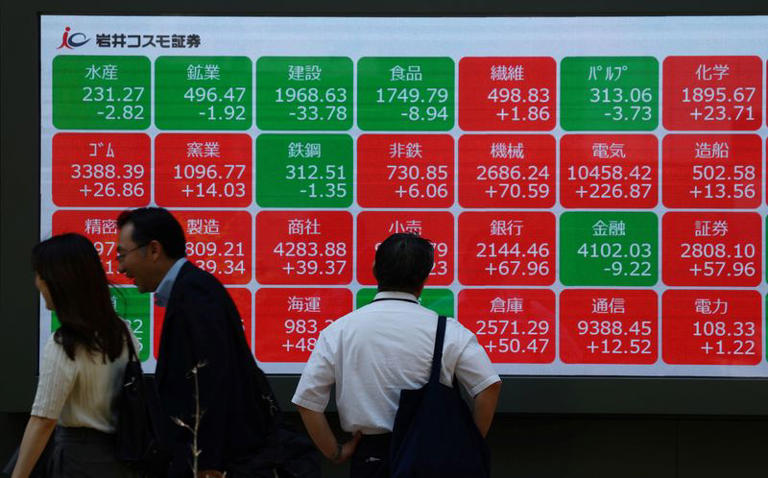
Other major technology companies, including Reddit and Amazon, also recorded losses as investors reassessed the financial outlook for an industry that has become increasingly dependent on expectations surrounding artificial intelligence.
The Nasdaq index, which tracks some of the largest technology companies listed in the United States, ended October with its steepest monthly decline since March 2025, highlighting growing uncertainty across the technology sector.
At the centre of the market turbulence is the extraordinary amount of money being invested in AI infrastructure, including advanced computer chips, data centres and cloud computing facilities. Major technology companies have significantly increased their spending commitments as they compete to develop more powerful AI systems and establish dominance in the rapidly expanding market.
Meta, Alphabet, Oracle, Amazon and Microsoft have collectively committed approximately $800 billion in spending for 2026, much of it directed towards artificial intelligence infrastructure and related investments.
However, investors are increasingly questioning whether the companies will be able to turn these massive expenditures into sustainable revenue growth and profits. While AI products have attracted considerable attention and corporate investment, earnings and financial projections have not always matched the expectations built into technology stock valuations.
This growing gap between investment and returns has fuelled concerns that the industry could be experiencing an artificial intelligence bubble, with company valuations increasingly reflecting future promises rather than demonstrated financial performance.
Alphabet has been among the companies facing particular scrutiny. Its shares suffered a significant setback on Thursday after investors reacted to concerns surrounding the impact of AI-generated search summaries on the company’s traditional advertising business.
Google has increasingly incorporated AI-powered summaries at the top of search results, providing users with direct answers rather than requiring them to click through multiple websites. Although the feature represents a major shift in the company’s search technology, questions have emerged over whether it could affect the advertising model that has historically generated a substantial portion of Google’s revenue.
The concerns contributed to a sharp fall in Alphabet’s market valuation, wiping more than $500 billion from its market capitalisation in Thursday’s trading session.
The decline came despite the company’s continued investment in artificial intelligence. Alphabet has indicated that its capital expenditure could reach as much as $205 billion this year, with the overwhelming majority of the spending linked to AI-related infrastructure and development.
The scale of the planned investment has raised questions about the balance between long-term technological ambitions and the need to maintain profitability. Investors are looking for clearer evidence that AI-powered products can generate sufficient advertising revenue, subscriptions and enterprise demand to support the growing costs.
Intel, meanwhile, experienced an even steeper decline on Friday. Its 28% share-price plunge made it one of the biggest contributors to the day’s technology market losses, with more than $130 billion wiped from its market value.
The wider market reaction suggests that investors are becoming more selective about technology companies’ AI strategies. Simply announcing large investments or introducing new AI products may no longer be enough to reassure shareholders, who increasingly want measurable evidence of commercial success.
For the major technology firms, the challenge is becoming more complicated. They must continue investing heavily to remain competitive in an industry developing at extraordinary speed, while also demonstrating that the spending can translate into stronger earnings and long-term shareholder value.
The latest sell-off has therefore brought renewed attention to the financial risks surrounding the global AI boom. Although artificial intelligence continues to attract significant investment and interest, the market’s reaction indicates that investors are increasingly focused on the costs, commercial prospects and profitability of the technology.
With hundreds of billions of dollars committed to AI development in 2026, the coming months could prove important in determining whether the current investment wave produces sustainable business growth or whether expectations have moved too far ahead of actual returns.