
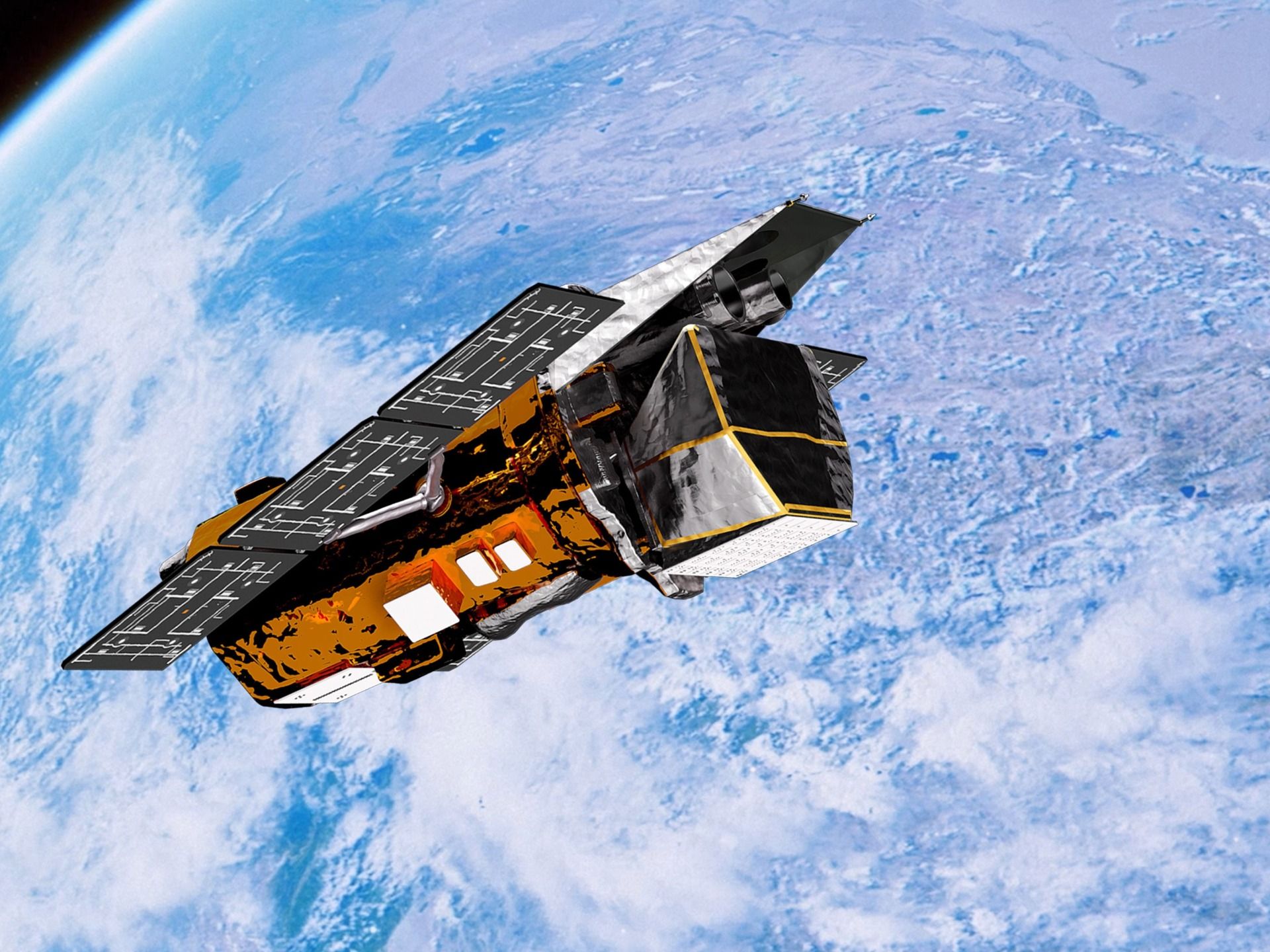
The observatory, officially known as the Neil Gehrels Swift Observatory, re-entered Earth’s atmosphere at approximately 7:39 a.m. EST (12:39 GMT) on November 4, passing over northern Sumatra, Indonesia, according to satellite tracker Jonathan McDowell, who cited US Space Force data.
Weighing approximately 3,200 pounds (1,450 kilograms), the spacecraft had been gradually losing altitude because of atmospheric drag. NASA had expected most of the observatory to burn up during re-entry, with only a small possibility that surviving debris would reach the ground.
Before its return, NASA estimated the probability of any surviving pieces injuring someone on Earth at just 1 in 2,100, suggesting that the uncontrolled re-entry was unlikely to cause significant damage or casualties.
The spacecraft’s destruction marks the conclusion of an extraordinary mission that significantly exceeded its original operational expectations. Launched in November 2004, Swift was initially designed to operate for just two years. Instead, it continued collecting valuable scientific observations for more than two decades.
Its primary objective was to detect and study gamma-ray bursts (GRBs), extraordinarily powerful cosmic explosions that can release enormous amounts of energy within seconds.
Swift was specifically designed to identify these distant explosions, determine their locations and rapidly redirect its telescopes towards them before their fading afterglows disappeared.
The observatory could complete this entire process in approximately one minute, allowing scientists on Earth and other space-based observatories to investigate these extraordinary events in unprecedented detail.
S. Bradley Cenko, Swift’s principal investigator at NASA’s Goddard Space Flight Center in Maryland, previously explained that the spacecraft’s ability to rapidly change its viewing direction was central to its scientific success.
However, Swift’s scientific contributions extended far beyond gamma-ray bursts. Throughout its operational lifetime, the observatory studied distant supernova explosions, black holes consuming surrounding material, asteroids, comets and numerous other astronomical phenomena.
Its observations helped scientists better understand the changing universe and demonstrated the importance of quickly responding to unpredictable cosmic events.
In 2018, the spacecraft was renamed the Neil Gehrels Swift Observatory in honour of its first principal investigator, Neil Gehrels, who died in 2017.
NASA officials have repeatedly praised the observatory for delivering scientific results far beyond what was originally expected.
“Swift delivered an incredible, lasting return on investment for the nation, designed for a two-year primary mission but productive for more than 10 times as long,” Shawn Domagal-Goldman, director of NASA’s Astrophysics Division, said in an October 23 statement.
He added that Swift played a major role in advancing humanity’s understanding of the changing universe and demonstrated how rapid-response observations could benefit the wider astrophysics community.
Interestingly, Swift completed its final scientific observation on October 20, just 15 days before its eventual re-entry into Earth’s atmosphere.
Failed rescue mission sealed Swift’s fate
The observatory’s return to Earth was not entirely unexpected. Its altitude had been gradually declining because it lacked onboard thrusters capable of counteracting atmospheric drag.
As it descended into lower orbital altitudes, atmospheric resistance increased, accelerating its fall towards Earth.
NASA had attempted to prevent the spacecraft’s premature destruction through an ambitious commercial partnership aimed at extending its operational life.
In September 2025, the agency awarded Arizona-based company Katalyst Space a $30 million contract to develop, launch and operate a robotic spacecraft capable of capturing Swift and boosting it into a higher orbit.
The project was designed as a pioneering satellite-servicing mission that could demonstrate how ageing spacecraft might be rescued and kept operational rather than abandoned in orbit.
Katalyst developed a refrigerator-sized robotic vehicle called LINK, equipped with three mechanical arms intended to capture and reposition the observatory.
The spacecraft launched successfully on July 3, 2026, with the original plan targeting an August rendezvous with Swift.
However, the rescue attempt encountered serious technical difficulties.
LINK experienced problems with its propulsion system and reaction wheels, which are essential for maintaining a spacecraft’s orientation in orbit. These failures prevented the vehicle from completing the planned rendezvous and capturing Swift.
The situation ultimately proved impossible to recover, and LINK itself re-entered Earth’s atmosphere on September 25, ending the rescue mission before it could save the ageing observatory.
Despite the failure, NASA considered the project a valuable technological experiment.
Domagal-Goldman described the effort as a high-risk, high-reward mission, arguing that it provided important opportunities to advance American spacecraft-servicing technology and test new approaches to extending satellite lifetimes in low Earth orbit.
The experiment could also help shape future missions involving the maintenance, repair and repositioning of satellites.
Growing space debris presents another challenge
Swift’s final descent also highlights a broader problem facing the increasingly crowded orbital environment around Earth.
The spacecraft’s return was not an isolated event. A 2025 report estimated that at least three large pieces of space debris, including defunct satellites and discarded rocket bodies, re-enter Earth’s atmosphere every day on average.
That number could increase significantly as governments and private companies continue launching thousands of satellites to build massive orbital networks.
Companies such as SpaceX are expanding satellite internet constellations, while other operators are developing competing systems for communications and global connectivity.
Although most objects burn up during atmospheric re-entry, the growing volume of orbital traffic raises questions about collision risks, debris management and the long-term sustainability of space activities.
For NASA, Swift’s departure represents the loss of a remarkably productive scientific observatory. Its failed rescue also demonstrates how difficult and technically demanding satellite servicing can be.
After 22 years in orbit, Swift’s mission is over, but the scientific discoveries it delivered will continue helping astronomers understand some of the universe’s most violent and mysterious events.


