
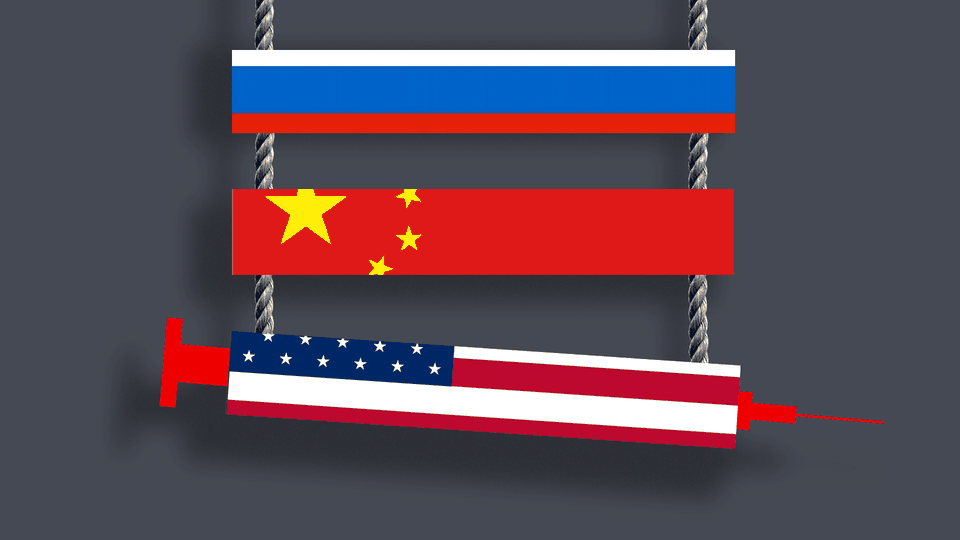
How Rivalry Between Major Powers Could Redraw the World Map- Throughout history, competition between powerful states has often reshaped the political map of the world. Borders have shifted, new countries have emerged, and entire regions have been reorganized due to conflicts between dominant powers. In the twenty-first century, rivalry among major powers is once again intensifying. Strategic competition involving countries such as the United States, China, and Russia is not only influencing diplomacy and security but also raising questions about whether global borders and political alignments could change in the future.
Although the world today is more interconnected than ever before, geopolitical rivalry still has the potential to transform territories, alliances, and spheres of influence.
1. Why Great-Power Rivalries Shape Borders
When major powers compete, smaller states often become arenas of influence. These rivalries can affect borders in several ways:
Military conflict: Wars between powerful states or their allies can lead to territorial changes.
Political fragmentation: Internal divisions within states may intensify when rival powers support different factions.
Creation of new states: Independence movements sometimes gain momentum with external support.
Expansion of influence zones: Powerful states may not annex territory directly but can reshape political geography through alliances or protectorates.
These processes have historically reshaped the world map many times.
2. Historical Examples of Rivalry Changing Borders
The Post-World War Rearrangement
After World War II, the global order was dramatically restructured. The defeat of Germany and Japan led to territorial changes across Europe and Asia. Germany itself was divided into two separate states aligned with opposing ideological blocs. Eastern Europe fell under Soviet influence, while Western Europe aligned with the United States and its allies.
This division created a geopolitical boundary that lasted for decades.
The Breakup of the Soviet Union
The collapse of the Soviet Union in 1991 is another powerful example of how great-power dynamics reshape geography. Fifteen new independent states emerged from the former Soviet republics. This transformation dramatically altered the political landscape of Eurasia.
The end of the Cold War reduced ideological rivalry temporarily, but it also created new security challenges and disputes over borders and influence.
The Dissolution of Yugoslavia
During the 1990s, Yugoslavia broke apart into multiple independent states following ethnic tensions and international involvement. The wars that followed resulted in new national borders across the Balkans.
This process demonstrated how internal divisions, combined with external pressures, can reshape entire regions.
3. Modern Rivalries and Potential Geographic Shifts
Today’s geopolitical competition differs from earlier eras in important ways. Direct wars between major powers remain unlikely due to the risks involved, especially with nuclear-armed states. However, rivalry still manifests through indirect competition, regional conflicts, and strategic influence.
Several regions illustrate how modern rivalries might influence future borders.
Eastern Europe
Eastern Europe remains a key area where geopolitical competition could influence territorial arrangements. Conflicts and tensions between Russia and Western powers have created uncertainty about regional stability.
Border disputes, security alliances, and military positioning in this region highlight how geopolitical rivalry can reshape influence zones, even without large-scale territorial annexation.
The Indo-Pacific
The Indo-Pacific has become a major center of global strategic competition. Rising tensions over maritime territories and influence are shaping regional alliances.
Disputes over islands and sea boundaries could eventually lead to changes in administrative control or new security arrangements. While these changes may not immediately alter internationally recognized borders, they can transform effective control over strategic areas.
The Middle East
The Middle East remains one of the most geopolitically complex regions in the world. Rivalries among global powers intersect with regional tensions, creating an environment where borders and political structures remain fragile.
Conflicts in parts of the region have already produced semi-autonomous territories, shifting alliances, and new political actors. External powers sometimes support different factions, influencing the outcome of regional disputes.
This makes the region particularly sensitive to the effects of great-power competition.
4. New Forms of Territorial Influence
Unlike earlier centuries, modern geopolitical rivalry does not always require formal annexation or border changes. Instead, influence may be exercised in less visible ways.
Strategic Bases
Countries establish overseas military bases to extend their strategic reach. These bases may not change borders, but they expand a nation’s geopolitical footprint.
Economic Corridors
Infrastructure projects such as railways, ports, and energy pipelines can reshape regional connectivity. By controlling key economic corridors, powerful states can increase their influence over neighboring regions.
Digital and Technological Domains
Competition in technology, cyber capabilities, and satellite systems has introduced a new dimension to geopolitical rivalry. Control over digital infrastructure can affect sovereignty and security without altering physical borders.
5. Why the Modern World Map Is Harder to Change
Despite ongoing rivalries, changing borders today is much more difficult than in the past. Several factors contribute to this stability.
International law: Global norms discourage territorial conquest.
Economic interdependence: Countries rely heavily on trade, making large-scale conflicts economically costly.
Nuclear deterrence: The presence of nuclear weapons discourages direct wars between major powers.
International organizations: Institutions and diplomatic mechanisms help manage disputes and reduce the risk of escalation.
Because of these constraints, territorial changes today often occur gradually or indirectly rather than through large-scale wars.
6. Possible Future Scenarios
Looking ahead, great-power rivalry could reshape the global map in several ways:
Fragmentation of unstable states: Internal conflicts may produce new political entities.
Shifting spheres of influence: Regions may align more closely with particular major powers.
Autonomous territories gaining recognition: Some regions may seek independence with international backing.
Control over strategic maritime zones: Competition for sea routes and resources may redefine effective territorial control.
While dramatic border changes remain unlikely in the near term, gradual geopolitical shifts could still transform how the world map functions politically and strategically.
In Summary
Great-power rivalry has historically played a central role in shaping the world’s borders and political order. From the aftermath of world wars to the collapse of major states, competition between powerful nations has repeatedly redrawn the global map.
In the modern era, however, geopolitical competition operates within a more interconnected and regulated international system. Rather than dramatic territorial conquest, rivalry now influences political alignments, regional stability, and strategic influence.
The world map may not change as visibly as it did in earlier centuries, but the forces shaping it remain active. As major powers continue to compete for influence, the political geography of the world will likely evolve—sometimes subtly, sometimes dramatically—reflecting the shifting balance of global power.


