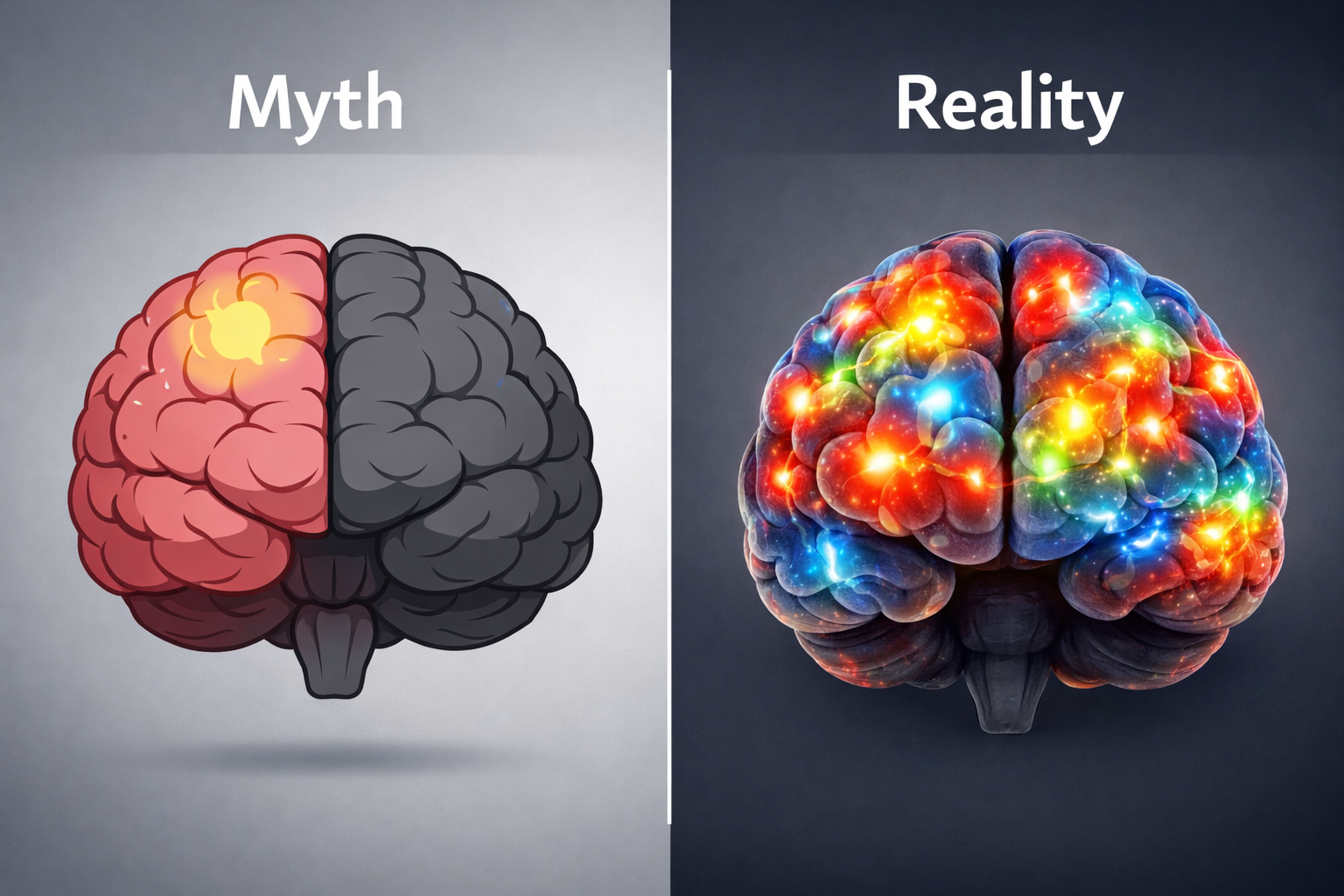
Can Humans Ever Use 100% of Their Brain? Myth vs Science- Few ideas about the human body have proven as stubborn — or as seductive — as this one: that we only use 10% of our brains, and that somewhere inside each of us lies a vast, untapped reservoir of mental potential waiting to be unlocked. It has powered Hollywood blockbusters, sold self-help books by the millions, and been casually repeated in classrooms and dinner conversations for decades. There is just one problem with it. It is completely false.
But dismissing it as a myth is only half the story. The more interesting question is what the science actually says — because the truth about how the brain works is, in many ways, more remarkable than the fiction.
Where the Myth Came From
No one has pinpointed a single origin for the 10% claim, which is itself telling. It does not come from a landmark study or a misquoted neuroscientist. Instead, it appears to have accumulated over time from several loosely connected sources that became tangled together in popular culture.
One thread leads to the early twentieth century, when psychologist William James wrote that humans “make use of only a small part of our possible mental and physical resources.” He was talking about motivation and effort, not neural anatomy — but the line proved easy to strip of context. Another thread traces to early neuroscience research, where scientists noticed that damaging certain brain regions did not always produce obvious deficits, leading some to assume those areas were inactive or redundant. Misreadings of glial cell research (the support cells of the brain, which outnumber neurons) may also have contributed. And somewhere along the way, the vague idea crystallised into a specific, memorable number: 10%.
By the time self-improvement culture picked it up in the twentieth century, the claim had taken on a life of its own. It was too neat and too motivating to fact-check.
What Brain Imaging Actually Shows
Modern neuroscience has the tools to put this myth to rest definitively, and it has done exactly that.
Techniques like functional MRI (fMRI) and positron emission tomography (PET) allow researchers to observe brain activity in real time by tracking blood flow and metabolic changes across different regions. What these scans consistently reveal is that virtually all parts of the brain show activity, and no significant region sits permanently dark and dormant.
Different tasks light up different areas. Reading activates visual processing regions and language centres. Solving a maths problem draws on the prefrontal cortex and parietal lobes. Listening to music engages auditory cortex, memory networks, and emotional processing areas simultaneously. Even during sleep, large portions of the brain remain highly active — the hippocampus consolidates memories, the default mode network hums with internal processing, and the brain cycles through restorative phases that are essential to daytime function.
There is no scan that shows 90% of the brain sitting unused while the other 10% does all the work. That image simply does not exist in the data.
The Brain Is Too Expensive to Waste
Beyond imaging, there is a compelling evolutionary and metabolic argument against the myth.
The human brain accounts for roughly 2% of total body weight, yet it consumes approximately 20% of the body’s energy at rest. This is an extraordinary demand. The brain requires a continuous supply of glucose and oxygen to function; even brief interruptions — seconds of lost blood flow — begin to cause damage. Neurons that are not used tend to weaken or be pruned away through a process called synaptic pruning, which the brain uses to improve efficiency rather than maintain idle capacity.
In short, the brain is among the most metabolically expensive organs in the animal kingdom. Evolution does not preserve costly tissue without function. If 90% of the brain truly sat idle, natural selection would have dramatically reduced its size over millions of years. The fact that the human brain is as large and energy-hungry as it is argues strongly that every part of it earns its keep.
Neurological evidence makes the same point from a different angle. If 90% of the brain were expendable, damage to most of it should produce little to no effect. In reality, injury to almost any brain region produces specific and often devastating consequences — memory loss, personality changes, loss of motor control, language impairment, disrupted emotional regulation. There is no large section of the brain you can lose without paying a significant price.
So What Does “Using More of Your Brain” Actually Mean?
Here is where the science gets genuinely interesting, because while the 10% myth is wrong, the idea that brain performance can be improved is not.
Neuroplasticity — the brain’s ability to reorganise itself by forming new neural connections throughout life — is one of the most significant discoveries in modern neuroscience. Learning a new skill, practising a musical instrument, acquiring a second language, or regularly engaging in complex problem-solving all physically reshape the brain. New synaptic connections form, existing pathways strengthen, and certain regions actually grow in density and efficiency.
Studies of London taxi drivers, who must memorise vast networks of streets, have shown measurable enlargement in the hippocampus — the brain region central to spatial navigation and memory. Musicians show enhanced connectivity between auditory and motor regions. Meditation practitioners demonstrate structural changes in areas related to attention and emotional regulation.
None of this means unused brain regions are being switched on. What it means is that the brain’s existing circuits become more efficient, better connected, and more capable through deliberate use and challenge. It is less about quantity of brain activity and more about the quality, organisation, and depth of neural connections.
Sleep, physical exercise, nutrition, and stress management also meaningfully influence cognitive performance — not by activating dormant brain matter, but by maintaining the biological conditions under which the brain’s full existing capacity can function at its best.
Why the Myth Refuses to Die
Part of the myth’s durability is psychological. The idea that we are each sitting on a vast reserve of unused genius is profoundly appealing. It reframes human limitation as something temporary and correctable — a lock waiting for the right key. Films like Lucy and Limitless have made this fantasy vivid and entertaining, even while neuroscientists roll their eyes in the back row.
But comfort and scientific accuracy are different things. The brain you have is not 10% operational. It is a dense, energy-hungry, constantly active organ that never fully switches off, adapts continuously to experience, and has been shaped over millions of years to perform exactly the functions it performs — with remarkable efficiency.
Final Thoughts: The Real Potential Is Already Running
The 10% myth sells humans short in an ironic way. By suggesting that most of the brain is unused, it implies the organ is wasteful and underperforming by default. The science tells a different story: the brain is almost always doing far more than we consciously notice, and its real potential lies not in unlocking dormant sections, but in deepening, sharpening, and sustaining the extraordinary capacity that is already there.
That is a less dramatic story than a magic pill that opens the other 90%. But it is a truer one — and in the long run, it is far more useful.
Can Developing Nations Afford a Green Transition Amid Rising Debt? | Maya