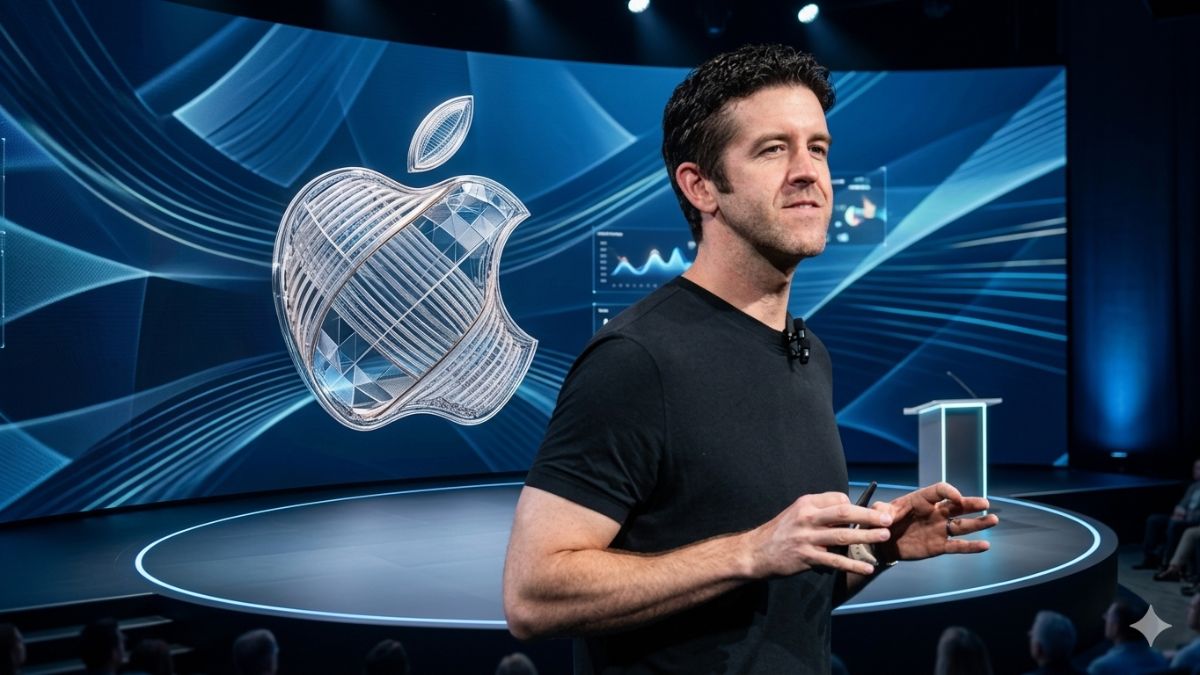
Apple’s Leadership Shift Signals a Hardware-First AI Future- Apple is entering a pivotal new chapter as it works to stay competitive in artificial intelligence while navigating mounting global pressures. The company announced that John Ternus will take over as CEO later this year, succeeding Tim Cook—a transition that could reshape Apple’s long-term strategy at a critical moment.
Cook’s tenure transformed Apple into one of the most valuable companies in history, pushing it to a $4 trillion valuation while expanding its services ecosystem and delivering record profitability. Under his leadership, Apple refined its supply chain, scaled its global reach, and strengthened recurring revenue streams. However, as the tech industry pivots toward AI-driven innovation, Apple now faces pressure to define its next era of growth.
Ternus brings a distinctly different background to the role. A longtime hardware leader, he joined Apple in 2001 and steadily rose through the ranks of engineering. Unlike Cook, whose expertise centered on operations and business strategy, Ternus is deeply rooted in product development, having played a key role in shaping devices such as AirPods, Apple Watch, and Vision Pro.
His appointment signals a renewed emphasis on hardware innovation, particularly as Apple seeks to integrate artificial intelligence more directly into its devices. Rather than competing head-on with companies building massive AI models, Apple under Ternus is expected to focus on embedding AI into everyday consumer products—from smartphones and wearables to entirely new categories.
One of the most anticipated developments is the long-rumored foldable iPhone. While competitors have already introduced foldable devices, Apple has taken a more cautious approach, prioritizing design quality and durability. Reports suggest that a foldable iPhone could debut soon, and Ternus will likely oversee its launch, making it an early test of his leadership.
Beyond smartphones, Apple is also exploring more experimental concepts. Internal efforts reportedly include home robotics, such as a tabletop device with a robotic arm connected to a display—essentially a smart assistant capable of physically interacting with its environment. The idea aligns with Ternus’s long-standing interest in robotics, dating back to his early work developing assistive technology.
Other concepts under consideration include mobile robotic companions that could follow users, assist with basic tasks, or function as a moving communication interface. While more advanced ideas—like humanoid robots—remain speculative and years away, they reflect Apple’s broader ambition to expand computing beyond screens into physical, interactive systems.
At the same time, Apple faces significant external challenges. Supply chain uncertainty and geopolitical tensions continue to complicate operations. The company has long depended on China for manufacturing, with a large majority of iPhones historically produced there. However, shifting trade policies under Donald Trump, including fluctuating tariffs, have forced Apple to diversify production.
India has emerged as a key alternative, with a growing share of iPhones now assembled there. This transition is part of a broader effort to reduce reliance on any single region, but it also introduces new logistical and operational complexities. In addition, ongoing shortages of critical components like memory chips could impact production timelines and costs.
Against this backdrop, AI remains both an opportunity and a challenge for Apple. Competitors have moved aggressively into generative AI, but Apple has taken a more measured approach, focusing on privacy and on-device processing. Under Ternus, that strategy may evolve into a clearer vision centered on AI-powered hardware ecosystems.
Speculation is already building around future products. Potential developments include smart glasses, AI-enhanced AirPods, and wearable devices with integrated cameras, all designed to work seamlessly with the iPhone. At the center of this ecosystem would be Apple’s voice assistant, which could play a much larger role as AI capabilities improve.
The underlying strategy appears to be making AI invisible yet indispensable—deeply embedded in devices people already use, rather than confined to standalone applications. If successful, this approach could allow Apple to differentiate itself in a crowded AI landscape.
Ultimately, Ternus’s leadership marks a turning point. Apple is shifting from refining its existing empire to defining what comes next, balancing innovation with global uncertainty. Whether through foldable phones, robotics, or AI-driven wearables, the company’s next phase will likely be shaped by how effectively it can merge hardware excellence with intelligent software.
The challenge is significant, but so is the opportunity. As Apple enters this transition, its future will depend on how well it can reinvent the devices people rely on—once again setting the direction for the broader tech industry.
Xbox Leadership Signals Major Shift in Strategy, Focuses on Affordability and Openness | Maya

/industry-wired/media/post_attachments/wp-content/uploads/2023/07/Meta-Teams-Up-with-Microsoft-for-its-Open-Source-AI-Model-Llama.jpg "Llama 4 on AWS: Meta’s Bold Move to Challenge AI Giants")