US Reviews Troop Presence in Germany as Tensions Rise With Europe
The United States is reassessing its military footprint in Germany, a move that signals growing strain in transatlantic relations at a time of heightened geopolitical uncertainty. The announcement by US President Donald Trump that his administration is reviewing the possible reduction of American troops stationed in Germany has stirred concern across European capitals, where security guarantees from Washington have long been taken as a cornerstone of regional stability.
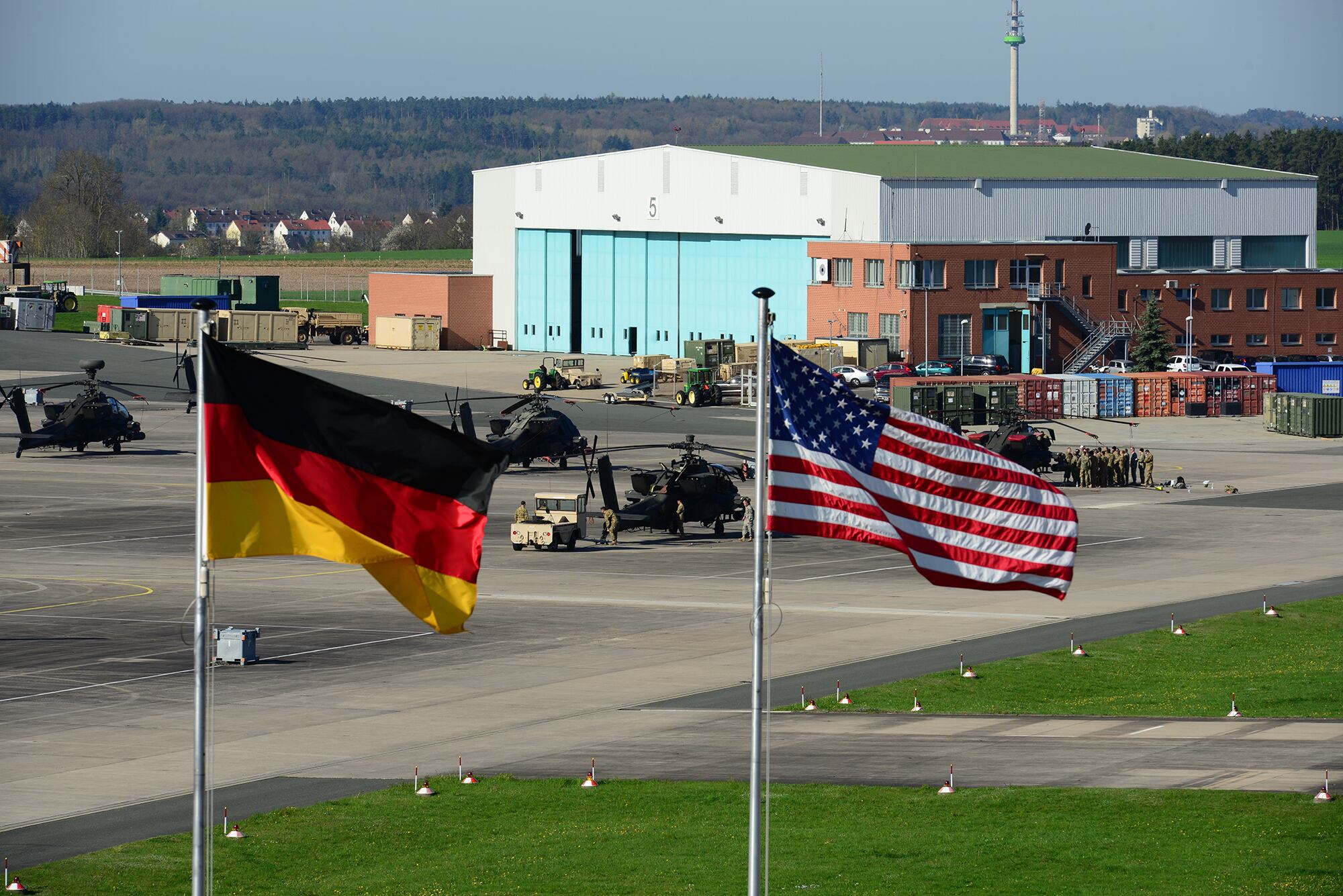
Germany currently hosts the largest contingent of US forces in Europe, with tens of thousands of troops stationed across key bases. These forces play a critical role not only in defending Europe but also in supporting operations under NATO, coordinating logistics, intelligence, and rapid-response capabilities across the continent. Any reduction in their presence would therefore carry significant strategic implications.
The timing of the review is particularly sensitive. It follows a public exchange between Trump and German Chancellor Friedrich Merz over the handling of tensions with Iran. Merz recently criticized the US approach to negotiations with Tehran, suggesting that Washington was being outmaneuvered diplomatically. His remarks pointed to stalled efforts to address Iran’s nuclear ambitions and reopen the Strait of Hormuz, a vital artery for global energy supplies that has faced disruption amid ongoing conflict.
Trump responded sharply, accusing the German leader of misunderstanding the situation and defending his administration’s stance on Iran. While Merz later sought to downplay the disagreement, describing bilateral relations as stable, the exchange has underscored deeper disagreements between the United States and its European allies.
At the heart of the issue lies a broader debate over burden-sharing and strategic priorities. Trump has repeatedly criticized European NATO members for failing to meet defense spending targets, arguing that the United States shoulders a disproportionate share of the alliance’s costs. The possibility of troop reductions in Germany is widely interpreted as part of this ongoing pressure campaign, aimed at pushing European nations to take greater responsibility for their own defense.
However, analysts warn that such a move could have unintended consequences. A reduced US military presence might weaken deterrence against potential adversaries, particularly Russia, and could embolden challenges to European security. It may also accelerate efforts within Europe to develop more independent defense capabilities, potentially reshaping the structure and cohesion of NATO itself.
The review also comes amid a broader deterioration in trust between Washington and its allies. Trump’s past remarks questioning the value of NATO and his willingness to consider withdrawing from the alliance have already unsettled European leaders. Although legal constraints make a full US withdrawal from NATO unlikely without congressional approval, incremental steps—such as reducing troop deployments—could still undermine the alliance’s effectiveness.
Compounding these tensions is the ongoing crisis involving Iran and the disruption of maritime traffic through the Strait of Hormuz. The waterway is one of the world’s most critical chokepoints for oil transport, and any instability there has immediate global repercussions. European economies, heavily reliant on energy imports, have been particularly affected by the uncertainty, adding urgency to calls for a coordinated international response.
Despite the rhetoric, some experts believe the troop review is more symbolic than imminent. They argue that such announcements are often used as leverage in negotiations with allies, rather than as definitive policy shifts. Nonetheless, even the suggestion of a drawdown carries weight, as it introduces uncertainty into long-standing security arrangements.
For Germany, the stakes are especially high. US bases in the country are not only vital for defense but also contribute significantly to the local economy and serve as hubs for broader US operations in Europe, the Middle East, and Africa. A reduction in forces could therefore have both strategic and economic repercussions.
The situation also has wider global implications. For countries like India, disruptions linked to tensions in the Strait of Hormuz can directly affect energy prices and supply chains. Meanwhile, any weakening of NATO’s cohesion could alter the global balance of power, influencing relationships with other major actors such as China and Russia.
As the review proceeds, much will depend on whether it leads to concrete changes or remains a negotiating tool. What is clear, however, is that the transatlantic relationship is undergoing a period of strain not seen in decades. Decisions made in Washington in the coming weeks could have lasting consequences for the security architecture of Europe and beyond.
In this evolving landscape, allies on both sides of the Atlantic face a difficult balancing act: maintaining unity in the face of shared challenges while navigating increasingly divergent political and strategic priorities. Mali’s Day of Shock: How Militants Breached the Capital | Maya