
How did a cold, dark Nordic nation become the happiest place on Earth — nine times running?
Every March 20th, when the International Day of Happiness rolls around, the world quietly waits for a familiar outcome.
Not a surprise. Not a shock. More like confirmation of a pattern that has become almost boring in its consistency.
And once again, in the 2026 World Happiness Report, Finland is at the top.
Nine years in a row.
Nine years of outscoring countries with stronger economies, longer summers, bigger populations, and louder global influence. Nine years of doing something the rest of the world still cannot quite replicate.
The last time Finland was not number one, the global smartphone era still felt young, Norway briefly held the spotlight, and social media was still figuring out what it wanted to become.
Now, Finland has turned its position into something close to a global constant.
For a nation of just 5.6 million people, where winters stretch long and dark, where silence is more common than small talk, and where social life often leans toward solitude, the result seems almost contradictory.
Yet the numbers are clear.
Finns report an average life satisfaction score of 7.764 out of 10 — a level that consistently places them ahead of countries that, on paper, should feel far more “happy.”
Which leads to the real question:
How is this possible? And why does no one else seem able to copy it?
What the “happiness ranking” is actually measuring
To understand Finland’s position, you first have to understand what this report is really asking people.
The World Happiness Report, created by the Wellbeing Research Centre at Oxford University in collaboration with the United Nations and Gallup, does not track smiling frequency, vacation time, or number of cafés per square kilometre.
Instead, it relies on something much simpler — and far more revealing.
People are asked to imagine a ladder.
At the top is the best possible life they can picture for themselves. At the bottom is the worst. Then they are asked a single question:
Where do you feel you stand today?
That self-assessment becomes the foundation of the global ranking, averaged over several years to smooth out short-term disruptions.
No weather adjustments. No cultural “positivity bias” scoring. No bonuses for economic growth.
Just a reflection of how people internally evaluate their own lives.
And for nearly a decade, Finland has consistently scored higher than almost every other country on Earth.
Not because Finns say they are “happy” in a loud or expressive way, but because they consistently report that life feels stable, workable, and fundamentally okay.
The 2026 leaders in global life satisfaction
The top of the 2026 rankings reads like a familiar map of small, high-trust societies:
Finland once again leads, followed closely by Iceland, Denmark, Sweden, Norway, and a few unexpected entrants like Costa Rica.
What stands out is not just who is on the list, but who is missing.
Some of the world’s largest economies, brightest cities, and most culturally influential nations do not appear anywhere near the top tier.
Instead, the list is dominated by smaller societies that share one underlying trait: strong social cohesion.
Finland’s quiet formula for wellbeing
Finland’s long-term dominance is not the result of a single policy or cultural habit. It is the outcome of several systems reinforcing each other over time, until they form something self-sustaining.
It is less a “strategy” and more a social architecture that has been built slowly, deliberately, and consistently over generations.
1. Trust as a default setting
In Finland, trust is not something people actively build case by case. It is assumed.
Experiments testing honesty — such as whether lost wallets are returned — consistently place Finland among the highest in the world.
This kind of trust extends beyond individuals. People tend to trust institutions, public services, and each other. That reduces daily stress in ways that are hard to quantify but easy to feel.
When you expect fairness as a baseline, life requires less emotional vigilance.
2. A welfare system that reduces fear of collapse
Finland’s social model is built on the idea that hardship should not turn into permanent instability.
Healthcare is universal. Education does not carry tuition fees. Parental leave is extensive. Unemployment benefits provide a cushion rather than a cliff edge.
The effect is subtle but powerful: people can take risks, change careers, or fail without fearing total financial destruction.
This doesn’t eliminate struggle — but it reduces the panic that often accompanies it elsewhere.
3. Education designed for calm growth, not pressure
Finland’s schools are often studied globally for what they do differently.
There is less emphasis on constant standardized testing and more focus on curiosity, creativity, and emotional wellbeing.
Students are not trained primarily to outperform each other, but to develop stable, functional skills and independent thinking.
The result is a population that does not grow up internalizing constant academic comparison as a life-long pressure system.
4. Work that does not consume life
In many countries, work defines identity. In Finland, it is more compartmentalized.
Working hours are generally shorter, overtime culture is limited, and taking leave is normal rather than exceptional.
Life outside work is not treated as recovery time for productivity — it is treated as equally important time in its own right.
Family, nature, rest, and silence are not interruptions to life. They are part of it.
5. Nature as everyday infrastructure
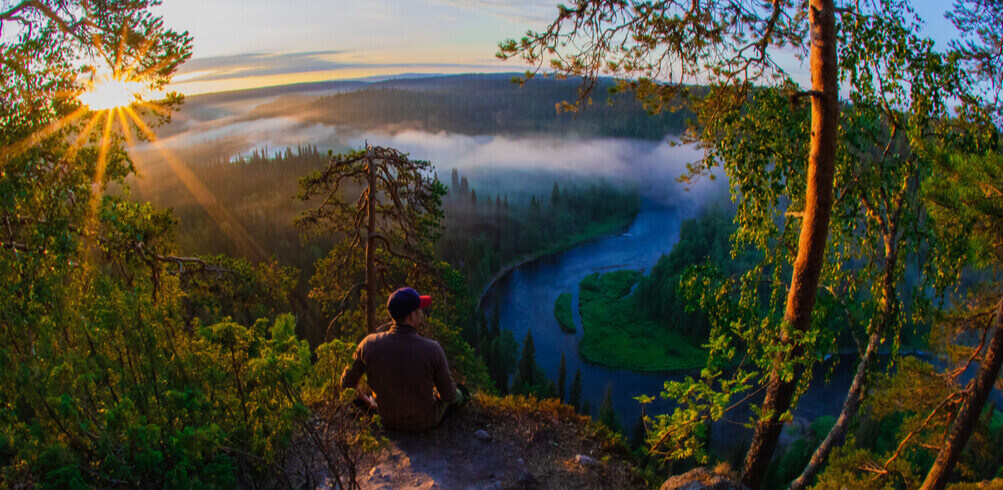
In Finland, nature is not something people escape to on holidays. It is something they live alongside constantly.
Forests, lakes, and open land are widely accessible under the principle known as “everyman’s right,” which allows people to walk, forage, and spend time in nature freely across vast areas.
With hundreds of thousands of lakes and extensive forest coverage, the environment itself acts like a psychological release valve.
When life feels overwhelming, stepping outside does not require planning — it requires only walking a few minutes.
6. Equality that reduces social tension
Finland maintains relatively low levels of income inequality compared to many developed nations.
This matters more for happiness than raw wealth does.
When the gap between richest and poorest is smaller, social comparison becomes less intense. Fewer people feel left behind, and fewer feel pressured to constantly signal status.
The social atmosphere becomes less competitive and more stable.
The cultural undercurrent: sisu
Beyond systems and policies, Finland has a concept that often appears in explanations of its resilience: sisu.
It refers to a form of inner endurance — not dramatic optimism, but quiet persistence.
It is the ability to keep going when circumstances are difficult, not because things feel easy, but because stopping is not considered an option.
But sisu is not just individual toughness. It exists alongside a social belief that individuals should not have to endure everything alone.
That combination — resilience plus support — is central to Finland’s model of wellbeing.
Why other countries cannot simply copy it
Finland’s system looks deceptively simple from the outside. Strong welfare state, high trust, good schools, balanced work culture.
But the deeper truth is that these elements did not appear overnight. They evolved together, reinforcing one another over decades.
High trust supports strong public systems. Strong public systems reinforce stability. Stability increases trust again.
It is a feedback loop — not a checklist.
And perhaps most importantly, it depends on long-term cultural agreement. In Finland, paying taxes is widely seen as contributing to a shared system rather than losing personal income.
That level of collective buy-in cannot be imported quickly.
The quiet warning beneath the success
Despite its top ranking, Finland is not immune to global trends.
Across many countries, younger generations are reporting lower wellbeing, often linked to digital overload, social fragmentation, and weaker in-person community ties.
Finland has managed to resist some of these pressures better than most — but no society is permanently insulated.
Even the most stable systems require maintenance.
The paradox that remains
Finland does not behave like a stereotypically “happy” country.
It is not loud about its success. It does not perform happiness for the world. It does not rely on constant enthusiasm or public displays of joy.
Instead, it offers something quieter and more durable:
a sense that life is stable, people are trustworthy, systems function, and tomorrow is unlikely to collapse without warning.
So when the annual rankings arrive, Finland does not celebrate like a champion on a stage.
It simply acknowledges the result, returns to its routines, and disappears back into its forests — once again sitting at the top of a list it seems to have quietly mastered without ever trying to impress anyone.
Nine years running.
And still, no one has quite figured out how to beat it. The UAE Just Walked Out on OPEC. This Time It’s Different | Maya


