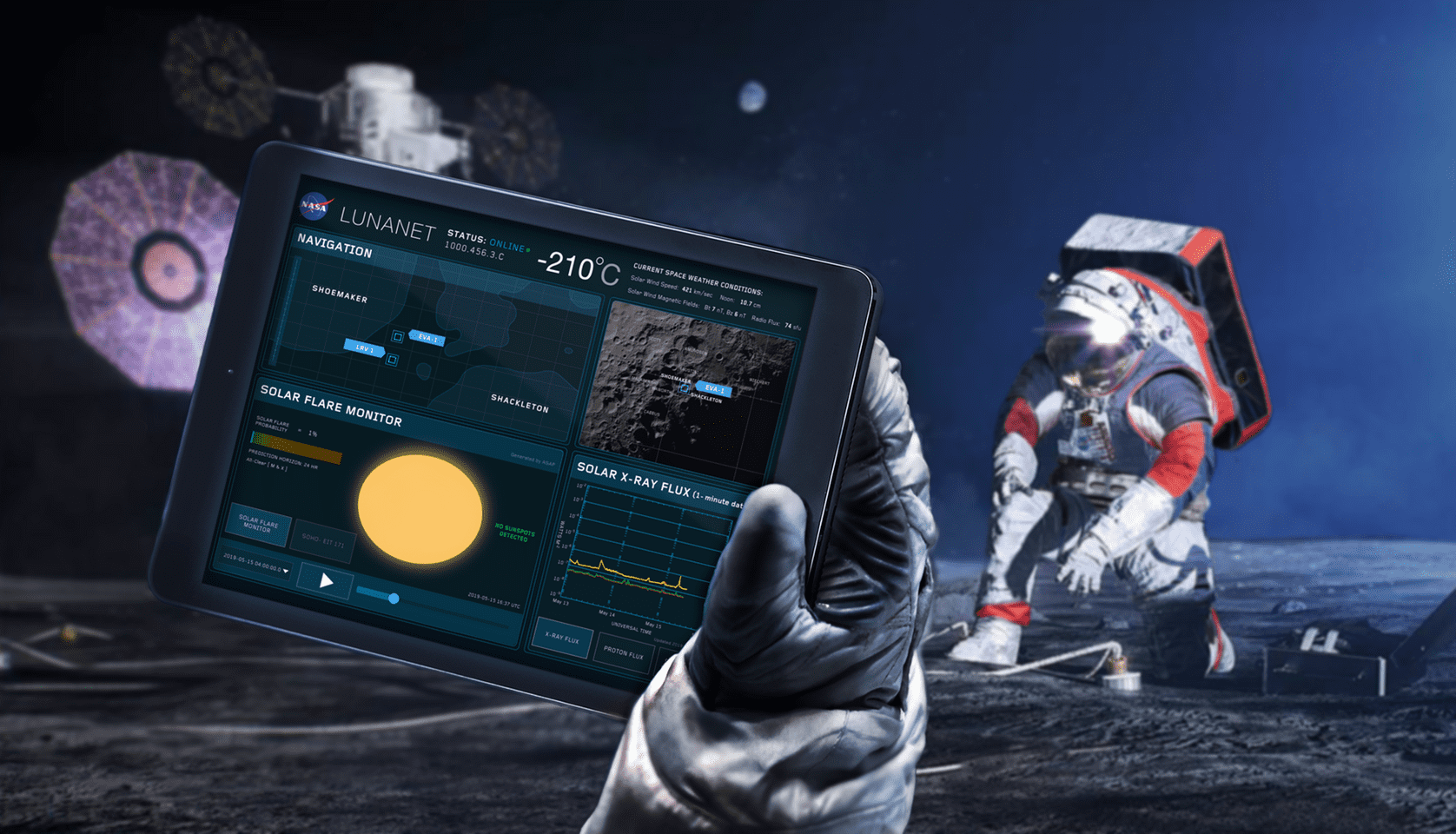
Can humans build internet networks on the Moon? Picture trying to send a message from one side of a silent, airless world to the other, with nothing but light or radio waves carrying your words across nearly 400,000 kilometers of empty space. That is the starting point for thinking about internet on the Moon.
Yes, humans can build internet networks on the Moon, but it won’t feel like the internet you use on Earth. There will be no instant scrolling, no real-time gaming, and no “everything is just a click away” experience. Instead, a lunar internet would behave more like a carefully designed communication system built for survival, coordination, and science rather than entertainment.
Why Earth’s internet doesn’t simply “extend” to the Moon
On Earth, the internet works because we have:
- Fiber optic cables connecting continents
- Cell towers covering cities and highways
- A dense web of routers and data centers
All of this creates a near-instant network.
The Moon has none of that. No cables, no infrastructure, no atmosphere to help stabilize signals. Everything must be built from scratch in a hostile environment.
So instead of extending Earth’s internet, engineers would need to create something entirely new.
The unavoidable problem: delay changes everything
Even at the speed of light, signals between Earth and the Moon take time:
- About 1.3 seconds to travel one way
- Around 2.6 seconds for a round trip
That delay might sound small, but it completely breaks real-time communication.
It means:
- Conversations feel delayed and unnatural
- Remote control of machines becomes tricky
- Video calls lose their natural rhythm
This is why a lunar internet cannot rely on constant Earth control. It must be partly independent.
How data would actually move around the Moon
A lunar network would likely be built in layers rather than one single system.
1. Orbiting relay satellites
Satellites around the Moon would act like communication towers in space. Their job would be to:
- Receive signals from bases and rovers
- Pass data between different lunar regions
- Link the Moon to Earth stations
Without them, communication would be patchy and limited.
2. Surface communication networks
On the Moon itself, bases and machines would form local networks.
These would allow:
- Habitats to communicate internally
- Rovers to coordinate with nearby systems
- Scientific instruments to share data quickly
This local network is the closest thing to “internet on the Moon” in a traditional sense.
3. Earth connection links
Large antennas on Earth would still be essential. They would handle:
- Scientific data transfer
- Mission updates
- Long-distance coordination
But Earth would act more like a supervisor than a central hub.
Why autonomy is not optional
Because of delay and distance, lunar systems cannot wait for instructions from Earth for every action. That is where autonomy becomes critical.
Machines on the Moon would need to:
- Navigate terrain on their own
- Detect and avoid hazards
- Manage energy and resources
- Handle basic repairs or system errors
This is similar in concept to how the International Space Station already performs many automated operations, although it is still close enough to Earth for rapid intervention.
On the Moon, that safety net is much weaker, so independence becomes essential.
What kind of “internet experience” would astronauts get?
It would feel very different from Earth:
- No instant website loading
- No real-time streaming without buffering
- Messages arrive with noticeable delay
- Most systems prioritize function over speed
Instead of browsing freely, astronauts would interact with:
- Local databases stored on the Moon
- Preloaded information systems
- Scheduled data transfers to Earth
It is less like a global web and more like a controlled, mission-focused network.
Why satellites are essential for coverage
The Moon is large enough that direct Earth communication is not always reliable. Mountains, craters, and the Moon’s rotation can block signals.
So orbiting satellites are needed to:
- Maintain constant visibility of lunar bases
- Route signals around obstacles
- Provide backup communication paths
Without them, parts of the Moon would be completely isolated from Earth at times.
Security becomes even more important in space
A lunar network would need strong protection because:
- Signals travel through open space
- Interception is theoretically easier than on Earth
- Systems must remain reliable even during solar disturbances
So encryption, redundancy, and self-healing systems would be built into the network from the start.
Power and environment challenges
Building communication systems on the Moon is not just about technology—it is about survival in extreme conditions.
Engineers must deal with:
- Intense temperature swings
- Long lunar nights with no sunlight
- Sharp, abrasive lunar dust
- Radiation exposure from space
Every component must be designed to survive long-term without easy maintenance.
A stepping stone to deeper space
The Moon is not the final goal for this kind of network. It is more like a testbed.
If a lunar internet works, it becomes a model for:
- Mars communication systems
- Deep-space mission networks
- Future interplanetary data infrastructure
In that sense, the Moon is like a practice field for building a wider space communication web.
What it will not be
It is important to be clear about expectations. A Moon internet will not be:
- A place for casual browsing
- A replacement for Earth’s global internet
- A high-speed entertainment network
It will be:
- A mission-critical communication system
- A scientific data backbone
- A coordination layer for human and robotic activity
Outcome
Building internet networks on the Moon is not only possible, it is already being actively designed in pieces. But it will not resemble the internet we know on Earth. Instead, it will be a layered, delayed, highly autonomous communication system built around satellites, local networks, and Earth connections.
The key difference is purpose. Earth’s internet is built for speed, convenience, and global connection. A lunar internet will be built for reliability, survival, and coordination in one of the most extreme environments humans have ever tried to operate in.
In simple terms, it won’t be about browsing the Moon—it will be about keeping life and machines on the Moon connected, stable, and working together across the silence of space.
The Hunt for Earth-Like Planets Beyond Our Solar System | Maya