Meta Employees Trained the A.I. That Replaced Them
For years, Silicon Valley sold artificial intelligence as a tool that would eliminate repetitive work, increase productivity, and free humans to focus on more creative tasks. The future, tech executives promised, was collaboration between humans and machines — not replacement.
Then Meta happened.
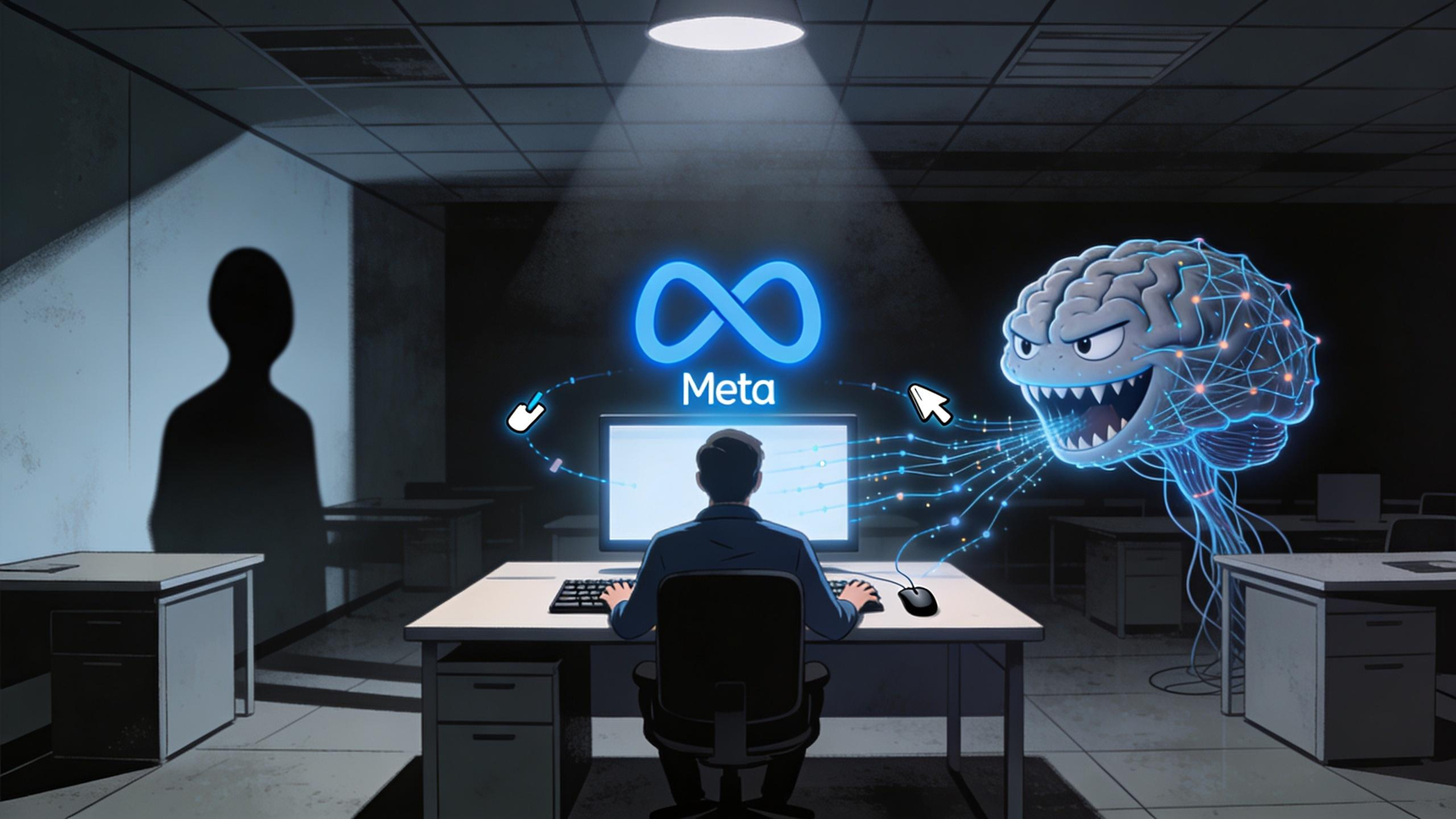
This week, thousands of employees across Meta woke up to the reality that the A.I. systems they helped build, train, improve, and operationalize may now be helping eliminate their own jobs.
The company behind Facebook, Instagram, and WhatsApp has laid off around 8,000 employees while simultaneously restructuring another 7,000 workers into new A.I.-focused initiatives. Internally, employees reportedly referred to one of the new reorganizations as “The Draft,” a term that sounded less like corporate restructuring and more like wartime mobilization.
What is happening inside Meta is bigger than another tech layoff story. Silicon Valley has seen layoffs before. But this moment feels fundamentally different because it reveals something uncomfortable about the new A.I. economy:
The people building artificial intelligence are no longer safely above automation. They are now inside its blast radius.
For decades, automation mainly targeted factory workers, warehouse laborers, and routine administrative jobs. White-collar workers, especially software engineers, were considered the architects of the future — the people designing the systems that would automate everyone else.
Meta shattered that assumption.
According to reports from inside the company, employees had grown increasingly anxious for months as Meta aggressively transformed itself into what executives called an “A.I.-first” company. Internal systems were reportedly being developed to track employee data for A.I. training purposes, triggering petitions and backlash among workers worried about surveillance and automation.
More than 1,000 employees signed petitions against some of these internal tracking initiatives. Others criticized leadership in internal forums. But resistance inside the company appeared fragmented and ultimately powerless against a leadership team that sees A.I. dominance as an existential race.
One line from an internal management message reportedly captured the new reality perfectly:
“Participation was not optional.”
That sentence may end up defining the next era of the tech industry.
The transformation at Meta is not happening because the company is struggling financially. In fact, the opposite is true. Meta recently reported record revenues while announcing plans to spend as much as $145 billion this year, much of it directed toward A.I. infrastructure, computing power, and engineering.
This is what makes the layoffs psychologically jarring for employees. Historically, layoffs were associated with corporate distress. Companies cut jobs when profits collapsed or economic crises forced survival measures.
Meta is laying off workers during one of its strongest financial periods ever.
The message being sent across Silicon Valley is unmistakable: profitability no longer guarantees employment security if A.I. systems can increase efficiency further.
Employees inside Meta reportedly described a workplace atmosphere filled with paranoia, uncertainty, and quiet resignation. Workers checked internal directories to see which colleagues had disappeared overnight. Some scavenged office supplies, snacks, and laptop chargers before layoffs officially arrived. Others exchanged salute emojis in internal chats as coworkers vanished from company systems.
The symbolism was difficult to ignore. The same industry that once promised unlimited growth, luxurious campuses, and lifelong innovation careers is now introducing a colder reality: employees are becoming variables in optimization models.
Perhaps the most unsettling aspect of the Meta situation is the idea that employees may have indirectly trained the systems contributing to their redundancy.
Modern A.I. systems do not emerge magically. They require enormous quantities of human-generated data, workflow analysis, testing, labeling, moderation, feedback loops, and operational knowledge. The engineers, analysts, content reviewers, managers, and operations teams inside companies like Meta provide exactly the ecosystem these systems learn from.
Every workflow improvement becomes training material.
Every efficiency process becomes automation potential.
Every internal optimization becomes a blueprint for reducing future human involvement.
In other words, the workers were not simply using the system. They were teaching it how the company functions.
Now the company appears increasingly confident that many of those functions require fewer humans.
This may explain why employee resistance has carried such emotional intensity. Workers are not just afraid of layoffs. They are confronting the possibility that they helped engineer the mechanisms reducing their own value inside the organization.
The irony is brutal.
For years, learning to code was considered one of the safest career paths in the modern economy. Governments encouraged students to enter STEM fields. Parents pushed children toward software engineering. Tech companies cultivated the image that coding skills guaranteed stability and elite status in the labor market.
Now many of the world’s most advanced A.I. systems are rapidly automating portions of programming itself.
Meta is hardly alone in this transition. Cisco recently announced thousands of layoffs tied to A.I. restructuring. Microsoft, Coinbase, and Block have also cut jobs while increasing investments in artificial intelligence. Across the industry, companies are reducing layers of middle management, automating workflows, and consolidating teams around smaller groups of highly specialized A.I. talent.
The corporate logic is simple.
A.I. systems can potentially:
- reduce operational costs,
- compress timelines,
- eliminate repetitive tasks,
- increase scalability,
- and allow fewer employees to manage larger systems.
For executives and shareholders, the incentives are enormous.
But the social consequences may be profound.
The traditional middle layer of white-collar employment — project coordinators, mid-level engineers, analysts, support teams, operations staff — could face increasing pressure as companies realize they can maintain output with leaner workforces supported by advanced automation.
Meta’s internal restructuring hints at exactly this future. Reports suggest some new A.I. divisions operate with dramatically flatter management structures, with as many as 50 employees reporting to a single manager.
That is not just organizational redesign.
That is algorithmic efficiency culture.
The emerging workplace model appears to prioritize speed, output, and scalability over stability, mentorship, or traditional corporate hierarchy.
And unlike previous automation waves, this transformation is happening incredibly fast.
Factories took decades to automate.
Digital transformation unfolded over years.
But generative A.I. systems are improving on near-monthly cycles.
The speed is destabilizing even the people building the technology.
Inside Meta, some executives reportedly attempted to calm concerns by offering retention packages to critical employees, including substantial equity incentives. But even that reveals a growing divide inside the modern tech workforce.
The future may increasingly belong to a relatively small class of elite A.I. engineers, researchers, and infrastructure specialists, while many other white-collar roles become more vulnerable to automation or consolidation.
In effect, the tech industry may be creating its own internal class separation:
a concentrated upper tier designing the systems,
and a shrinking broader workforce displaced by them.
What makes this moment historically significant is not simply the layoffs themselves. Companies have always restructured. Technology has always disrupted industries.
The difference is that this may be the first large-scale white-collar automation cycle happening in real time inside the very companies building the future.
And the workers can see it happening before everyone else.
They understand the capabilities.
They understand the roadmaps.
They understand what the systems will eventually be able to do.
That knowledge creates a uniquely unsettling atmosphere because the people closest to the technology appear increasingly uncertain about where humans fit once the systems mature.
Meta’s layoffs may ultimately be remembered as more than a corporate restructuring. They may mark the moment Silicon Valley stopped treating A.I. as merely a product and started reorganizing society around it.
The frightening part for workers everywhere is that if highly paid engineers inside one of the richest companies in the world are no longer safe from automation, then nobody can confidently assume they are immune anymore.
SpaceX Opens IPO Access to Retail Investors Through Robinhood, Fidelity and Schwab | Maya