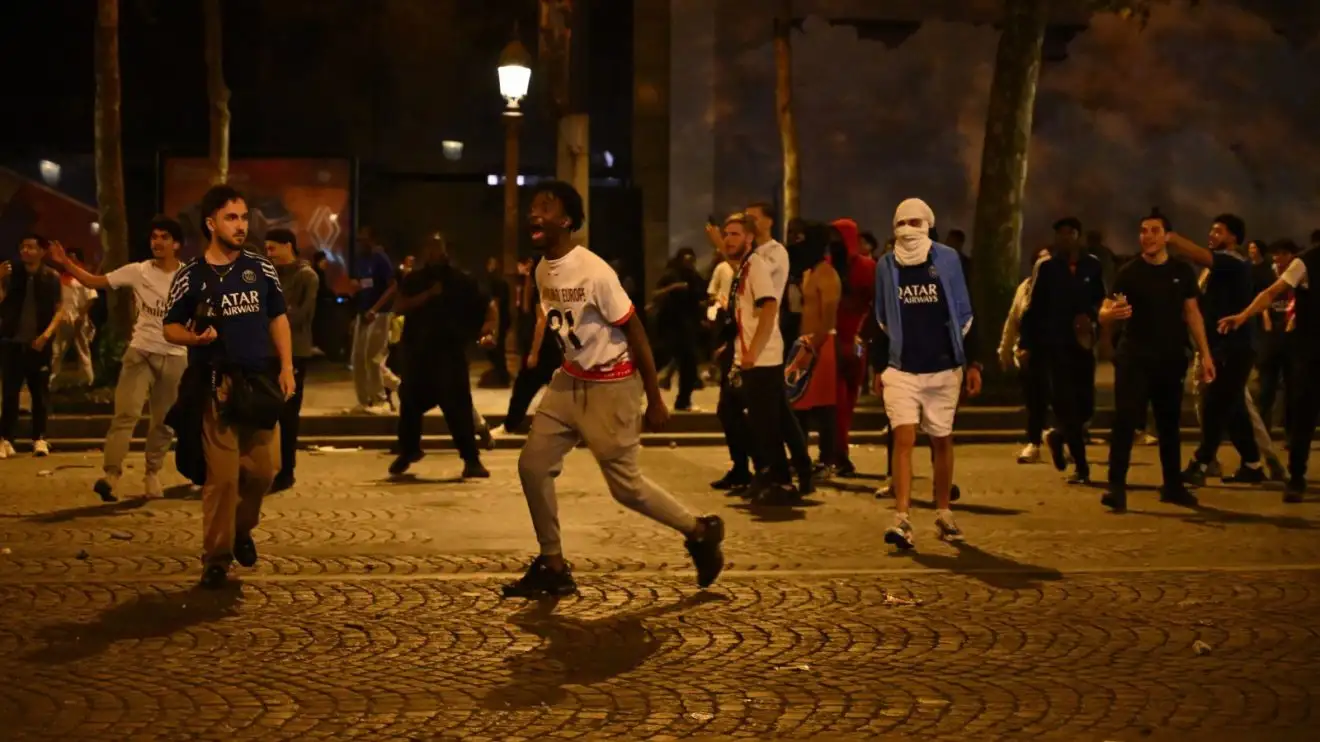
Is Multiculturalism Under Pressure Across Europe? The violent scenes that followed Paris Saint-Germain’s latest UEFA Champions League victory have once again forced Europe to confront a question that many leaders would rather avoid: Is multiculturalism working as intended, or is the continent facing a deeper integration crisis?
What should have been a night of football celebration quickly descended into chaos across parts of France. Authorities reported 780 arrests, more than 200 injuries, and dozens of injured police officers after celebrations turned violent in Paris and other cities. Fires were set, businesses were damaged, and clashes erupted between police and groups of rioters. For many Europeans watching the events unfold, the disturbances were about more than football. They became another symbol of broader concerns surrounding public order, social cohesion, and the future of multicultural societies.
The Paris unrest did not emerge in isolation. Over the past decade, Europe has witnessed recurring episodes of riots, gang violence, social unrest, and political polarization. Whether in France’s suburbs, Sweden’s troubled neighborhoods, or Germany’s heated debates over migration policy, a growing number of citizens believe that integration has become one of the continent’s greatest challenges.
A Decade of Demographic Change
Europe has experienced one of the largest migration waves in its modern history. Wars in Syria and Ukraine, instability in parts of Africa and the Middle East, and economic migration have brought millions of newcomers to European countries.
Supporters of immigration argue that migration has helped address labor shortages, support aging populations, and sustain economic growth. Many European industries, including healthcare, logistics, agriculture, and construction, rely heavily on foreign-born workers. Without immigration, several countries would face even more severe demographic and workforce challenges.
However, critics argue that governments focused heavily on admitting newcomers while paying insufficient attention to integration. They contend that language barriers, educational disparities, housing segregation, and unemployment have created pockets of isolation in some urban areas.
The result, according to critics, is a growing disconnect between political promises and lived reality.
The Crime Debate Nobody Agrees On
Perhaps no issue generates more controversy than the relationship between immigration and crime.
Research from Sweden has shown that foreign-born individuals have been overrepresented in crime-suspect statistics, particularly in certain categories of crime. One study found that the proportion of crime suspects with a foreign background increased significantly over recent decades, becoming a majority among registered suspects by some measures.
These findings are frequently cited by politicians who argue that Europe’s immigration policies have produced unintended social consequences.
Yet the story is far more complex than many political slogans suggest.
Research from Germany’s respected Ifo Institute found no overall positive association between immigration levels and crime rates across German districts. In other words, areas with more immigrants did not automatically experience higher crime levels. Researchers concluded that broad claims linking immigration and crime often overlook factors such as age demographics, urban density, poverty, and economic conditions.
This contradiction highlights a reality often lost in political debates: overrepresentation in some crime statistics does not necessarily mean immigration itself is the primary cause of crime. Socioeconomic conditions, education levels, employment opportunities, and neighborhood environments all play major roles.
The Challenge of Parallel Societies
While crime statistics remain disputed, another concern has attracted increasing attention: social segregation.
Several European cities have developed neighborhoods where immigrant communities remain geographically and socially separated from the broader population. Researchers studying urban areas across Europe have identified persistent patterns of residential segregation, particularly in parts of Western and Northern Europe.
Critics argue that when communities become isolated, integration becomes more difficult. Schools, workplaces, and social networks become less mixed, reducing opportunities for interaction between newcomers and long-established residents.
This can create a cycle where mistrust grows on both sides.
For some Europeans, the concern is not immigration itself but the emergence of what are often described as “parallel societies”—communities that live alongside one another without fully integrating.
Why the Political Backlash Is Growing
Public anxiety over these issues has reshaped European politics.
Across France, Germany, the Netherlands, Italy, Sweden, Austria, and other countries, parties advocating stricter immigration controls have gained support. Their message resonates with voters who believe mainstream leaders have ignored concerns about security, cultural identity, housing pressures, and integration failures.
The recent riots in Paris are likely to add further momentum to these debates. Even though authorities have not demonstrated that the football-related violence was predominantly committed by migrants, incidents of disorder often become part of wider public discussions about immigration and integration.
This distinction matters. Public perception is frequently shaped by visible events rather than detailed statistical analysis.
The Real Question Facing Europe
The central challenge facing Europe may not be whether immigration should occur. Given demographic realities, most experts agree that migration will remain part of Europe’s future.
The more difficult question is whether governments can successfully integrate large numbers of newcomers while maintaining social cohesion, public confidence, and security.
For decades, multiculturalism was promoted as a model that allowed different cultures to coexist while preserving individual identities. Today, that model is facing increasing scrutiny from both the political left and right.
Some argue that Europe needs stronger assimilation policies emphasizing language, civic values, and labor market participation. Others believe the solution lies in greater investment in education, housing, and economic opportunity rather than stricter cultural expectations.
What is clear is that public patience is wearing thin.
The riots in Paris may eventually fade from the headlines, but the questions they have revived will remain. Across Europe, citizens are increasingly asking whether multiculturalism has fulfilled its promise—or whether the continent must rethink how it approaches integration in the decades ahead.
The future of Europe may depend less on how many people arrive at its borders and more on what happens after they get there. How Did Football Festivities Descend Into Riots Across France? | Maya