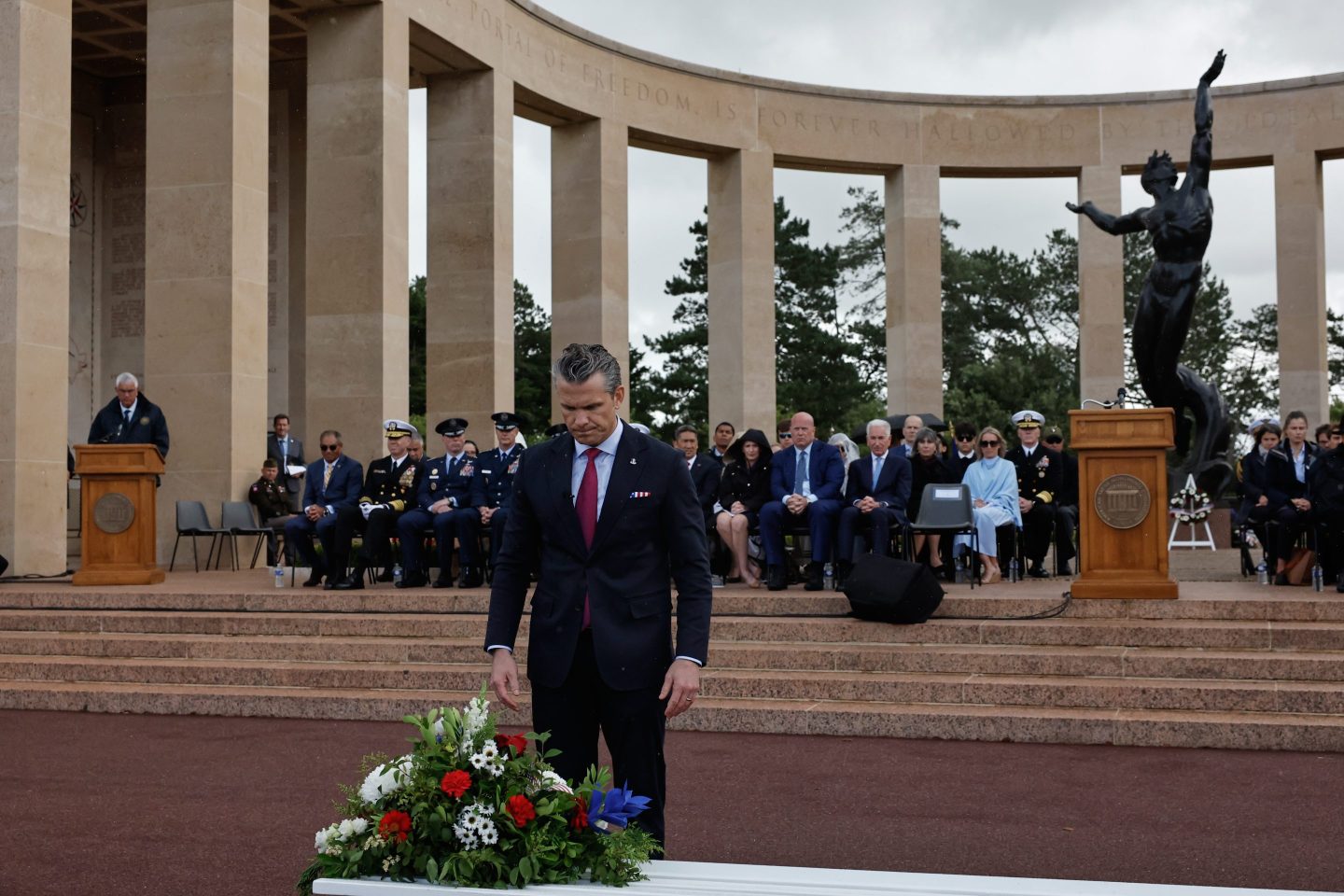
Hegseth Uses D-Day Commemoration to Warn Europe on Immigration and Defense- U.S. Defense Secretary Pete Hegseth used a solemn D-Day remembrance ceremony in France to deliver a pointed message to European leaders, urging them to confront what he described as the growing challenges posed by mass migration and to strengthen their military capabilities amid an increasingly uncertain global security environment.
Speaking during commemorations marking the 82nd anniversary of the Allied landings in Normandy, Hegseth drew a controversial comparison between the historic invasion that helped liberate Europe during World War II and the migration pressures facing several European countries today. His remarks immediately attracted attention on both sides of the Atlantic, reflecting ongoing debates about immigration, national identity, and defense responsibilities within the Western alliance.
The ceremony took place at the Normandy American Cemetery in northwestern France, where thousands of American service members who lost their lives during World War II are buried. The event honored the Allied troops who stormed the beaches of Normandy on June 6, 1944, launching one of the most significant military operations in modern history and paving the way for the liberation of Western Europe from Nazi occupation.
During his address, Hegseth shifted from remembrance to contemporary geopolitical concerns, warning that Europe now faces a different kind of challenge. He argued that several Mediterranean countries have experienced sustained migration pressures that have sparked political and social debates across the continent. Referring to arrivals by sea along Europe’s southern coastline, he questioned whether European governments were doing enough to address the issue.
The defense secretary’s comments echoed concerns frequently raised by members of the administration of Donald Trump, which has consistently advocated for stricter immigration controls both domestically and internationally. The administration has often argued that uncontrolled migration can place pressure on social services, border security, and national cohesion.
Hegseth’s remarks also reflected a broader ideological discussion that has gained prominence in recent years among conservative political leaders in both the United States and Europe. Supporters of tougher immigration policies argue that governments must maintain stronger border controls and ensure that migration levels remain manageable. Critics, however, contend that such rhetoric risks oversimplifying complex humanitarian and economic issues while fueling political divisions.
The speech came just one day after JD Vance made separate comments linking migration to broader cultural and political challenges facing Western societies. Those remarks drew criticism from officials in the United Kingdom and renewed debate about the role immigration plays in shaping national policies and social dynamics.
Beyond immigration, Hegseth used the occasion to emphasize another long-standing concern of Washington: defense spending among America’s European allies.
Invoking the spirit of cooperation that defined the Allied effort during World War II, he argued that today’s security challenges require a similar level of commitment and shared responsibility. According to Hegseth, the success of the D-Day operation was possible because participating nations contributed resources, personnel, and military capabilities toward a common objective.
He stressed that while the United States remains committed to leading international security efforts, European nations must continue increasing their own defense investments. The message aligns with repeated calls from Washington for members of the North Atlantic Treaty Organization to strengthen military readiness and meet defense spending targets.
For several years, American officials from both political parties have argued that Europe should assume a greater share of the burden for regional security. Russia’s invasion of Ukraine and broader geopolitical instability have intensified those discussions, leading many European governments to announce increases in military budgets and modernization programs.
Hegseth’s speech highlighted the administration’s belief that immigration, national security, and military preparedness are increasingly interconnected issues. In the administration’s view, governments must simultaneously address border security challenges while maintaining strong defense capabilities to respond to external threats.
The choice of venue made the remarks particularly significant. D-Day commemorations traditionally focus on honoring sacrifice, international cooperation, and the defense of democratic values. As a result, introducing contemporary political themes into such ceremonies often generates debate about how historical events should be remembered and interpreted.
Some observers viewed Hegseth’s comments as a continuation of Washington’s effort to encourage greater European self-reliance. Others argued that drawing comparisons between modern migration and military invasions risks overshadowing the historical significance of the Normandy landings.
Nevertheless, the speech underscored a key priority of current U.S. foreign policy: encouraging allies to take a more active role in addressing security and political challenges within their own regions. Whether discussing defense spending, border management, or strategic preparedness, administration officials have repeatedly emphasized the importance of burden-sharing among allied nations.
As Europe continues to grapple with migration pressures, economic uncertainty, and evolving security threats, Hegseth’s remarks are likely to resonate across political circles on both sides of the Atlantic. The debate surrounding immigration and defense remains one of the defining issues facing Western governments, and the comments delivered in Normandy suggest those discussions will remain central to transatlantic relations in the years ahead.
More than eight decades after Allied troops landed on the beaches of Normandy, the questions confronting Western leaders have changed dramatically. Yet Hegseth’s message was clear: preserving security and stability requires not only remembering the lessons of history but also confronting the challenges of the present. How a $30 Billion Google Deal Is Transforming SpaceX Into an AI Infrastructure Powerhouse | Maya