
How AI Is Helping Historians Decode Ancient Languages
Some of history’s most important messages have been sitting in plain sight for centuries — carved into crumbling stone, pressed into clay, or coiled inside blackened scrolls — waiting for an instrument sophisticated enough to read them. That instrument has finally arrived.
Artificial intelligence is reshaping one of the oldest and most painstaking disciplines in scholarship: the decipherment of ancient languages. Tasks that once consumed entire careers — cross-referencing thousands of inscriptions, reconstructing damaged fragments, matching unfamiliar symbols to known linguistic patterns — are now being accelerated by machine learning at a scale no human team could ever match. The results are overturning long-held assumptions about ancient civilisations, recovering texts lost for two millennia, and, in some cases, raising the extraordinary prospect of cracking writing systems that have resisted every attempt at translation for over a century.
The Slow Old World of Decipherment
To appreciate how revolutionary AI is, it helps to understand just how brutally difficult traditional decipherment has always been. The script known as Linear B — the Bronze Age writing system of Mycenaean Greece — was first discovered in 1900 by archaeologist Arthur Evans on clay tablets at Knossos. It took fifty-two years of collective scholarly effort, culminating in the solitary genius of architect Michael Ventris in 1952, to finally crack it. The work demanded an almost impossible combination of statistical rigour, comparative linguistic expertise, and inspired guesswork. One of the field’s most dedicated researchers, Alice Kober, spent years hand-compiling index cards of symbol frequencies before dying at forty-three — just two years before the breakthrough she helped make possible.
That was the pace. Decades. Lifetimes. An enormous investment of human intellectual capital for each successful decipherment, with no guarantee of success and long stretches of complete darkness.
AI does not replace that depth of human scholarship. But it can compress the grunt work of pattern recognition — the sorting, the cross-referencing, the statistical tabulation — from decades into hours, leaving human experts free to do what machines still cannot: interpret context, apply cultural knowledge, and make the creative leaps that turn data into meaning.
Ithaca: Teaching a Machine to Read Damaged Stone
One of the clearest demonstrations of AI’s potential in this field came from a collaboration between Oxford University researchers and Google DeepMind, which produced a model called Ithaca — named, pointedly, after the Greek island in Homer’s Odyssey.
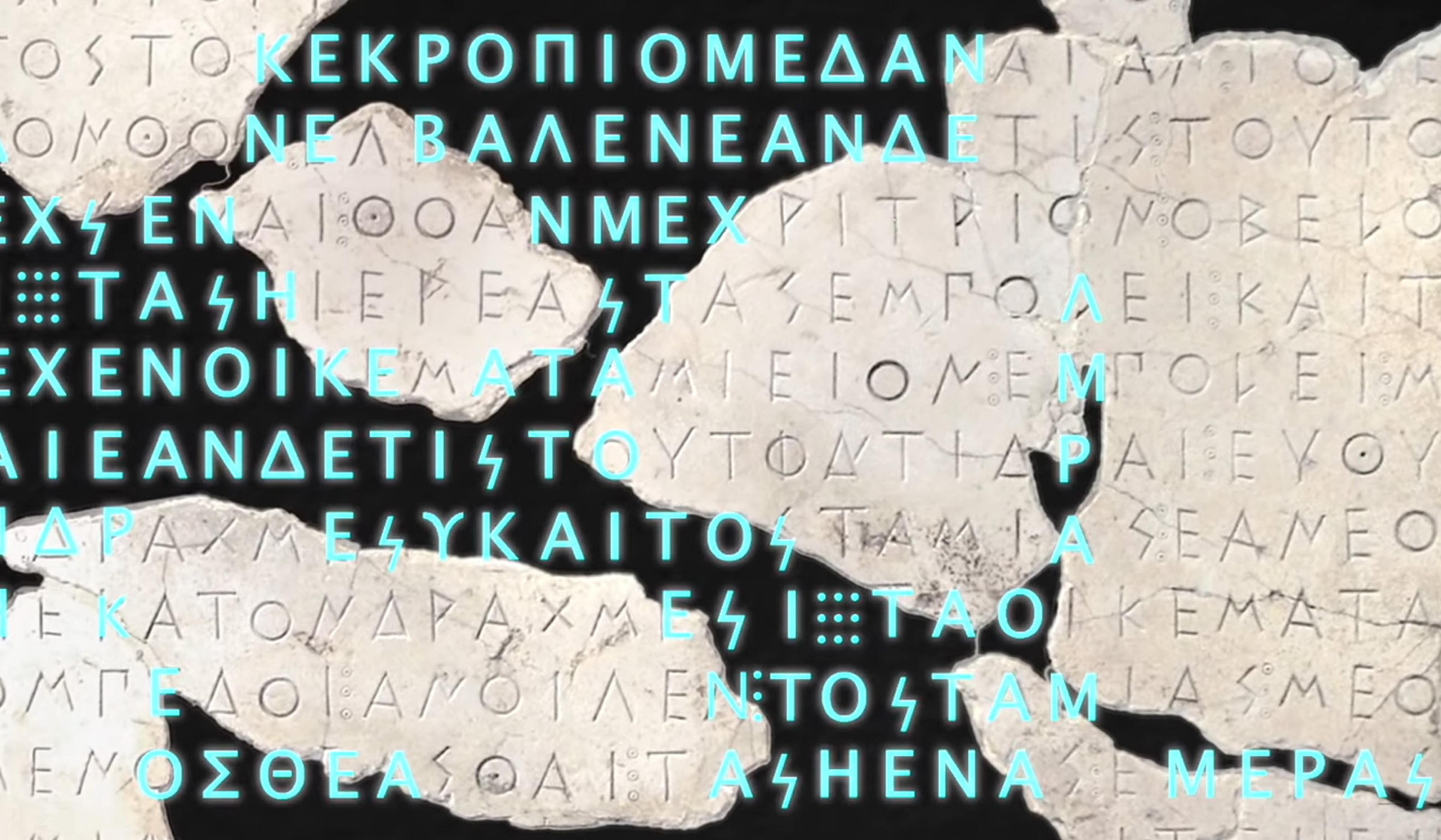
Ithaca was trained on a vast corpus of ancient Greek inscriptions and tasked with three problems that have long tormented classical historians: restoring missing or damaged text, identifying the geographic origin of an inscription, and estimating its date of composition.
The results were striking. When working alone, Ithaca achieved 62% accuracy at restoring damaged texts — a meaningful figure given the fragmentary state of most ancient inscriptions. But the more significant finding was what happened when historians worked alongside the model. Human experts attempting restoration without AI support achieved roughly 25% accuracy. With Ithaca as a collaborator, that figure jumped to 72%. The machine was not replacing the historian; it was amplifying them.
The system also demonstrated real historical usefulness. A long-running dispute about the dating of a set of important Athenian decrees — documents that scholars had placed variously before 446/445 BCE or, more recently, in the 420s BCE — was submitted to Ithaca. The model’s average predicted date for the decrees was 421 BCE, aligning precisely with the newer scholarly evidence and helping to tip a decades-old academic argument.
As one DeepMind researcher put it, machine learning could support historians the way microscopes and telescopes extended the reach of natural science — not by replacing the scientist, but by letting them see further.
The Vesuvius Challenge: Reading the Unreadable
Perhaps the most dramatic story in AI-assisted language recovery involves not an undeciphered script but a known language locked inside a physically inaccessible object.
When Mount Vesuvius erupted in 79 CE, it buried the Roman town of Herculaneum under twenty metres of volcanic mud and ash, carbonising a private library of hundreds of papyrus scrolls. The scrolls survived — but in a form so brittle and tightly fused that attempting to unroll them physically caused them to crumble to dust. For nearly two thousand years, the only surviving library from classical antiquity sat in museum drawers, effectively unreadable.
In 2023, a $1 million prize competition called the Vesuvius Challenge was launched, inviting researchers worldwide to apply machine learning to CT scan data of the scrolls in an attempt to extract text without touching them. The approach combined high-resolution X-ray tomography — which could detect the faint chemical signature of ancient ink on compressed papyrus — with AI models trained to identify letter shapes within the three-dimensional scan data.
The breakthrough came faster than almost anyone expected. A team of three young researchers, including then-undergraduate Luke Farritor, used an ink-detection model to surface visible Greek characters from inside a sealed scroll. By the end of the competition’s first phase, the team had transcribed more than 2,000 characters — entire passages from what papyrologists believe is a previously unknown work by the Epicurean philosopher Philodemus of Gadara, writing in the first century BCE about the nature of pleasure and whether scarcity makes things more enjoyable.
Words unread for two millennia. Recovered not by unrolling but by listening, algorithmically, to the faint trace of ink on papyrus that no human eye could ever have found unaided.
The Vesuvius Challenge has since awarded over $1.7 million in prizes and is now working toward recovering full texts from the four completely scanned scrolls. The ancient library of Herculaneum, long considered permanently sealed, is slowly opening.
Akkadian, Gilgamesh, and the Mesopotamian Archive
Beyond Greek, AI is making significant inroads into Akkadian cuneiform — one of humanity’s oldest writing systems, used across Mesopotamia for over three thousand years in languages including Sumerian and Akkadian. The sheer volume of surviving cuneiform tablets — hundreds of thousands of clay documents covering everything from astronomical observations to legal contracts to epic literature — has long overwhelmed the small community of trained Assyriologists capable of reading them.
Neural machine translation models, trained on existing cuneiform corpora and their scholarly translations, can now produce working draft translations of unread tablets at speed. The accuracy is imperfect and always requires expert review — but the pipeline is transformative, opening up archives that might otherwise wait generations for a human specialist’s attention.
A specific example is the Fragmentarium project at Ludwig Maximilian University in Munich, where an algorithm has been matching broken tablet edges and linguistic context to reconnect fragments of the Epic of Gilgamesh — the world’s oldest surviving literary work — separated for thousands of years. AI-assisted matching has restored previously unknown passages, including a scene that adds nuance to the relationship between Gilgamesh and his companion Enkidu in a pivotal moment of the story.
Meanwhile, recent projects have recovered a 250-line Babylonian hymn previously considered too damaged to translate, adding a complete literary work to the known canon of ancient Mesopotamian poetry.
The Indus Script: History’s Greatest Unsolved Cipher
Not every ancient language has yielded to AI’s pattern recognition — and the most tantalising case of all remains stubbornly resistant.
The Indus Valley script, used by the Harappan civilisation of modern-day Pakistan, western India, and Afghanistan roughly four thousand years ago, consists of hundreds of distinct signs found on thousands of carved seals and inscriptions. Despite over a century of effort by the world’s best linguists, it has never been deciphered. Unlike Egyptian hieroglyphs, which were unlocked by the trilingual Rosetta Stone, no bilingual Indus text has ever been found. The inscriptions are also very short — most only four to five signs — giving statistical analysis very little to work with.
Machine learning models have been applied to the script’s structure, analysing symbol frequencies, identifying positional patterns, and attempting to map its grammar. The Tamil Nadu state government, reflecting the high stakes of the problem, has offered a $1 million prize for a verified decipherment. In early 2026, a systems theorist working with an AI in Toronto attracted attention by publishing a structural analysis of the complete open-access seal corpus — not a full decipherment, but a detailed argument about the script’s internal logic and potential phonetic dimensions.
The honest assessment, as of mid-2026, is that AI has brought the Indus script closer — but not close enough. The challenge illustrates an important limitation: AI learns from patterns in data, and without either a bilingual text or a related known language to anchor the analysis, even the most sophisticated model cannot generate verified meaning from pure symbol structure alone. Human interpretive judgment remains the irreplaceable missing ingredient.
The Dead Sea Scrolls and the Multiplication of Expertise
One area where AI has delivered consistent, practical value is in processing highly fragmented texts — documents physically broken into thousands of pieces where reconstruction is partly a linguistic puzzle and partly a visual jigsaw.
The Dead Sea Scrolls, discovered in caves near Qumran between 1947 and 1956, comprise thousands of fragments of ancient Jewish manuscripts. AI-powered optical character recognition, combined with machine learning models trained to distinguish between the handwriting styles of different ancient scribes, has helped researchers identify which fragments belong together, group texts by authorship, and enhance the legibility of passages previously considered too deteriorated to read. The ability to identify individual scribal hands has opened new questions about how the texts were composed, copied, and distributed across the ancient Jewish world.
What AI Cannot Do — And Why That Matters
A recurring theme across all of these projects is the collaborative structure that makes them work. Ithaca’s historians outperform Ithaca alone. The Vesuvius Challenge’s algorithms were guided by papyrologists who validated what the machine surfaced. Cuneiform translation models produce drafts that Assyriologists review and correct.
AI brings extraordinary speed and scale. It can process thousands of inscriptions simultaneously, find structural patterns across datasets no human team could survey in a lifetime, and surface connections between documents separated by geography, time, or physical damage. What it cannot do — at least not yet, and perhaps not ever in the deepest sense — is understand meaning. Language is not just structure; it is culture, context, metaphor, and intent. A machine trained on ancient Greek can identify that a word appears where a verb should be. It cannot independently grasp what it meant to the person who carved it into stone outside an Athenian courthouse in 421 BCE, or what it might reveal about the political anxieties of that particular year.
That is what the historian brings. And it is why the most successful AI applications in ancient language research have not been attempts to replace scholars — they have been attempts to give those scholars far better tools.
Voices from the Silence
There is something quietly profound about what is happening in this field. The ancient world was not mute — it was simply waiting for instruments capable of hearing it. Every scroll recovered, every damaged inscription restored, every clay tablet translated is a message from a specific human being who thought those words worth committing to a durable surface: a philosopher contemplating the nature of pleasure on the slopes of a doomed volcano, a Mesopotamian scribe recording the oldest story ever told, an Athenian administrator noting the date of a political decision that mattered to his city.
AI is not deciphering the ancient world so much as it is finally doing its correspondence. The letters have always been there. For the first time, we have something fast enough — and patient enough — to read them all. Could AI End Up Drinking More Water Than 8 Billion People? | Maya
/wp-content/uploads/2019/03/Jallianwala1.jpg "Why Is the Jallianwala Bagh Massacre a Turning Point in Indian History?")