Albania Protests Turn Violent as Thousands Demand Prime Minister Edi Rama’s Resignation: Thousands of young protesters gathered in Albania’s capital, Tirana, on Saturday as a student-led movement demanding the resignation of Prime Minister Edi Rama entered its fifth day, with clashes between demonstrators and riot police intensifying the country’s growing political crisis.
The demonstrations, driven by anger over corruption, unemployment and allegations of political misconduct, have spread beyond the capital, posing the most serious challenge to Rama’s leadership since he came to power in 2013.
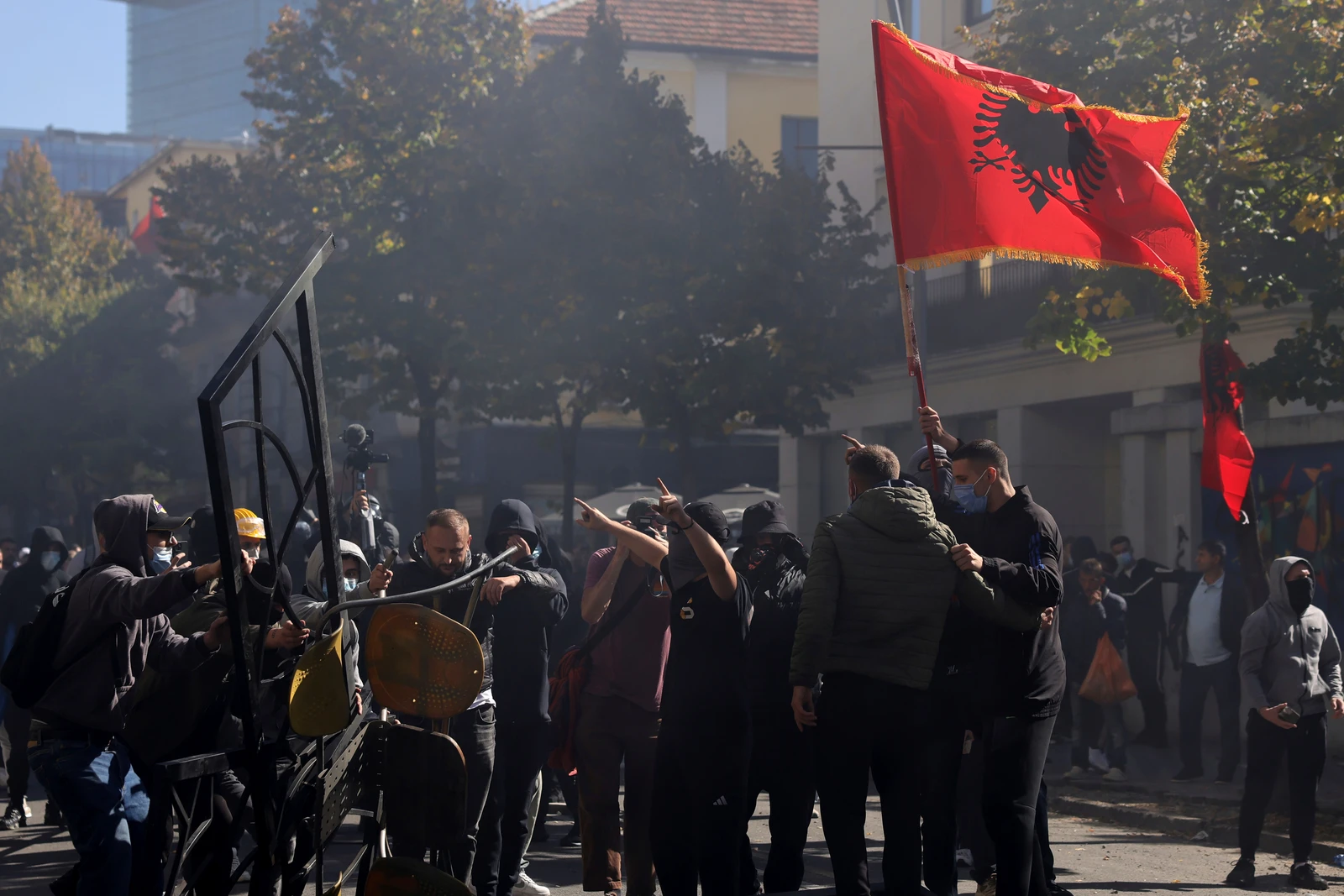
Outside the Education Ministry in central Tirana, large crowds assembled to demand government accountability. The protest descended into violence when a group of masked young people threw rocks at police officers. Security forces responded with stun grenades, tear gas and water cannons in an attempt to disperse the crowds.
Tensions have been mounting throughout the week, with protesters smashing windows, setting fire to government buildings and confronting police in the capital. The unrest has raised fresh questions about political stability in the Balkan country as its government continues to pursue membership of the European Union.
Police figures indicate that around 500 protesters had been detained so far, including 330 who were subsequently released. Authorities also recorded injuries among both demonstrators and law enforcement personnel, with approximately 120 police officers and 45 protesters reported injured.
However, the actual number of injured demonstrators could be higher, as many may not have reported their injuries to authorities.
The scale and intensity of the protests have placed Rama under growing pressure. The prime minister has governed Albania since 2013 and secured a fourth term following elections last year. Yet persistent corruption allegations and public frustration over economic opportunities have increasingly challenged his administration.
Rama has rejected calls to resign, insisting that his government retains a clear mandate to govern. Speaking to Reuters earlier in the week, he made clear that he would not step down despite the mounting demonstrations.
In a statement published on Facebook on Saturday, Rama said his government respected students and would protect their right to protest.
He also defended his administration’s broader political objectives, presenting Albania’s ambition to join the European Union as a central priority.
“My responsibility is even clearer during these difficult times … to protect our citizens, guarantee justice, and move Albania forward — together with this governing majority, which holds a very clear mandate: to see Albania in the European Union by 2030,” he said.
His remarks appear aimed at reassuring supporters and international partners that the government remains committed to political stability and European integration, even as opposition to his leadership grows.
However, the current unrest did not emerge in isolation. Albania has experienced months of largely peaceful demonstrations, with anger fuelled by a controversial proposal to develop a luxury resort along the country’s largely unspoiled southern coastline.
The project has attracted particular attention because of its links to investors including Jared Kushner, the son-in-law of US President Donald Trump.
Villagers told Reuters in July that their land had been wrongfully sold for the proposed development. Reuters subsequently reported that the man who sold the land was wanted by prosecutors on suspicion of drug trafficking, allegations that his lawyer denied.
Reuters found no evidence of wrongdoing by Kushner, who was not directly involved in the villagers’ dispute.
Nevertheless, the controversy has become part of a wider debate about land ownership, political influence and the role of wealthy investors in Albania. For critics of the government, the project has reinforced concerns about whether public interests are being adequately protected when major developments are approved.
The wider corruption debate has proved particularly damaging for Rama’s administration. His government has faced repeated scandals, while analysts have described Albania as an important hub for criminal networks seeking to launder money generated through drug and weapons trafficking.
Such concerns have complicated the country’s efforts to join the European Union, which requires candidate countries to demonstrate progress on the rule of law, judicial independence and the fight against corruption.
Albania, alongside Montenegro, is among the leading candidates in the Western Balkans’ EU accession process. Rama has repeatedly presented membership as a defining objective for his government, with 2030 set as the target.
But the latest protests illustrate the political difficulties facing the country as it attempts to reconcile that ambition with public demands for greater accountability and economic opportunity.
For many young Albanians, unemployment and limited prospects have become central grievances. Their participation has helped transform the demonstrations into a broader movement, extending beyond individual disputes to challenge the government’s record and its legitimacy.
The unrest also comes amid a wider wave of demonstrations across Europe, where economic pressures and dissatisfaction with government policies have brought thousands onto the streets.
In France, high-school students have been protesting for weeks over shortages of teachers and inadequate school facilities. The campaign has increasingly attracted support from other groups, raising concerns that the education dispute could develop into a wider confrontation with the government.
Spain has also witnessed large demonstrations over rising rents and a shortage of affordable housing. The pressure surrounding the housing crisis has prompted political repercussions, including a decision by the government to call a snap election.
Although the circumstances differ from country to country, the protests highlight a common challenge for European governments: responding to public frustration over economic insecurity, public services and confidence in political institutions.
In Albania, however, the immediate question is whether the student-led movement will continue to expand and whether the government can contain the unrest without deepening public anger.
Rama has ruled out resignation and insists that his administration has the authority to continue governing. Protesters, meanwhile, are demanding political change and accountability over allegations of corruption.
With clashes continuing and hundreds already detained, the coming days could prove critical in determining whether the demonstrations remain a temporary surge of public anger or develop into a sustained challenge to Rama’s government.
For now, Albania faces an increasingly difficult test of political stability, with its domestic unrest threatening to overshadow its ambition to secure a place in the European Union by the end of the decade.