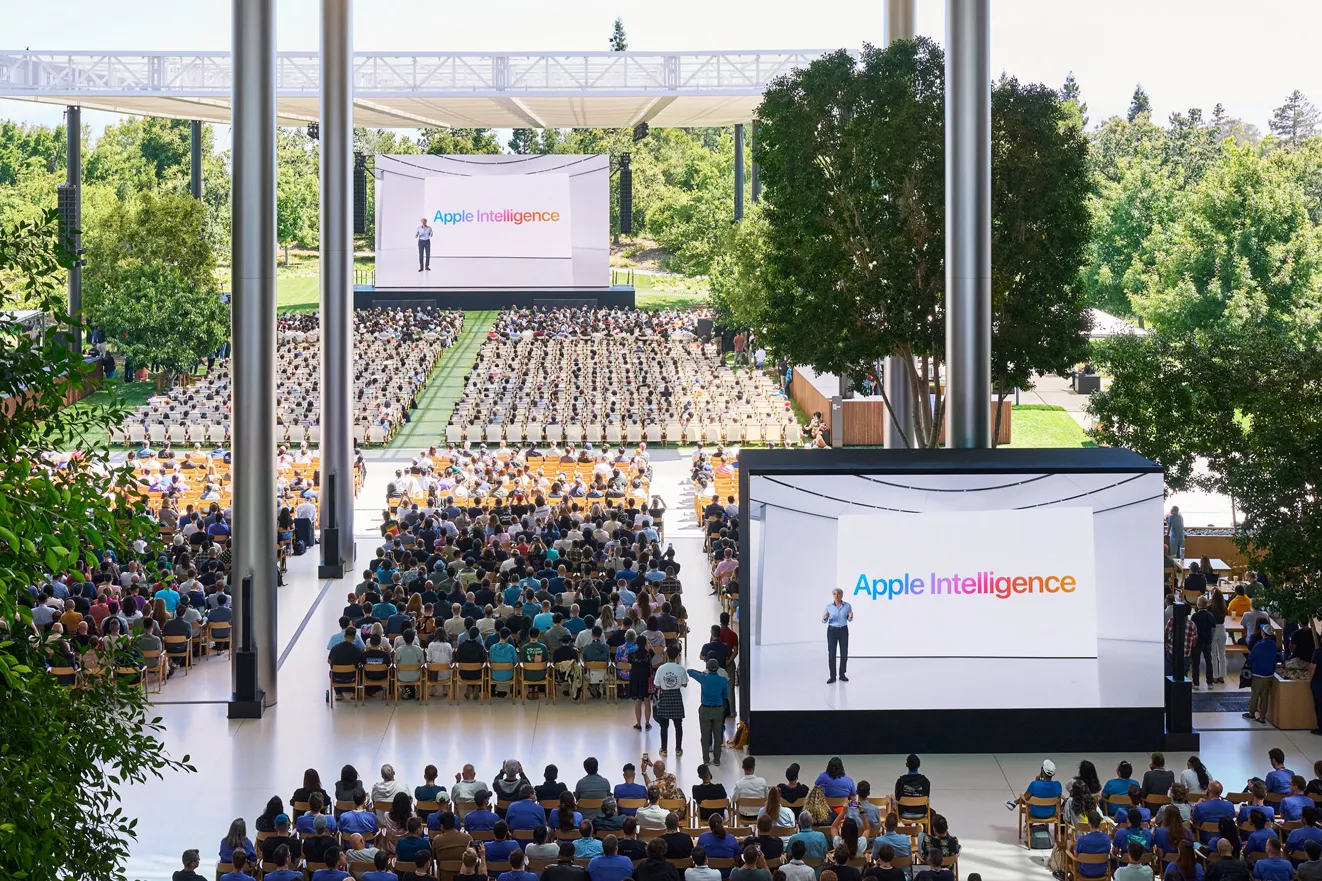
Apple’s New GenAI Domain Hints at Major WWDC 2026 AI Reveal: Apple may have just dropped one of its biggest hints yet about the future of artificial intelligence across its ecosystem. A newly discovered subdomain, genai.apple.com, has sparked fresh speculation that the company is preparing to unveil a major generative AI strategy during its upcoming Worldwide Developers Conference (WWDC) 2026, scheduled to begin on June 8.
The subdomain itself is not publicly accessible yet. Users attempting to visit the address are currently greeted with a timeout response instead of a standard “page not found” error. While subtle, the distinction matters. A timeout typically indicates that the domain exists and has been configured internally, but the service connected to it has not yet been activated or routed publicly. In the tech world, that often means a company is quietly preparing infrastructure for a future announcement.
Although Apple has not officially commented on the discovery, the timing of the domain’s appearance aligns almost perfectly with growing expectations that AI will dominate this year’s WWDC keynote.
Apple’s AI Moment Has Arrived
For years, Apple approached artificial intelligence differently from many of its competitors. Instead of loudly branding every feature as AI-powered, the company focused on machine learning behind the scenes. Features like on-device photo recognition, predictive typing, crash detection, and voice processing relied heavily on AI technologies, but Apple rarely marketed them aggressively.
That approach worked well when AI remained largely a background technology. However, the explosive rise of generative AI over the last two years changed the conversation across the entire tech industry.
Companies like Google, Microsoft, and OpenAI rapidly introduced AI chatbots, productivity assistants, image generators, and multimodal systems capable of understanding text, speech, images, and video. Consumers quickly became familiar with tools such as ChatGPT, Gemini, and Copilot, creating pressure on Apple to present a stronger public AI strategy.
While Apple eventually introduced “Apple Intelligence” branding for some of its AI features, many observers still believe the company has yet to deliver a breakthrough experience comparable to what rivals are offering.
That is why the emergence of a dedicated “GenAI” domain feels significant.
The naming itself is especially noteworthy. “GenAI,” shorthand for generative artificial intelligence, has become the industry-standard term for AI systems capable of generating content, understanding context, and interacting conversationally. By using that terminology directly in a subdomain, Apple appears to be embracing the category more openly than ever before.
WWDC 2026 Could Be Apple’s Most Important Software Event in Years
WWDC has traditionally focused on software announcements, including updates to iOS, macOS, iPadOS, watchOS, and developer tools. But this year’s event carries additional weight because Apple is widely expected to explain how AI will shape the future of its products.
The company has already faced criticism for delays surrounding its next-generation Siri overhaul. Apple initially promised a smarter, more context-aware version of Siri capable of handling complex tasks and interacting naturally across apps. However, rollout timelines reportedly slipped multiple times, leading to concerns that Apple was falling behind in the AI race.
Now, expectations are rising again that WWDC 2026 will finally showcase a major transformation for Siri.
According to ongoing reports and industry rumors, Apple has been rebuilding Siri’s underlying architecture to support modern generative AI capabilities. Instead of relying on rigid command structures, the updated assistant could understand conversational context more naturally, summarize information, perform multi-step tasks, and integrate deeply across Apple devices.
The improvements may also involve collaboration with Google’s Gemini AI models. Previous reports suggested Apple and Google explored partnerships that would allow Gemini to assist with more advanced cloud-based AI tasks while Apple continues prioritizing privacy-focused on-device processing.
If such integrations are announced, it could represent one of Apple’s most significant strategic shifts in years.
Privacy Could Remain Apple’s Biggest Advantage
Despite entering the generative AI race later than competitors, Apple still possesses one major advantage: trust.
Privacy has long been central to Apple’s brand identity, and the company is likely to frame its AI strategy around secure, on-device intelligence rather than fully cloud-dependent systems.
Many consumers remain cautious about how AI companies collect, store, and process user data. Apple has repeatedly emphasized that sensitive information should remain on the device whenever possible. That philosophy could become a major differentiator as AI adoption continues to grow.
Industry analysts expect Apple to highlight hybrid AI processing at WWDC. Simpler requests may be handled entirely on-device using Apple silicon, while more advanced queries could be securely processed through private cloud infrastructure or external AI partnerships.
This balanced approach would allow Apple to compete in generative AI without abandoning its long-standing privacy principles.
More AI Features Could Arrive Across Apple Apps
Beyond Siri, several Apple apps are rumored to receive substantial AI upgrades this year.
The Photos app may gain more advanced editing tools powered by generative AI. Users could potentially remove unwanted objects, improve image quality, create automatic edits, or generate personalized memory collections more intelligently than before.
Visual Intelligence is also expected to expand further. Apple introduced early versions of the feature to help users identify objects, landmarks, and contextual information through the camera. Future updates may allow deeper real-time interactions with the environment using AI-assisted recognition.
The Camera app itself could see a redesigned interface focused on AI-powered search, scene understanding, and intelligent capture suggestions.
Productivity apps may also benefit. AI-generated summaries, writing assistance, smart notifications, and context-aware recommendations are all possibilities frequently mentioned by analysts ahead of WWDC.
Developers are watching closely as well. One of the most important announcements could involve new APIs and frameworks that allow third-party apps to integrate Apple’s AI systems directly. If Apple opens its generative AI tools to developers, it could rapidly accelerate adoption across the App Store ecosystem.
The Meaning Behind the Domain Discovery
On its own, a subdomain discovery does not guarantee a major launch. Large technology companies regularly register hidden domains for testing, internal tools, and experimental projects that never become public products.
However, several factors make this situation different.
First, the timing is unusually close to WWDC. Second, the naming convention directly references generative AI instead of vague internal terminology. Third, Apple faces increasing pressure from investors, developers, and consumers to demonstrate leadership in AI innovation.
Combined, those factors make it difficult to dismiss the discovery as insignificant.
The domain could eventually host developer documentation, AI demos, cloud services, research initiatives, or entirely new consumer-facing tools. Apple may even use it as a central hub for future AI-related announcements and services.
Regardless of its exact purpose, the existence of the domain strongly suggests that generative AI is becoming a far more visible part of Apple’s long-term strategy.
Apple’s AI Reputation Is on the Line
The stakes for WWDC 2026 are extremely high.
Apple remains one of the world’s most influential technology companies, but many analysts believe it has appeared unusually quiet during the generative AI boom. Rivals moved aggressively while Apple took a slower, more cautious path.
That caution may ultimately work in Apple’s favor if it delivers polished, reliable, and privacy-conscious AI experiences instead of rushing unfinished products to market. Still, the company now needs to prove that its approach can compete with rapidly evolving AI ecosystems from Google, Microsoft, and OpenAI.
WWDC 2026 could become the moment Apple finally clarifies its AI vision.
If the rumors surrounding Siri, Visual Intelligence, Photos, and developer tools prove accurate, the event may mark the beginning of a new era for Apple software. And with the discovery of genai.apple.com, the company may have already offered the clearest hint yet that generative AI is about to take center stage.
GTA 6 Price Still a Mystery as Take-Two Avoids Major Reveal | Maya