BepiColombo’s Mercury Mission Begins Amid Technical Hurdles- After an eight-year journey through the inner Solar System, the European-Japanese BepiColombo spacecraft has successfully entered orbit around Mercury. However, a software-related glitch during its crucial orbital insertion manoeuvre has raised concerns, with mission engineers investigating the issue. Despite the technical setback, the spacecraft remains safe, marking a significant milestone in humanity’s exploration of the Solar System’s smallest planet.
A Historic Achievement in Space Exploration
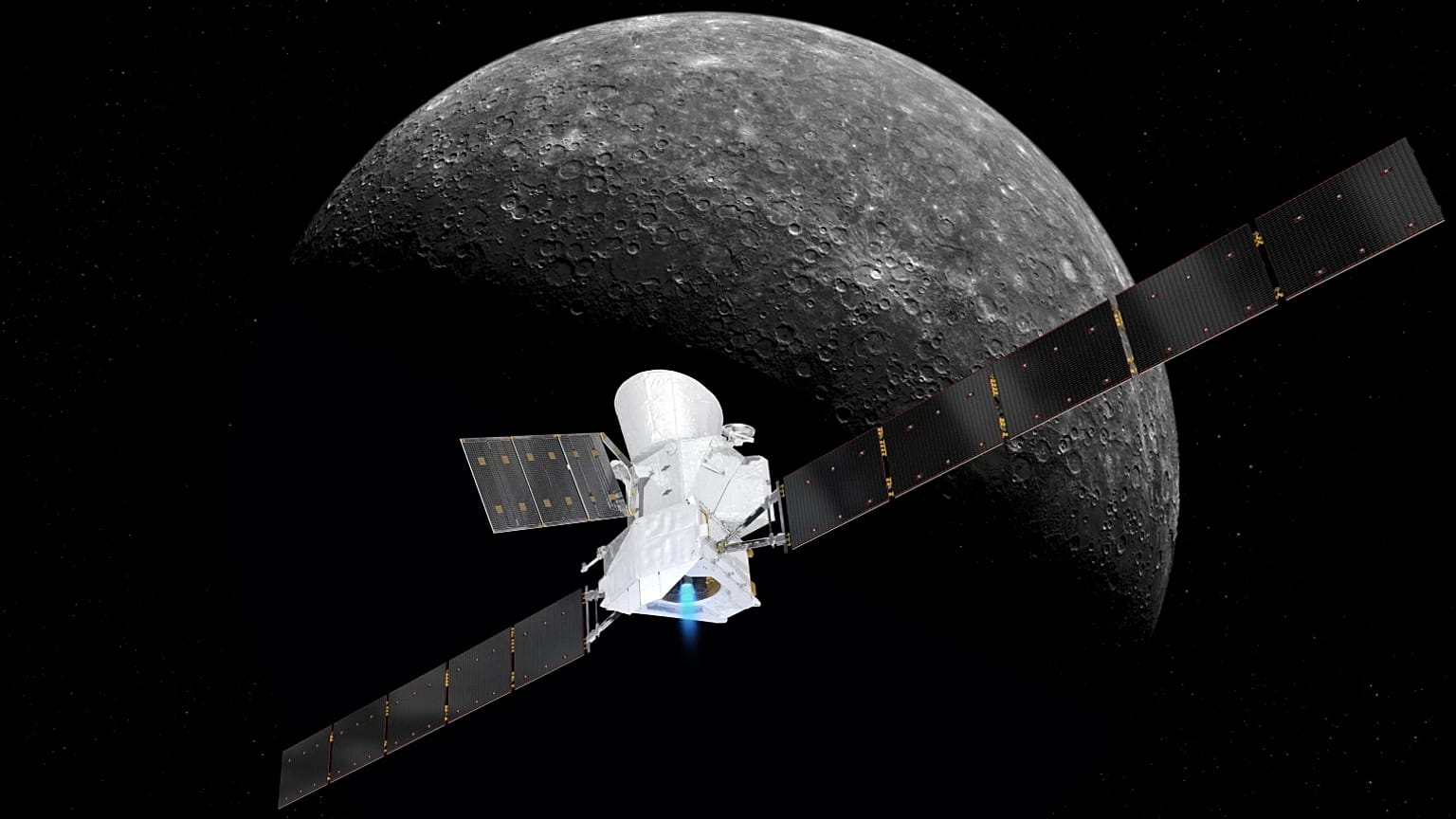
The European Space Agency (ESA) and the Japan Aerospace Exploration Agency (JAXA) have achieved a major breakthrough with the successful orbital arrival of their joint BepiColombo mission at Mercury. The spacecraft entered orbit around the planet on November 21, 2026, following an extraordinary journey that began with its launch in October 2018.
The achievement is particularly important because Mercury is one of the least-explored planets in the Solar System. Despite being the closest planet to the Sun, its extreme environmental conditions and challenging orbital dynamics have made it difficult for scientists to study.
BepiColombo is only the third spacecraft mission to visit Mercury and the second to enter orbit around it. NASA’s Mariner 10 conducted three flybys of the planet during the 1970s, while the MESSENGER spacecraft became the first to orbit Mercury in 2011. MESSENGER continued its observations until 2015, when it ended its mission by impacting the planet’s surface.
Now, BepiColombo is expected to take planetary exploration further by providing detailed information about Mercury’s internal structure, magnetic environment, surface composition and geological history.
Technical Glitch During Critical Orbital Manoeuvre
While the successful arrival represents a significant achievement, the mission has encountered an unexpected technical problem.
According to the European Space Agency, a software-related issue caused the spacecraft’s thruster burn to end earlier than originally planned during the orbital insertion manoeuvre. The thrusters are essential for slowing down the spacecraft so that Mercury’s relatively weak gravitational pull can capture it into orbit.
The manoeuvre was a particularly sensitive operation because BepiColombo had to reduce its enormous speed with exceptional precision. Even a relatively small deviation could have affected its intended orbital trajectory.
ESA confirmed that the spacecraft successfully entered Mercury’s orbit and remains safe. Engineers at the European Space Operations Centre (ESOC) in Germany are examining the telemetry data to determine what caused the premature termination of the thruster firing.
The agency indicated that further information would be provided after the technical assessment.
Although the glitch has introduced uncertainty into the mission’s next operational steps, the successful orbital capture is an encouraging development. The engineering teams will now focus on understanding the malfunction and ensuring that the spacecraft can continue its planned journey.
An Eight-Year Journey Through the Solar System
BepiColombo’s journey to Mercury has been anything but straightforward. Travelling towards the innermost planet is considerably more complicated than simply sending a spacecraft directly towards it.
Mercury orbits extremely close to the Sun, meaning spacecraft approaching the planet are strongly accelerated by the Sun’s gravitational pull. Reaching Mercury is therefore not just a matter of travelling towards it; a spacecraft must also lose considerable speed before it can enter a stable orbit.
To overcome this challenge, mission planners designed a complex trajectory involving multiple gravitational-assist manoeuvres.
Since its launch in October 2018, BepiColombo has used one Earth flyby, two Venus flybys and six Mercury flybys to gradually adjust its speed and trajectory. These encounters allowed the spacecraft to use planetary gravity to modify its path while reducing the amount of fuel required for its journey.
The spacecraft travelled billions of kilometres through the inner Solar System before reaching its destination.
The journey also faced earlier technical difficulties involving the spacecraft’s solar-electric propulsion system. Reduced power availability from its solar arrays required adjustments to the original flight plan, extending the journey.
Nevertheless, the mission teams successfully adapted to these challenges and brought BepiColombo to Mercury.
Two Spacecraft, Two Different Scientific Missions
One of the most interesting features of BepiColombo is that it consists of two specialised scientific orbiters designed to investigate different aspects of Mercury.
The first is the Mercury Planetary Orbiter (MPO), developed by the European Space Agency. It will focus primarily on Mercury’s surface, internal structure, composition and geological characteristics.
The second is the Mercury Magnetospheric Orbiter (Mio), developed by Japan’s JAXA. Its main objective is to investigate Mercury’s magnetic field, magnetosphere and interaction with the solar wind.
The two spacecraft are travelling together during the initial orbital phase but are scheduled to separate on December 9–10, 2026. After separation, each will move towards its designated scientific orbit.
This arrangement will allow researchers to study Mercury from different distances and perspectives.
The simultaneous observations from two orbiters could provide a much more comprehensive understanding of Mercury than a single spacecraft could achieve.
The European orbiter will conduct detailed investigations of the planet’s surface and interior, while the Japanese orbiter will concentrate on the surrounding magnetic environment.
Why Does Mercury Have a Magnetic Field?
One of the most intriguing questions surrounding Mercury is the existence of its magnetic field.
Unlike Mars and Venus, which do not currently possess strong global magnetic fields, Mercury has a relatively weak but significant magnetic field. This is particularly interesting because the planet is considerably smaller than Earth.
Scientists believe that Mercury’s magnetic field is generated by movements within its partially liquid iron-rich outer core. However, several aspects of this process remain poorly understood.
BepiColombo will investigate the planet’s magnetic environment and examine how it responds to the continuous stream of charged particles released by the Sun, known as the solar wind.
Understanding these processes could help scientists learn more about Mercury’s interior and the mechanisms responsible for generating planetary magnetic fields.
The Mystery of Water Ice on a Scorching Planet
Another major scientific puzzle concerns the presence of water ice on Mercury.
At first glance, the discovery of ice on a planet so close to the Sun seems almost impossible. Surface temperatures on Mercury can rise above 400 degrees Celsius, creating one of the most extreme environments among the rocky planets.
However, Mercury’s polar regions contain deeply shadowed craters where sunlight never reaches the crater floors. These permanently shadowed areas can remain extremely cold, allowing water ice to survive for extended periods.
Scientists believe that these deposits may contain important clues about the delivery and preservation of water in the inner Solar System.
BepiColombo will investigate the polar regions and gather additional information about the planet’s surface and composition.
Its findings could help researchers understand how volatile materials, including water, survive in environments exposed to intense solar radiation.
What Are Mercury’s Mysterious Hollows?
Apart from its magnetic field and polar ice, Mercury has unusual geological features known as hollows.
These are shallow, irregular depressions found across the planet’s surface, often characterised by bright interiors and relatively fresh-looking edges. They are different from conventional impact craters and have attracted considerable scientific interest.
Researchers believe that hollows may have formed through the loss of volatile materials from rocks near the surface. However, the precise processes responsible for their formation remain uncertain.
By studying these formations, BepiColombo could help scientists understand the chemical composition of Mercury’s crust and the geological processes that have shaped its landscape.
What Happens Next for the Mission?
The successful orbital insertion is an important beginning rather than the completion of BepiColombo’s mission.
The next major milestone will be the separation of the European and Japanese orbiters in December 2026. The spacecraft will then undergo additional manoeuvres and preparations before reaching their respective operational orbits.
The European Space Agency plans to place its Mercury Planetary Orbiter into its final scientific orbit by March 2027. Meanwhile, the Japanese orbiter will establish its designated orbit to study Mercury’s magnetosphere.
The mission’s main scientific operations are expected to begin in April 2027.
Until then, engineers will continue monitoring the spacecraft, assessing its performance and investigating the software issue reported during orbital insertion.
The coming months will therefore be crucial for ensuring that both orbiters are ready to begin their scientific investigations.
A New Chapter in Understanding Mercury
BepiColombo’s arrival at Mercury represents a remarkable achievement in international scientific cooperation and deep-space engineering.
The mission has demonstrated how carefully planned gravitational manoeuvres, advanced propulsion technology and international collaboration can make even the most challenging planetary destinations accessible.
Although the reported thruster glitch has added another challenge, the spacecraft’s successful orbital capture offers scientists a valuable opportunity to explore a planet that still holds many unanswered questions.
From understanding its unusual magnetic field to investigating hidden polar ice deposits and mysterious surface hollows, BepiColombo has an ambitious scientific agenda.
Its discoveries could reshape our understanding of Mercury, provide new insights into the formation of rocky planets and help scientists better understand the early evolution of our Solar System.
For now, the spacecraft has reached its destination. The real scientific journey is just beginning. How Are Scientists Using a 3D Brain Atlas to Unlock the Secrets of Human Brain Cells? | Maya