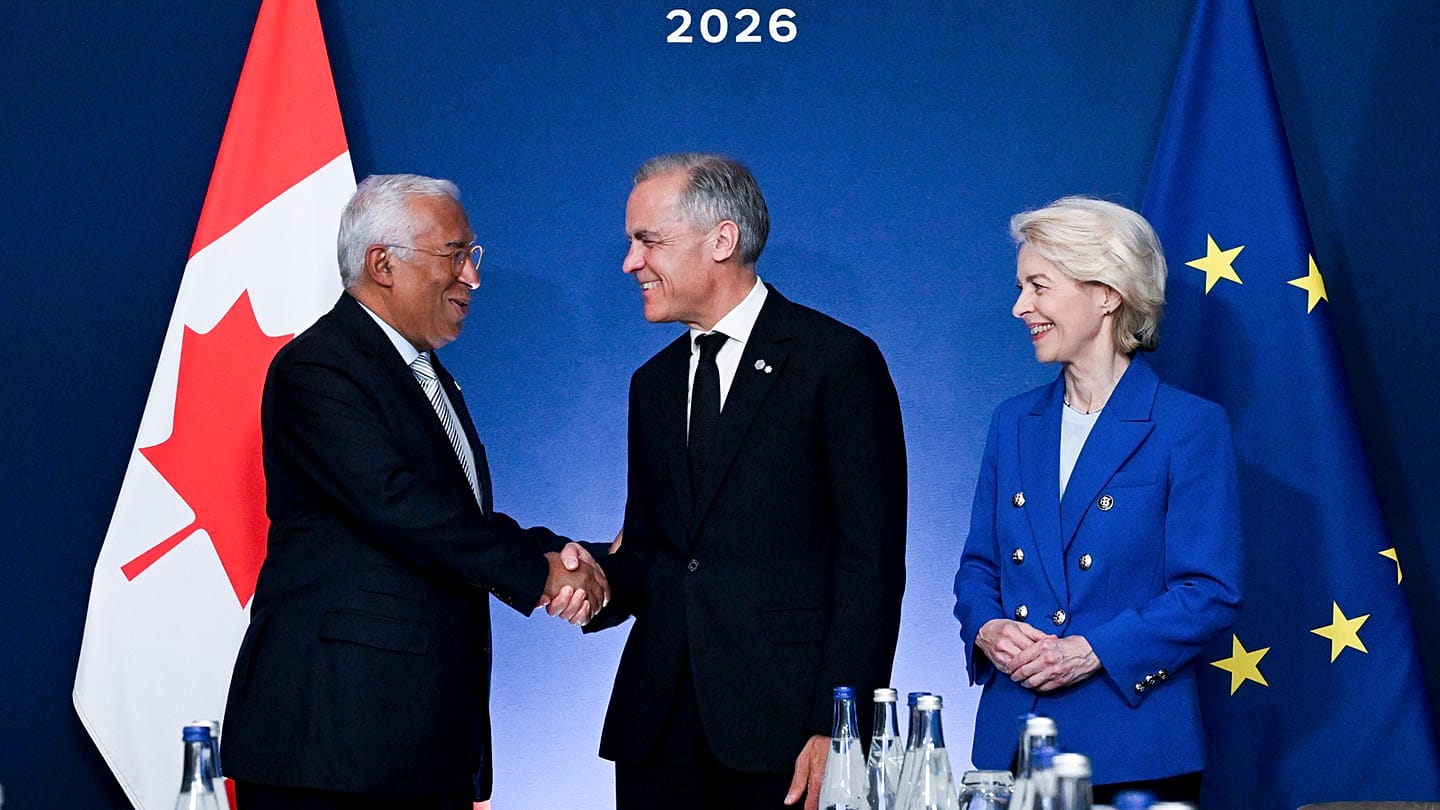
Carney Pitches Canada-EU “Alliance of the Future” Amid Escalating Trump Tariff Threats, STRASBOURG — In a direct challenge to the shifting architecture of global trade, Canadian Prime Minister Mark Carney presented an ambitious vision for a modernized transatlantic partnership before the European Parliament, urging democratic allies to build an “alliance of the future” in response to rising protectionist headwinds from Washington.
Addressing European lawmakers in Strasbourg, Carney framed the deepening cooperation between Ottawa and Brussels not as an antagonistic contest against traditional partners, but as an essential hedge against geopolitical extortion. The address arrived just twenty-four hours after European Commission President Ursula von der Leyen floated a historic proposal for Canada to assume the status of the European Union’s first non-continental “associate member”—a move that promptly drew sharp tariff threats from US President Donald Trump.
Pragmatism, Not Pretense
Confronting speculation that Canada is seeking to orchestrate an overt counterweight to the United States, Carney pushed back against simplistic geopolitical dichotomies.
“I want to be precise about what I am not proposing,” Carney declared to the assembly. “I am not proposing a third bloc in order to become a great power rival, only with better manners. We do not seek power to dominate others. On the contrary, we are pursuing resilience so that no one can control our open markets, impair our sovereignty, threaten our territorial integrity, or undermine our freedoms, our democracies, our rule of law.”
The phrase struck at the heart of Ottawa’s diplomatic balancing act. While seeking to insulate Canada’s export-driven economy from punitive border measures enacted by the Trump administration, Carney is acutely aware that Canada cannot unilaterally decouple from its southern neighbor. Instead, his pitch represents a structural realignment aimed at eroding unilateral leverage by constructing dependable, rules-based trade corridors across the Atlantic.
The Anatomy of an “Associate Member”
While Canada and the European Union have benefited from tariff reductions under the Comprehensive Economic and Trade Agreement (CETA) since 2017, the proposed “associate” framework goes substantially further into strategic integration. Rather than focusing merely on standard market access, Carney outlined concrete initiatives designed to weave Canadian resources into the European industrial ecosystem:
1. Strategic Mineral Supply Chains: Establishing dedicated processing and off-take channels for Canadian lithium, nickel, cobalt, and rare earths to reduce joint vulnerability to both Chinese export restrictions and American protectionist quotas.
2. Defense Industrial Synchronization: Aligning defense procurement and joint production capacities under European security frameworks, addressing growing anxieties surrounding the reliability of US military commitments.
3. Clean Energy and Decarbonization: Harmonizing carbon accounting and green hydrogen corridors to ensure industrial goods move seamlessly across borders without punitive border adjustments.
4. Research and Technological Convergence:** Fully integrating Canadian institutions into European innovation hubs such as Horizon Europe and the Erasmus+ exchange program, alongside shared ethical frameworks for artificial intelligence governance.
“Sovereignty in the twenty-first century cannot simply mean the freedom to be cornered,” Carney argued. “True economic sovereignty requires options. It requires partners whose commitments do not evaporate with each election cycle.”
Washington’s Shadow and Brussels’ Calculations
The stakes could hardly be higher. Following the breakdown of bilateral trade discussions earlier this year and the subsequent imposition of sweeping US tariff penalties on Canadian primary exports, the Trump administration warned that closer formal alignment between Ottawa and European capitals would incur fresh commercial penalties.
In Washington’s view, any concerted effort by historic allies to create regulatory or trade corridors outside of US bilateral oversight is seen as an evasion of American economic dominance.
Yet in Brussels, the appetite for deeper cooperation is palpable. Facing their own tariff escalations and the long-term imperative to de-risk key industrial inputs, European officials see Canada as a politically stable, resource-rich democracy with shared regulatory values. Von der Leyen’s invitation signaled an acknowledgment that the EU’s economic security cannot rely solely on internal markets or fickle bilateral deals.
A New Template for Middle Powers
Carney’s Strasbourg address marks a pivotal transition in Canadian foreign policy. For decades, Canada operated under the assumption that proximity to the world’s largest economy was an unassailable asset. Today, as that proximity brings heightened vulnerability to capricious economic statecraft, Canada is transforming into a pioneer of open-architecture multilateralism.
By framing this transatlantic leap not as a moral crusade or an adversarial bloc, but as a hard-nosed blueprint for democratic resilience, Carney has offered a compelling defense of shared sovereignty. The road ahead—to be tested at the upcoming summit in Montreal—will determine whether middle powers can effectively assemble a dependable collective shield, or if the gravity of economic nationalism will fracture their resolve.