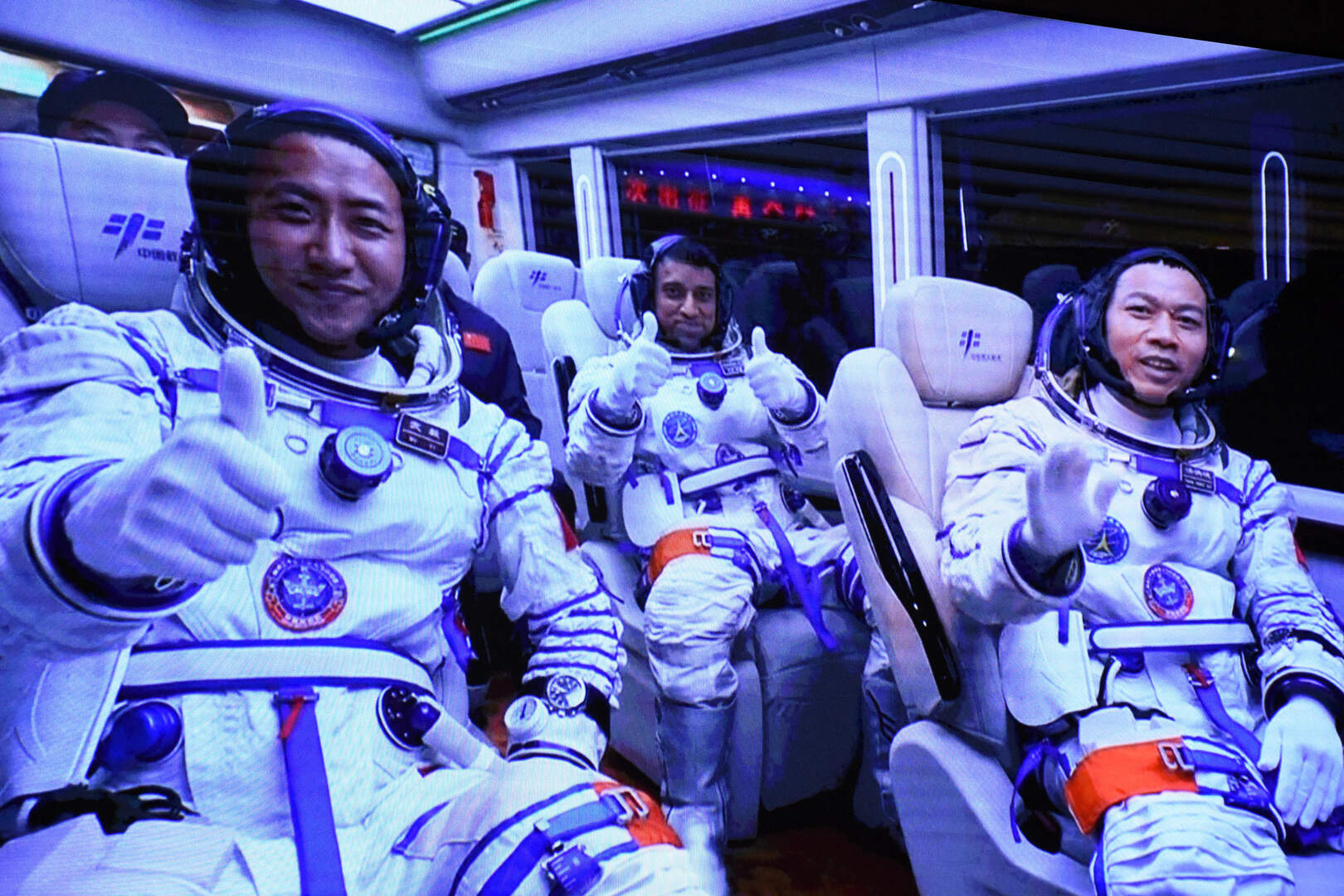
China Sends First Pakistani Astronaut to Tiangong Space Station in Historic Mission- China has achieved a significant milestone in international space cooperation by launching its Shenzhou-24 mission carrying three astronauts to the Tiangong space station, including Pakistani astronaut Muhammad Zeeshan Ali. The mission marks a historic moment for Pakistan, as Ali becomes the first foreign astronaut to participate in a Chinese crewed spaceflight, highlighting the growing scientific and strategic partnership between Beijing and Islamabad.
The development also carries considerable diplomatic significance, as China and Pakistan celebrate 75 years of cooperation in space-related activities and broader bilateral relations.
A Historic Achievement for Pakistan
For Pakistan, Ali’s participation represents a major achievement in its efforts to expand its presence in international space research. Although the country does not currently operate an independent human spaceflight programme or possess its own spacecraft for sending astronauts into orbit, the partnership with China has provided an opportunity to participate directly in a crewed space mission.
Speaking before the launch at the Jiuquan Satellite Launch Center, Ali expressed pride in representing his country on the international stage.
“I am carrying the name of Pakistan on my shoulder, the hopes of 250 million Pakistanis,” he said, according to the account provided.
His selection followed a competitive process involving Pakistani candidates who underwent training in China. Ali and Khurram Dawood emerged as the two candidates to reach the final stage of the selection process.
Both received specialised training under Chinese space experts, preparing them for the technical, physical and operational challenges associated with human spaceflight.
Ali’s journey from fighter pilot to astronaut highlights Pakistan’s growing ambitions in science, technology and international space cooperation.
One of the major challenges during his preparation was learning Chinese. Ali reportedly described mastering the language as one of the most difficult aspects of his training, reflecting the importance of communication and coordination in a multinational space environment.
Three Astronauts, One Mission
The Shenzhou-24 mission includes three crew members: commander Tang Hongbo, flight engineer Wu Yi and Pakistani astronaut Muhammad Zeeshan Ali.
While Ali will undertake a relatively short stay aboard the Tiangong space station before returning to Earth, Tang and Wu are scheduled to remain in orbit for approximately six months.
They will join Zhu Yangzhu, a member of the Shenzhou-23 mission, which arrived at the station in May. Zhu has been conducting research into how the human body adapts to extended periods in the microgravity environment of space.
The crew rotation is part of China’s regular operational schedule for maintaining its space station. Tiangong generally accommodates teams of three astronauts, with crew members replaced approximately every six months.
The arrangement allows China to maintain continuous human activity in orbit while conducting scientific experiments and testing new technologies.
Scientific Experiments in Space
Beyond its diplomatic importance, Shenzhou-24 has a substantial scientific research agenda. The astronauts will conduct experiments across several fields, including aerospace medicine, combustion science and biological research.
One important area of investigation involves understanding how space conditions affect living organisms. Researchers are particularly interested in the relationship between prolonged exposure to the space environment and biological ageing.
Scientists hope that studying these processes could contribute to improved methods of preventing and treating age-related vascular diseases.
The mission will also examine how microgravity and radiation influence biological processes, potentially generating findings relevant to both space exploration and medical research on Earth.
Ali has been assigned specific experiments involving photosynthesis in bacteria and the effects of radiation and microgravity on seeds.
These studies could provide valuable information about how microorganisms and plants respond to conditions beyond Earth. Such research is particularly relevant to the development of future long-duration space missions, where growing food and maintaining biological systems could become essential requirements.
The findings may also contribute to agricultural research and a better understanding of plant resilience under extreme environmental conditions.
China’s Expanding Space Ambitions
The launch comes as China continues to invest heavily in its independent space programme. Its Tiangong space station has become a central element of Beijing’s ambitions to establish itself as a leading force in international space exploration.
China wants to demonstrate that Tiangong can serve as more than a national research facility. By involving foreign astronauts and encouraging international scientific participation, Beijing hopes to develop the station into a broader platform for global research cooperation.
This ambition is particularly significant as access to space and international scientific partnerships become increasingly important in the competition between major powers.
China is also pursuing an ambitious lunar exploration programme, with the objective of landing Chinese astronauts on the Moon by 2030.
The country’s growing capabilities in human spaceflight, robotic exploration and space-based research are strengthening its position as an alternative to the US-led space exploration framework.
Strengthening China-Pakistan Relations
For Beijing, inviting a Pakistani astronaut aboard a Chinese crewed mission is also an important diplomatic achievement.
China and Pakistan have maintained close political, economic and defence relations for decades. Their cooperation in space technology adds another dimension to this longstanding partnership.
Pakistan’s participation demonstrates how China is using its growing space capabilities to develop international scientific relationships and expand its influence in the global space community.
For Islamabad, the mission offers access to advanced training, research facilities and practical experience that would otherwise be difficult to obtain independently.
The participation of a Pakistani astronaut also signals that China’s space programme is gradually opening opportunities for international partners beyond its own national astronaut corps.
A New Chapter in Regional Space Cooperation
The successful launch of Shenzhou-24 represents more than another milestone in China’s human spaceflight programme. It demonstrates the increasing importance of international partnerships in scientific research and the development of advanced space technologies.
For Pakistan, Ali’s participation is a historic opportunity to gain experience in human spaceflight and strengthen its scientific capabilities. For China, the mission supports its ambition to establish Tiangong as an internationally relevant research destination.
As the two countries continue to expand their cooperation, the mission could create further opportunities for Pakistani scientists, engineers and researchers to participate in future space projects.
Muhammad Zeeshan Ali’s journey to Tiangong is therefore not just a personal achievement or a symbolic diplomatic gesture. It represents a new chapter in Pakistan’s engagement with human space exploration and China’s efforts to build a wider international presence beyond Earth.