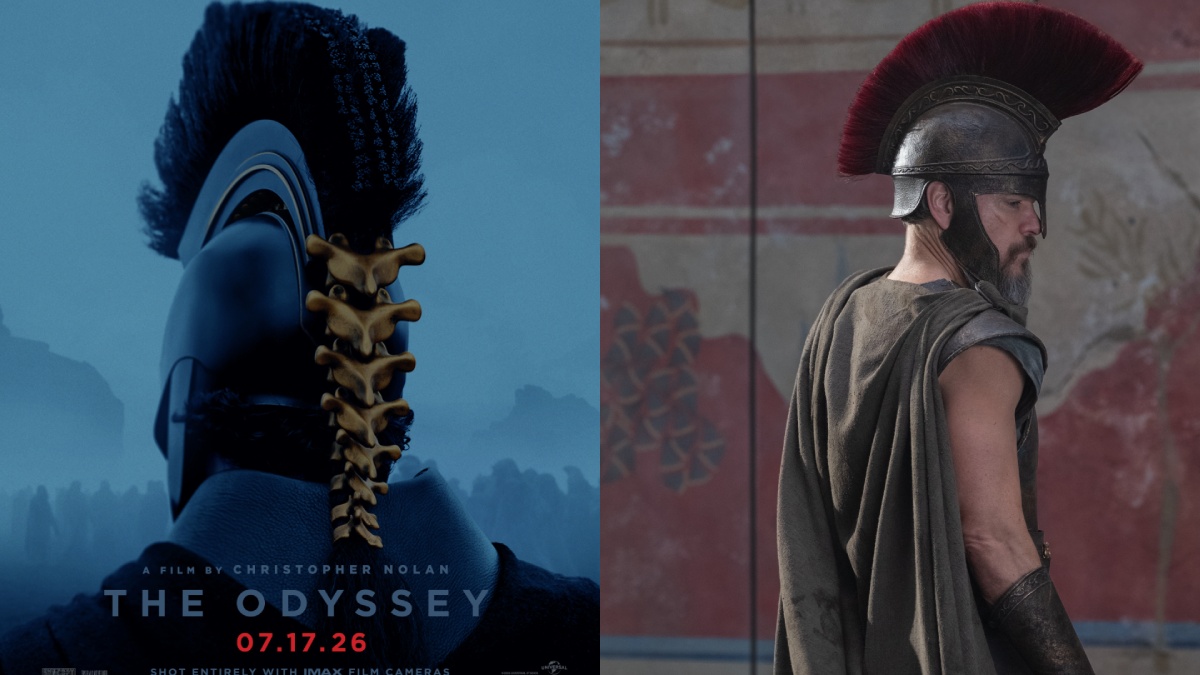
Christopher Nolan’s The Odyssey: A Myth Reimagined for the Modern Age- Christopher Nolan’s upcoming film The Odyssey is positioned as one of the most ambitious adaptations of classical literature in contemporary cinema. Based on Homer’s ancient epic poem, the story follows Odysseus’s long and dangerous journey home after the Trojan War. However, Nolan’s interpretation is not simply a historical or fantasy retelling. It appears to reshape the myth into a modern cinematic exploration of human endurance, perception, and identity.
The original Odyssey has survived for nearly three millennia as one of the foundational texts of Western storytelling. Its influence can be found across literature, philosophy, and modern narrative structures. At its core, it is a story about displacement and return, about a man struggling to find his place again after war, time, and suffering have altered both him and his world. Nolan’s adaptation takes these universal ideas and reframes them for a contemporary audience shaped by technological complexity, psychological uncertainty, and shifting realities.
Myth in a Modern Context
One of the most striking aspects of Nolan’s approach is how ancient myth is made relevant without being modernized in a superficial way. Instead of removing its mythological elements, the film appears to reinterpret them through a lens of realism and human perception. Creatures and divine encounters from Homer’s text may be presented not as literal fantasy but as experiences filtered through fear, isolation, and cultural belief systems.
This method allows the story to remain faithful to its origins while also engaging with modern questions. What did ancient people actually see or believe during unexplained events at sea? How does storytelling transform uncertainty into meaning? Nolan seems interested in how myths arise from human attempts to understand the unknown rather than treating them as purely fictional constructs.
Cinematic Philosophy and Realism
Nolan’s filmmaking style is widely known for prioritizing practical effects, large-scale physical environments, and immersive camera work. In The Odyssey, this approach is expected to reach an even larger scale. Reports suggest extensive use of IMAX-format cinematography, capturing vast ocean journeys, storms, and ancient landscapes in a physically grounded way.
Rather than relying heavily on digital spectacle, the emphasis appears to be on tangible realism. This choice aligns with Nolan’s long-standing interest in making extraordinary situations feel physically present. The ocean itself becomes more than a setting; it becomes a force that shapes the psychological and emotional state of the characters.
The effect is not just visual spectacle but immersion. The audience is meant to experience disorientation, scale, and vulnerability alongside the characters.
Psychological Depth of the Journey
At its narrative core, the film focuses on Odysseus as a figure shaped by trauma, memory, and time. His journey is not only across geography but also through psychological transformation. Each obstacle he faces represents a shift in identity, testing his ability to remain grounded in who he is.
This interpretation aligns with recurring themes in Nolan’s work. His films often explore memory fragmentation, subjective reality, and the instability of identity. In this context, Odysseus becomes a character who is continuously redefined by his experiences. The longer he remains away from home, the more uncertain the concept of “home” itself becomes.
The emotional structure of the story also extends to those waiting for him. Penelope and Telemachus are not passive figures; they represent endurance, expectation, and the psychological weight of absence. Their perspective reinforces the idea that time affects everyone differently and that return is never simple restoration.
Civilization, Order, and Collapse
Beyond its personal narrative, the story also reflects broader themes of social structure and instability. In Ithaca, the absence of Odysseus leads to political breakdown and the erosion of order. Competing suitors and internal tensions reflect how quickly systems of authority can deteriorate without leadership.
This aspect of the story resonates strongly in a modern global context. It reflects questions about governance, legitimacy, and the fragility of societal structures. Nolan’s adaptation appears to emphasize these dynamics not as background detail but as an essential part of the narrative tension.
The ancient world depicted in the story becomes a mirror for contemporary concerns about stability and power.
Cultural Continuity of the Myth
The Odyssey has influenced storytelling traditions across centuries and cultures. Its structure—the long journey filled with trials before returning home—has become a foundational narrative template in global storytelling. From literature to cinema, its impact is deeply embedded in how stories are constructed.
Nolan’s version enters this lineage at a time when reinterpretations of classical myths are increasingly common. However, what distinguishes this adaptation is its commitment to scale and seriousness. Instead of simplifying the myth into a straightforward adventure, it appears to treat it as a complex cultural artifact.
This approach respects the original text while also acknowledging that myths evolve as they are retold. Each generation reshapes them according to its own understanding of the world.
Narrative Intent and Interpretation
Although Nolan rarely explains his films in detail, his general creative approach suggests that The Odyssey is less about literal events and more about perception and meaning. The story becomes a framework for exploring how humans interpret experience under extreme conditions.
Rather than asking whether mythological events are real, the film seems to ask why such stories exist in the first place. It shifts focus from external truth to internal experience. Fear, isolation, hope, and memory become the real driving forces of the narrative.
This interpretive angle allows the film to function simultaneously as an epic adventure and a psychological study.
A Contemporary Epic Structure
The scale of the production suggests a deliberate attempt to redefine what an epic film can be in the modern era. The combination of large-format cinematography, practical effects, and mythological source material positions the film between historical drama and philosophical science fiction.
Yet despite its scale, the emotional focus remains grounded in human experience. The journey is not only about survival in a physical sense but also about maintaining identity through transformation.
Final Thoughts
Christopher Nolan’s The Odyssey is shaping up to be more than a traditional adaptation of a classical text. It appears to be an attempt to reinterpret one of humanity’s oldest stories through the lens of modern cinematic language and psychological realism.
By treating myth as a reflection of human perception rather than supernatural certainty, the film connects ancient storytelling with contemporary questions about identity, memory, and reality. It suggests that myths are not relics of the past but living frameworks through which people continue to understand themselves and the world.
In this interpretation, the journey of Odysseus is not only a return home but a deeper exploration of what home, self, and truth actually mean across time.
As AI Rises, Coinbase Shrinks Workforce to Stay Competitive | Maya