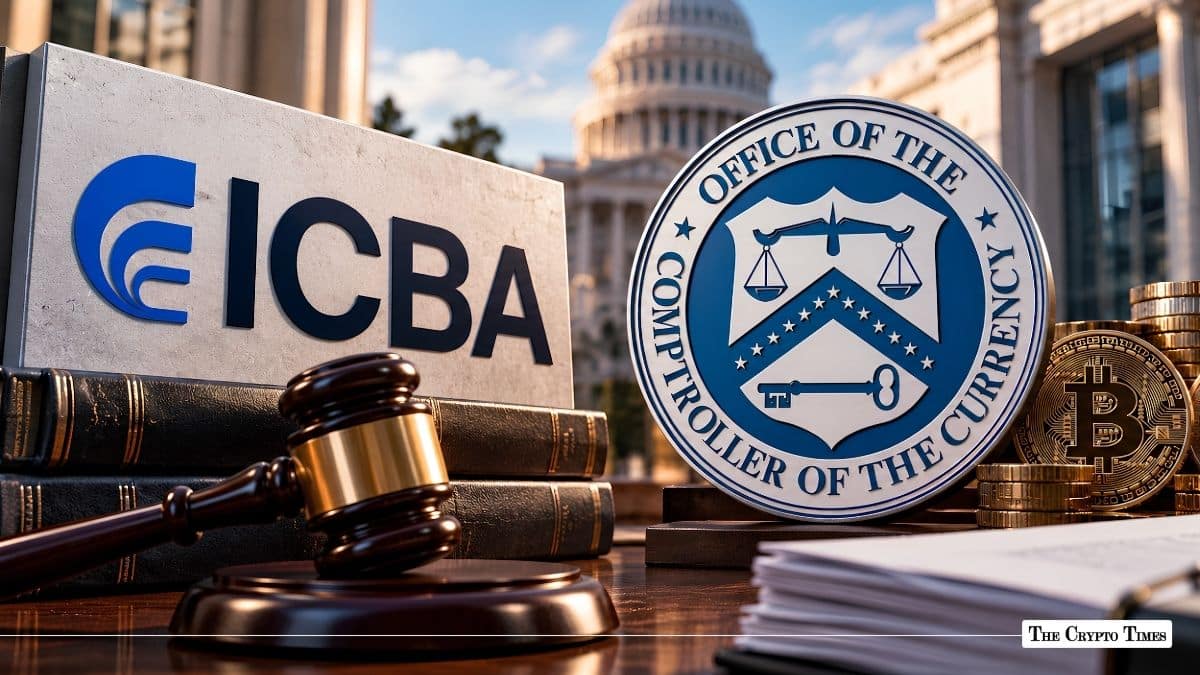
Community Bank Group Sues Over Expansion of Crypto Into Banking- The growing battle between traditional banks and the cryptocurrency industry has entered a new phase, with community bankers taking the fight to court over the expanding role of digital-asset companies in the U.S. financial system.
The Independent Community Bankers of America (ICBA) filed a lawsuit on Friday challenging the federal government’s approach to granting bank charters to cryptocurrency companies. The group argues that regulators are allowing businesses heavily involved in digital assets to gain access to the banking system without being subjected to the same regulatory standards that govern conventional banks.
The legal challenge comes as cryptocurrency companies increasingly seek a formal place inside the U.S. financial system. For years, many digital-asset businesses operated largely through partnerships with established banks. Now, a growing number are pursuing their own banking charters, potentially allowing them to provide financial services with greater independence.
The development has created a new point of tension between traditional community banks, federal regulators and an increasingly mainstream crypto industry.
Why Community Banks Are Objecting
At the center of the lawsuit is the use of national trust bank charters.
The Office of the Comptroller of the Currency, or OCC, has been granting or conditionally approving charters for several companies involved in cryptocurrency and digital assets. These companies can use the charters to conduct certain financial activities under federal supervision.
Community bankers argue that the approach gives crypto companies an advantage that traditional banks do not receive.
A conventional bank operates under a broad regulatory framework covering areas such as capital, liquidity, risk management, examinations and consumer protection. Many community banks are also subject to requirements connected to serving local communities.
The ICBA contends that some crypto-focused institutions can operate under a narrower regulatory structure while still gaining the credibility associated with a federal bank charter.
The banking group has specifically raised concerns about the absence of requirements such as FDIC insurance, Community Reinvestment Act obligations and certain capital and liquidity standards that apply to traditional insured banks.
The argument is straightforward: if two companies compete for similar financial business but face substantially different regulatory requirements, the traditional bank could be placed at a competitive disadvantage.
Crypto Companies Are Moving Closer to Mainstream Finance
The dispute comes at a time when cryptocurrency businesses are making a determined push into conventional finance.
For much of its history, the crypto industry existed alongside the banking system rather than inside it. Cryptocurrency exchanges and other digital-asset businesses often depended on banks for payment services, custody, settlement and access to the traditional financial infrastructure.
That relationship is beginning to change.
Federal regulators have received a growing number of applications from companies seeking bank charters or approval to expand their digital-asset activities.
The development is particularly significant for stablecoin companies.
Stablecoins are digital tokens designed to maintain a relatively stable value, typically by being linked to currencies such as the U.S. dollar. They are increasingly being used within cryptocurrency markets and are also attracting attention as potential tools for payments and financial settlement.
For crypto companies, obtaining a bank charter could provide several advantages. It can strengthen their relationships with other financial institutions, provide greater regulatory clarity and give customers additional confidence that the company operates within a recognized federal framework.
But greater acceptance also brings greater scrutiny.
The Crypto Industry’s Difficult Balancing Act
The cryptocurrency industry now faces something of a dilemma.
For years, crypto advocates pushed for recognition from traditional financial institutions and government regulators. A place inside the banking system represents a major step toward mainstream acceptance.
Yet that same acceptance can bring the regulatory obligations that many crypto companies historically sought to avoid.
Digital-asset businesses have frequently argued that traditional financial regulations were developed for banks and financial institutions that operate differently from blockchain-based companies.
As crypto moves closer to the mainstream, however, regulators are increasingly asking whether digital-asset companies should be treated differently when they perform functions traditionally associated with financial institutions.
This creates a difficult balance.
Crypto companies want the credibility, stability and market access that come with being connected to the banking system, but they also want regulations that recognize the differences between blockchain-based businesses and traditional banks.
The outcome of this debate could determine how the next generation of financial companies is regulated.
Why the Fight Matters to Community Banks
For community banks, the issue goes beyond cryptocurrency.
Smaller banks already face intense competition from the country’s largest financial institutions, online banks and financial technology companies.
Many community banks argue that they carry substantial regulatory costs while operating with fewer resources and smaller economies of scale than their largest competitors.
The arrival of crypto companies into the banking sector could add another layer of competition.
If digital-asset firms are able to offer services traditionally provided by banks while operating under a different regulatory structure, community banks fear they could be forced to compete against businesses with lower compliance costs and fewer traditional banking obligations.
The concern becomes particularly important if stablecoins and blockchain-based payment systems become more widely adopted.
Traditional banks have historically played a central role in moving money between individuals and businesses. New digital payment systems could eventually challenge some of those functions.
That is why community bankers are watching the regulatory changes so closely.
Traditional Banks Are Also Exploring Crypto
The relationship between banks and cryptocurrency is becoming increasingly complicated because traditional financial institutions are not necessarily opposed to digital assets themselves.
Many major banks are exploring blockchain technology, tokenized assets, digital payments and stablecoins.
In other words, the financial industry is moving toward crypto from both directions.
Crypto companies are moving into banking, while banks are moving deeper into digital assets.
That convergence is making it harder for regulators to draw a clean line between the two industries.
A company may begin as a technology platform and eventually offer financial services that look increasingly similar to those provided by a bank. Meanwhile, a conventional bank may adopt blockchain technology to improve payments, settlement or asset management.
The regulatory challenge is determining which rules should apply based on the company’s corporate identity and which should apply based on the financial activities it performs.
The OCC’s Position
The Office of the Comptroller of the Currency has taken the position that it has the authority to evaluate charter applications and determine whether applicants meet the legal and supervisory requirements for national banks and trust institutions.
The agency has also signaled greater openness toward certain digital-asset activities conducted by national banks.
From the regulator’s perspective, bringing crypto companies into a supervised financial framework may offer advantages over leaving them outside the traditional banking system.
That approach reflects a broader regulatory question: is it safer to keep crypto separate from banks, or to bring more of the industry under formal supervision?
Supporters of greater integration can argue that regulation becomes more effective when digital-asset companies are operating within a recognized framework.
Community bankers, however, argue that simply bringing a crypto company under a bank charter does not necessarily mean it faces the same safeguards as a traditional insured bank.
That distinction is likely to remain at the center of the legal dispute.
What Happens Next
The lawsuit could have implications well beyond the companies that have already received or applied for bank charters.
If the court sides with the community banking group, regulators could face greater restrictions on how they use national trust charters for cryptocurrency businesses. That could slow the industry’s push into traditional finance and force companies to reconsider how they structure their operations.
If regulators prevail, the decision could reinforce a broader shift toward integrating cryptocurrency businesses into the regulated banking system.
Either outcome could influence future decisions involving stablecoins, digital-asset custody, blockchain payments and other emerging financial technologies.
The case also highlights a much larger transformation taking place in American finance.
For decades, the banking system was dominated by institutions whose business models, regulatory obligations and customer relationships were relatively well established. Technology and cryptocurrency are now challenging those boundaries.
The question is no longer simply whether crypto will become part of mainstream finance.
The more important question is what kind of regulatory framework will govern it once it gets there.
Community banks want crypto companies to play by rules comparable to those governing traditional banks. Crypto businesses want access to the financial system without necessarily being forced into a regulatory structure designed for a different era.
Regulators are caught between those competing demands.
The lawsuit by the ICBA could therefore become an important test of where the boundary between cryptocurrency and traditional banking should be drawn.
What began as a dispute over bank charters is increasingly becoming a debate over the future structure of American finance—and whether the banking system can absorb digital assets without creating a new set of regulatory and competitive risks.
David Ellison Won Warner Bros. Now the Hard Part Begins | Maya